Dalal Street is bracing for a tectonic shift as Reliance Industries’ digital crown jewel, Jio Platforms, officially steps up to the public markets. Filing its Red Herring Prospectus (RHP) with the Securities and Exchange Board of India (SEBI), Jio has locked in a monumental ₹30,213 Cr ($3.6 billion approx.) listing.
Set to eclipse all previous domestic market debuts, this colossal public offering is poised to redefine the contours of Indian capital markets, drawing intense scrutiny from global institutional funds, retail investors, and industry analysts alike.
Beyond the headline-grabbing numbers, the IPO sheds light on the shifting strategies of India’s telecom and tech titan as it balances aggressive future-forward expansions with disciplined balance sheet management.
Main Facts: Inside the ₹30,213 Cr Public Offering
The sheer scale of the Jio Platforms initial public offering makes it a landmark moment for the Indian stock exchange ecosystem.
- IPO Size & Structure: The public issue consists entirely of a fresh issue of 27 crore equity shares. There is no Offer for Sale (OFS) component from existing shareholders, meaning 100% of the primary proceeds will flow directly into the corporate coffers to fund growth and eliminate debt.
- Key Dates: The bidding window opens for subscription on October 21 and closes on October 23.
- Price Band & Valuation: Jio has set a price band of ₹1,065 to ₹1,119 per share. At the upper band, the company commands an eye-watering valuation of ₹10.3 Lakh Cr (approximately $123 billion), cementing its position as one of India’s most valuable corporate entities.
- Ownership Breakdown: Reliance Industries Limited (RIL) maintains a commanding controlling stake of 66.43% in the digital giant. Silicon Valley heavyweights Meta and Google hold significant strategic stakes of 9.98% and 7.73%, respectively, with the remaining distributed among institutional and future public shareholders.
- Fund Utilization Strategy: Jio plans to deploy ₹27,500 Cr of the IPO proceeds entirely toward clearing its existing borrowings. The leftover ₹2,713 Cr will be allocated toward general corporate purposes, accelerating research and development, capital expenditure (capex), working capital requirements, and marketing initiatives.
Chronology: The Journey to Dalal Street
Jio’s evolution from an ambitious telecom disrupter to a digital powerhouse—and now, a publicly traded behemoth—has been meticulously orchestrated over the past decade.

- 2016–2019 (The Disruption Phase): Reliance Jio Infocomm enters the Indian telecom sector, offering dirt-cheap 4D data and free voice calls. It triggers a massive industry consolidation, eventually capturing over 400 million subscribers and upending legacy telecom operators.
- 2020 (The War Chest Injection): Recognizing the massive potential of Jio’s digital ecosystem, RIL reorganizes its digital assets under Jio Platforms. Between April and July 2020, Jio raises a staggering ₹1.52 Lakh Cr from global tech giants—including Meta, Google, Qualcomm, and Intel—alongside premier private equity firms like Vista Equity Partners, KKR, and General Atlantic.
- 2022–2024 (Infrastructure Scaling & 5G Rollout): Jio deploys a standalone 5G network nationwide at a breakneck pace, capturing a lion’s share of India’s high-value subscribers while pivoting aggressively into enterprise solutions, fiber broadband (JioFiber/JioAirFiber), and digital entertainment apps.
- Late 2025 – October 2026 (The IPO Countdown): Rumors solidify into reality as Jio files its RHP with SEBI. Market regulators approve the filing, setting the stage for an October 21 launch date that commands global financial attention.
Supporting Data: Financial Health and Market Metrics
Jio Platforms enters the public markets backed by a robust top-line growth trajectory and a profitable operating model.
Q1 FY27 Performance Overview
- Revenue from Operations: Continued its upward march, fueled by steady data consumption and subscriber upgrades.
- Operating Margins (EBITDA): Maintained strong double-digit expansion, benefiting from operational efficiencies and structural cost optimizations.
- Subscriber Metrics: Boasts a commanding market share in wireless connectivity, complemented by rapid scaling in home broadband and enterprise SaaS footprints.
Capital Allocation Breakdown
| Allocation Category | Amount (in ₹ Cr) | Strategic Objective |
|---|---|---|
| Debt Repayment | ₹27,500 Cr | Eradicate borrowings, slash interest overheads, and bulletproof the balance sheet. |
| Growth & Capex | ₹2,713 Cr | Fund AI initiatives, data center expansions, SaaS infrastructure, and marketing. |
Official Perspectives and Market Implications
The impending IPO has triggered widespread discourse among institutional strategists, venture capitalists, and retail market participants regarding what the listing means for the broader Indian startup and tech ecosystem.
The Bull Case: Why Jio’s Scale Matters
Market advocates point to Jio’s unrivalled ecosystem as its ultimate moat. By integrating nationwide 5G infrastructure with emerging technological frontiers—such as Artificial Intelligence (AI), hyperscale data centers, and enterprise Software-as-a-Service (SaaS)—Jio is carving out entirely new monetization avenues.
Furthermore, utilizing ₹27,500 Cr of the IPO proceeds to wipe out debt will substantially lower ongoing interest costs, immediately boosting net margins and fortifying the company’s financial foundation. Given RIL’s unmatched execution track record and deep market liquidity, institutional demand is projected to remain exceptionally high.
The Bear Case: Valuation Friction and Operational Hurdles
Conversely, cautious analysts warn of potential valuation fatigue. At a staggering ₹10.3 Lakh Cr valuation, public market investors may push back against aggressive pricing multiples.

Other headwinds include:
- Plateauing Subscriber Growth: Traditional wireless subscriber additions in India are approaching saturation. Future revenue growth will rely heavily on Average Revenue Per User (ARPU) hikes, which historically risk triggering user churn.
- Heavy Capital Expenditure: Ongoing investments in satellite communications (satcom) rollouts, AI infrastructure, and next-gen tech upgrades could temporarily squeeze cash flows and compress operating margins.
From the Editor’s Desk: Broader Market Movements
As Jio dominates financial headlines, several concurrent developments are reshaping the broader Indian tech and startup landscape:
- Zetwerk’s Anchor Haul: Contract manufacturing unicorn Zetwerk successfully secured ₹2,251 Cr from prominent anchor investors ahead of its own anticipated public offering, signaling sustained institutional appetite for B2B industrial tech platforms.
- Groww’s Q2 Profit Surge: Investment tech leader Groww reported a stellar 54% year-on-year jump in net profit to ₹725 Cr for Q2, alongside a 47% rise in revenue, underlining the explosive adoption of retail stockbroking and mutual fund investments in tier-2 and tier-3 India.
- Scimplify Nets $25 Mn: Specialty chemical and material sciences platform Scimplify secured $25 million in funding to scale its semiconductor-focused chemical supply chain business.
- Infotech Acquires Zluri: In a major consolidation within the enterprise software space, Infotech successfully acquired Lightspeed-backed SaaS management startup Zluri.
- Traya Eyes ₹300 Cr Funding: Direct-to-consumer (D2C) hair care brand Traya is reportedly in advanced discussions to raise approximately ₹300 Cr from European investment firm Verlinvest.
Inc42 Startup Spotlight: How EV91 Is Electrifying India’s Last-Mile Deliveries
While mega-caps like Jio capture public listings, early-stage innovators are quietly building the operational foundations of India’s digital-physical economy.
India’s rapid delivery ecosystem relies heavily on gig workers, yet delivery partners have long faced fragmented access to Electric Vehicles (EVs), transparent financing, charging stations, and fleet maintenance support. Addressing this friction point is EV91, an integrated electric mobility platform founded in 2023.
Building an Integrated Electric Ecosystem
Initially launched as a supplier of electric two-wheelers for delivery personnel, EV91 has rapidly evolved into a full-stack mobility provider. Its integrated ecosystem offers:

- EV Subscriptions & Rentals: Lowering the barrier to entry for gig workers through flexible asset-rental models.
- Charging & Battery Swapping: A unified network designed to minimize downtime for last-mile delivery riders.
- Fleet Management Solutions: Supplying reliable EV fleets and a steady stream of verified delivery partners to major e-commerce and quick-commerce aggregators.
Currently operational across key metropolitan hubs including Bengaluru, Chennai, Hyderabad, Delhi-NCR, and Mumbai, EV91 reported completing 10 lakh orders in FY25 utilizing a network of over 600 EVs and 1,000+ active riders. As India’s homegrown last-mile delivery market barrels toward a projected $5.5 billion economy by 2030, startups like EV91 are establishing the critical infrastructure required to power sustainable, green logistics.
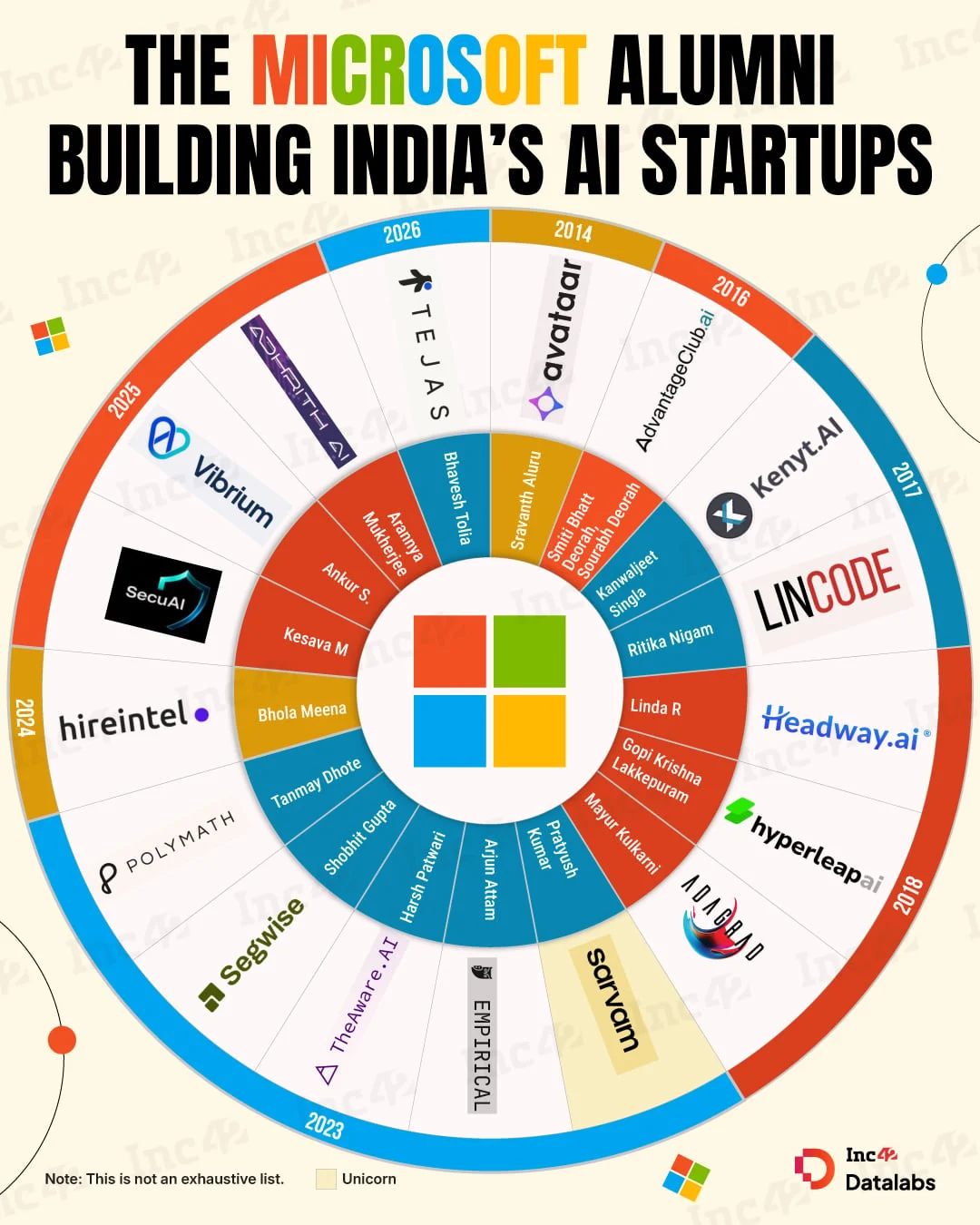
Infographic of the Day: The Microsoft Alumni Effect in India’s AI Boom
Global tech giants have long served as institutional launchpads for world-class engineering and management talent. In India, former employees of Microsoft are increasingly stepping out of corporate roles to embark on entrepreneurial journeys, driving innovation across the country’s fast-evolving Artificial Intelligence and deep-tech ecosystems.
Leveraging enterprise experience, technical acumen, and global exposure, these tech veterans are founding the next generation of B2B SaaS, generative AI, and cloud-infrastructure startups, further cementing India’s position as a global hub for technological innovation.