










For over two decades, digital marketing teams have meticulously constructed integrated measurement frameworks. They have stitched together paid search, organic social, email campaigns, and programmatic advertising into comprehensive multi-channel attribution models, creating a seamless picture of how modern buyers navigate the sales funnel.
Yet, that picture now features a glaring blind spot. A rapidly growing share of buyer discovery, vendor shortlisting, and product research is migrating away from traditional search engine results pages (SERPs) and directly into generative AI interfaces. Platforms like ChatGPT, Google Gemini, and Perplexity are answering complex, multi-layered queries with synthesized recommendations—and these interactions rarely show up cleanly in legacy channel reports.
As answer engine optimization (AEO) emerges as a vital discipline, it has introduced organizational friction. SEO teams often argue it belongs to content creators; content groups believe it falls under technical search optimization; meanwhile, demand generation leaders watch customer acquisition costs (CAC) climb while organic traffic flattens, lacking a cohesive answer to either challenge.
To solve this, progressive organizations are no longer treating AEO as a speculative experiment or a siloed tactic. Instead, they are embedding answer engine visibility directly into their existing data stacks, content workflows, and revenue reporting frameworks.
Main Facts: The Structural Shift from Search to Synthesis
The fundamental shift underlying the rise of AEO is a change in how consumers seek information. Traditional search required users to translate an intent into a string of keywords, parse a list of blue links, and manually visit multiple publisher sites to synthesize an answer. Today, AI answer engines do the synthesis upfront.

When a procurement director asks ChatGPT to "recommend enterprise marketing automation software with robust CRM integration and AI-driven reporting," the interface doesn’t just show a list of ads; it provides a curated shortlist of vendors. If a brand is absent from that synthesis, it is effectively excluded from the buyer’s consideration set before the traditional top-of-funnel journey even begins.
Key facets of this transformation include:
- The Ownership Vacuum: AEO frequently falls into a corporate gray area between SEO, content marketing, and brand strategy, leading to execution delays.
- The Attribution Gap: Legacy marketing automation and analytics platforms have historically categorized AI-driven traffic poorly, grouping it into "direct" or "referral" buckets without context.
- The Cost of Inaction: As organic search yields diminish due to AI-overviews and zero-click searches, failing to optimize for answer engines directly degrades pipeline efficiency and inflates paid acquisition costs.
Chronology: The Evolution of Search to Answer Engines
To understand why AEO has become an urgent boardroom topic, it is helpful to trace the technical and behavioral shifts that led to the current landscape.
1. The Era of Keyword Dominance (Early 2000s – Late 2010s)
Search engine optimization was defined by keyword density, backlink profiles, and technical site architecture. Marketers could reliably forecast traffic by mapping exact-match phrases to landing pages. Attribution models relied on last-click or multi-touch models that tracked users from a search engine result directly to a form fill.
2. The Rise of Zero-Click Searches and Featured Snippets (2018 – 2023)
Search engines began answering questions directly on the SERP through knowledge graphs, featured snippets, and quick answers. Organic click-through rates began to erode. Marketers were forced to optimize for visibility rather than mere traffic acquisition, though tracking remained tethered to traditional web analytics.

3. The Generative AI Inflection Point (2023 – Present)
The widespread adoption of large language models (LLMs) fundamentally disrupted information discovery. Buyers bypassed search engines entirely for complex research queries, relying on conversational agents that aggregate reviews, forum discussions (such as Reddit), and technical documentation. Marketing teams suddenly found themselves blind to how their brands were represented in AI-generated dialogues.
Supporting Data: The Metrics Driving AEO Investment
While early adopters viewed AEO as a branding play, contemporary data underscores its direct tie to revenue and pipeline generation.
- The Decline of Traditional Organic Reach: Industry benchmarks indicate that informational queries answered directly by AI interfaces have reduced organic click-through rates for traditional long-tail content by double-digit percentages across B2B sectors.
- Rising Customer Acquisition Costs (CAC): As organic discovery channels saturate, brands have leaned heavily into paid acquisition, driving up cost-per-lead (CPL) metrics. Organizations integrating AEO report a stabilizing effect on organic pipeline generation, helping to offset rising paid media costs.
- The Shortlisting Phenomenon: Studies on buyer behavior reveal that over 60% of enterprise software buyers formulate their initial vendor shortlists during the generative AI research phase, long before filling out a contact form on a vendor website.
Official Perspectives: Industry Leaders on Operationalizing AEO
As marketing executives grapple with this paradigm shift, industry authorities and software ecosystems are reacting by unifying disparate workflows. Rather than treating AI search as an isolated channel, the consensus among forward-thinking CMOs is integration.
"When AEO data lives in the same reporting stack as the rest of your marketing mix, it ceases to be a theoretical metric and becomes part of everyday operational decision-making," notes marketing operations leadership at HubSpot. "Content teams, demand gen leaders, and executive suites need to see AI visibility shifts in real-time, without requiring manual data extraction across fragmented tools."
Experts emphasize that successful integration relies on three core pillars:

- Unified Dashboards: Bringing brand visibility scores across ChatGPT, Gemini, and Perplexity into the same ecosystem as traditional web traffic and lead generation metrics.
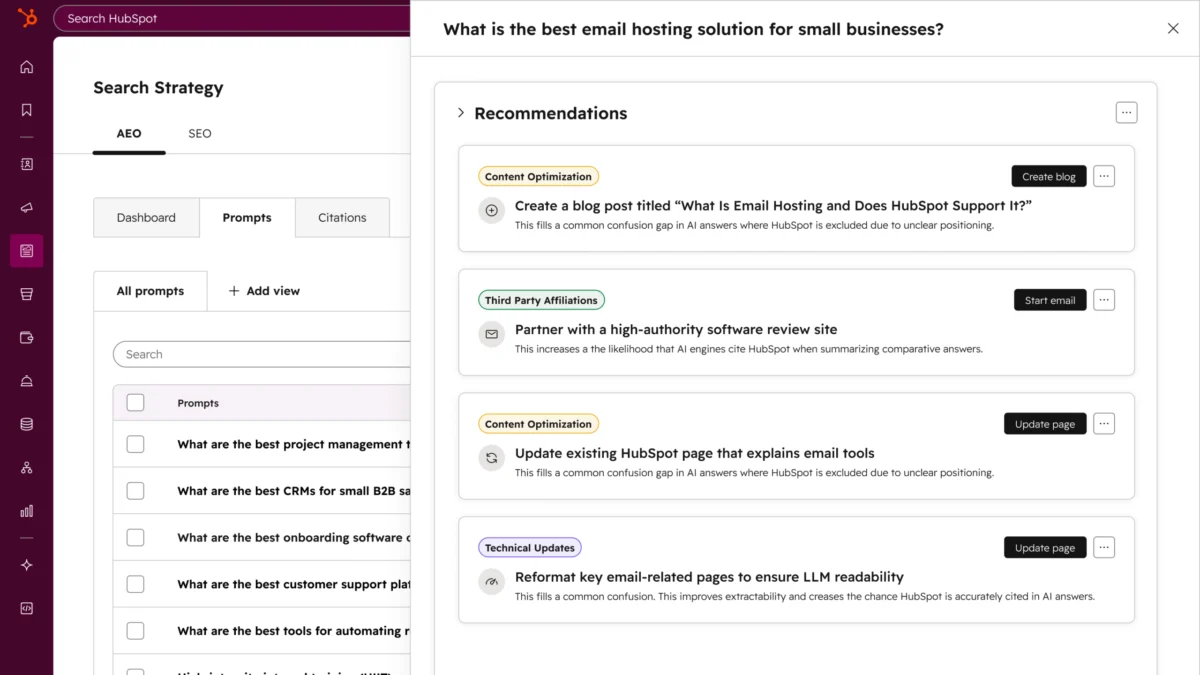
- Contextual Recommendations: Embedding optimization tasks directly into existing editorial workflows so content creators do not have to juggle standalone software.
- Pipeline Attribution: Passing AI referral data through the CRM to connect conversational discovery directly to closed-won revenue.
Implications: Building the Infrastructure for the Next Era of Marketing
The implications of the AEO revolution extend far beyond the marketing department; they fundamentally alter how businesses measure brand equity and forecast future revenue.
1. Organizational Restructuring
Companies are beginning to dismantle rigid departmental silos between SEO and content teams. Because answer engines reward deep topical authority, clear structuring, and multi-source consensus, content creation and technical optimization must happen in tandem. Forward-looking enterprises are establishing cross-functional "Discovery Teams" dedicated to monitoring and improving brand sentiment and visibility across LLMs.
2. The Evolution of Attribution Models
As smart CRM systems evolve to natively track AI-driven traffic sources—tagging contacts that originate from conversational answers and associating them with specific pipeline deals—the excuse of "fuzzy returns" for organic brand investments is disappearing. Marketing leaders who can accurately report AEO’s contribution to core KPIs like CPL, MQL volume, and influenced revenue will secure outsized budgets.
3. Compounding Competitive Advantages
Much like early adopters of SEO in the late 1990s gained an entrenched advantage over legacy brands slow to digitize, early adopters of AEO are building a compounding defensive moat. Because large language models rely on established web authority, sentiment consistency, and structured data footprints, establishing a dominant presence in AI answers today makes it exponentially harder for competitors to displace that authority tomorrow.
Conclusion
The gap in the modern digital marketing funnel is no longer theoretical—it is where your buyers are currently evaluating your competitors. By integrating AEO into existing analytics stacks, streamlining content recommendations through established editorial calendars, and tying AI referrals directly to CRM pipeline data, digital marketing teams can transition from playing catch-up to leading the next evolution of customer acquisition.



