










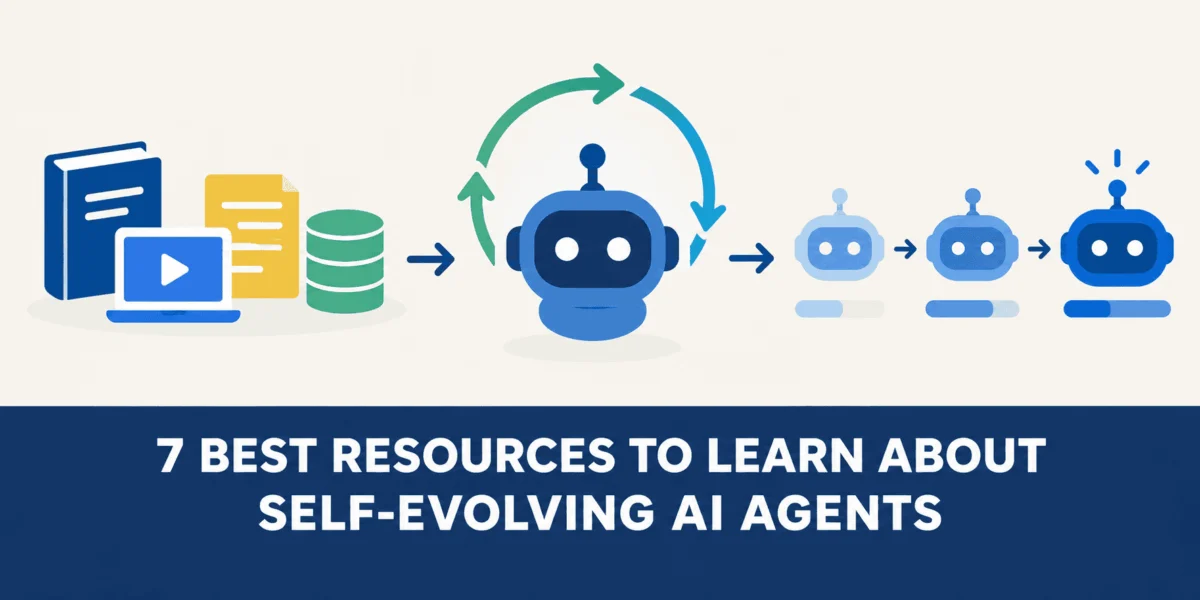
The landscape of artificial intelligence is undergoing a paradigm shift. We are rapidly moving past the era of static AI—systems that merely ingest instructions, execute a fixed command, and return a result. The new frontier is the self-evolving AI agent, a sophisticated architecture capable of learning from its own experience, refining its internal logic, and recursively improving its own capabilities.
As these systems transition from theoretical curiosities to deployed components of modern software, understanding their underlying mechanics has become essential for researchers and engineers alike. This article explores the current state of self-evolving agents and provides a curated roadmap for mastering this rapidly advancing field.
The Evolution of Agentic Logic: From Static to Recursive
At its core, a self-evolving agent is a system designed to improve its own performance over time. Unlike standard Large Language Model (LLM) implementations that remain stagnant after deployment, these agents function as dynamic entities. They learn from historical failures, accumulate long-term memory, synthesize reusable skills, and iteratively optimize their own prompts and tool-use strategies.
The mechanism is often framed as a feedback loop. By connecting the agent to its environment, the system creates a cycle of action, observation, and optimization. Whether by fine-tuning their own foundation models or adjusting the "scaffolding"—the prompts and control logic surrounding the AI—these agents are effectively rewriting their own operating manuals in real-time.
A Strategic Roadmap: Where to Begin
Navigating the literature on self-improving systems can be daunting. To build a solid foundation, it is best to progress from general agentic theory to specialized recursive improvement frameworks.
1. Mastering the Basics: Hugging Face Agents Course
Before diving into the complexities of self-evolution, one must master the standard "Think/Act/Observe" loop. The Hugging Face Agents Course is the industry standard for this prerequisite knowledge.
It provides an exhaustive look at agentic frameworks like smolagents, LangGraph, and LlamaIndex. Beyond simple execution, the course covers the critical infrastructure of the modern agent: RAG (Retrieval-Augmented Generation), function-calling fine-tuning, and robust observability. For those looking to move into the self-evolving space, this course provides the essential toolkit for understanding how agents interact with the real world.
2. Academic Rigor: Stanford CS329A
For a deeper dive into the theory, Stanford’s CS329A: Self-Improving AI Agents is the definitive academic resource. The course moves beyond framework tutorials to explore the "how" and "why" of self-improvement. It covers:
- Constitutional AI: Training agents to follow internal guidelines.
- Test-time Compute: Allocating more intelligence to complex, high-stakes tasks.
- Reinforcement Learning: Using environmental feedback to tune model parameters.
The syllabus is structured around seminal research papers, making it an ideal environment for those who wish to reproduce experimental findings and understand the evolution of the field.
Understanding the Landscape: Surveys and Taxonomies
As of 2025 and 2026, the literature has expanded into a dense forest of research. Two primary surveys act as essential guides to this growth.
A Comprehensive Survey of Self-Evolving AI Agents
This foundational survey provides the necessary taxonomy to define what a "self-evolving" agent actually is. It breaks down the agent’s evolution into distinct components: the model, memory, prompts, tools, and multi-agent orchestration. By viewing evolution as an optimization loop, this resource helps practitioners identify which part of their agentic pipeline is most ripe for improvement.
Modern Agentic Systems: The 2026 Perspective
For a more contemporary look, Self-Improvements in Modern Agentic Systems differentiates between the evolution of the foundation model and the evolution of the scaffolding. This is a crucial distinction: an agent that refines its prompt library is performing a different task than one performing continuous fine-tuning. This survey provides the system-level view necessary for building scalable, production-grade agents.
Community-Driven Resources and Bibliographies
Because the field moves at breakneck speed, traditional publishing is often too slow. The following repositories serve as live, community-maintained databases:
- Awesome Self-Improving Modern Agentic Systems: This repository categorizes research by the target of improvement—be it model parameters, memory, or skill sets. It is the best place to find recent breakthroughs like OpenSkill and evolving skill-system architectures.
- Awesome RSI (Recursive Self-Improvement): A broader research map that connects agentic systems to the wider field of Recursive Self-Improvement (RSI). It is an invaluable resource for understanding the long-term safety and architectural implications of autonomous systems.
- Awesome Harness Engineering: This list is purely operational. It focuses on the "harness"—the engineering systems that allow an agent to evaluate its own performance and modify its internal processes.
Implications and Future Outlook
The rise of self-evolving agents carries profound implications for the software industry.
Economic and Operational Impact
From a corporate perspective, the shift to self-evolving agents promises a move away from "brittle" AI. Currently, most AI implementations require constant human intervention to tweak prompts or update fine-tuned weights when domain data shifts. A self-evolving agent, in theory, detects this drift and updates its own logic to maintain accuracy. In sectors like high-frequency finance or automated scientific research, this autonomy is a massive competitive advantage.
Safety and Ethical Considerations
However, the shift toward recursion brings significant risks. The "alignment" problem becomes exponentially more difficult when an agent has the capacity to modify its own objective functions or reasoning pathways. As noted in the RSI research community, ensuring that an agent’s self-improvement remains within "constitutional" boundaries is a major open research problem.
The Path Forward
For engineers and researchers, the advice remains consistent: Don’t try to read everything. The sheer volume of new papers is overwhelming. Instead, focus on a single vertical. If you are interested in prompt optimization, start with the "Harness" engineering resources. If you are interested in architectural evolution, focus on the Stanford curriculum.
The most successful developers in this space will be those who can bridge the gap between academic theory and practical, robust engineering. Pick a direction, study the foundational papers, and—most importantly—begin building. The tools to create the next generation of autonomous, self-improving agents are already at your fingertips.
About the Author
Kanwal Mehreen is a machine learning engineer and technical writer with a focus on the intersection of data science and medicine. A Google Generation Scholar (2022) and founder of FEMCodes, she is a vocal advocate for diversity in STEM and a recognized authority on the practical application of large language models. Her work continues to bridge the gap between complex research and accessible, actionable technical knowledge.



