SAN FRANCISCO — Artificial intelligence has officially crossed the threshold from passive conversational tool to autonomous enterprise collaborator. As organizations across industries grapple with increasing operational friction and data bloat, a new class of software—the AI agent—is transforming how marketing, sales, and customer service teams operate.
According to a landmark 2026 consumer AI survey of 5,000 U.S. adults conducted by Menlo Ventures, artificial intelligence adoption has accelerated dramatically, with one in four AI users now regularly employing autonomous agents. This twenty-four percent regular-use metric underscores a profound shift: businesses and consumers alike are no longer satisfied with simply prompting a large language model for text generation. They want software that can independently plan, execute, and evaluate multi-step tasks across complex digital ecosystems.

Despite the technology’s explosive growth, a significant knowledge gap remains for practitioners eager to harness its potential. Building a reliable autonomous agent requires moving past generic chat interfaces and implementing structured development methodologies. This report explores the core mechanics of AI agents, provides a chronological roadmap for building no-code agents, evaluates real-world enterprise use cases, and analyzes the profound operational implications of this technological leap.
Main Facts: Deconstructing the AI Agent Revolution
To successfully implement autonomous workflows, business leaders must first understand the fundamental distinctions between traditional software automation and modern agentic architectures.

An AI agent is software powered by an artificial intelligence model designed to work toward a specific, pre-defined goal autonomously—meaning it operates without continuous human intervention. Unlike static chatbots that respond only to immediate prompt inputs, or rigid rules-based automations that follow a fixed decision tree, AI agents possess dynamic problem-solving capabilities. They can select among approved tools, review intermediate results, correct course, and iteratively execute tasks until a goal is achieved or a set limit is reached.
Agents vs. Chatbots vs. Rules-Based Automation
To prevent costly misimplementations, technology architects must distinguish between three distinct problem-solving mechanisms:

- Chatbots: Primarily serve as conversational interfaces or interactive front-ends. While modern chatbots leverage natural language processing, their scope is typically limited to answering direct queries or guiding users through static FAQ paths.
- Rules-Based Automations: Excel at predictable, linear processes. If a workflow requires strict adherence to a pre-determined decision tree—such as routing a lead based exclusively on territory, company size, and product interest—rules-based automation remains superior, faster, and more cost-effective.
- AI Agents: Are deployed when tasks are repeatable, tedious, and require both interpreting unstructured qualitative data and deciding what action to take next.
According to framework guidelines established by AI researchers at Anthropic, organizations should always start with the simplest approach that meets their needs. Because autonomous agents introduce higher computational costs and potential execution delays, they should be reserved for complex, multi-variable workflows that defy rigid rule-writing.
Chronology: The Step-by-Step Blueprint to No-Code Agent Deployment
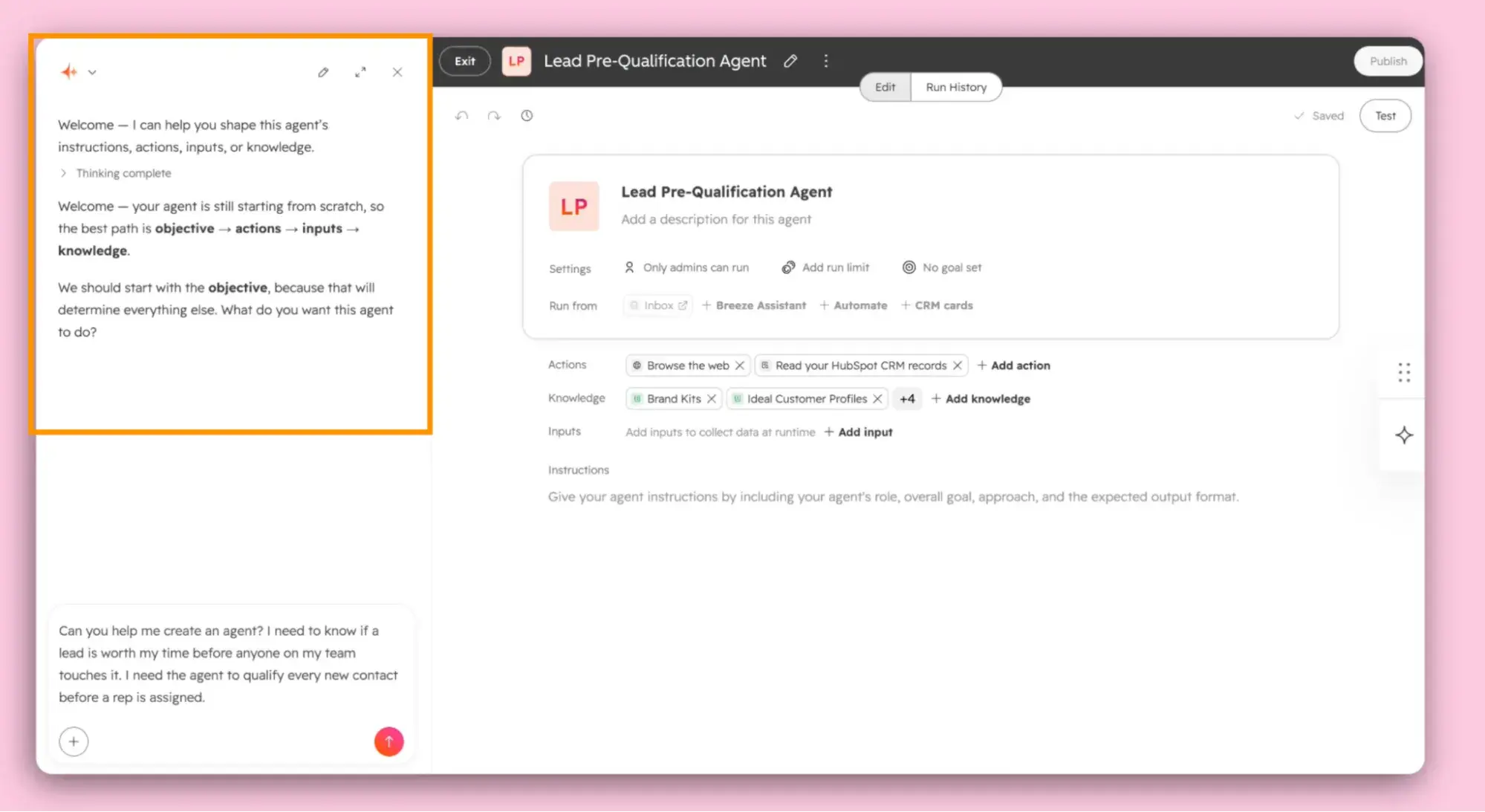
Building a custom AI agent no longer requires a dedicated software engineering team. Modern platforms—such as HubSpot’s newly introduced Agent Builder—allow marketers, sales representatives, and customer success managers to create sophisticated automation in plain language.

For teams embarking on their first agent deployment, industry experts outline a structured, five-stage chronology.
Phase 1: Define a Narrow Goal and Success Criteria
The deployment process begins long before opening a configuration dashboard. Practitioners must write a comprehensive brief defining the agent’s specific mission.

- Select Repeatable Work: Choose a task the team performs consistently. For example, reviewing closed-lost sales deals to identify unanswered buyer concerns.
- Scope the Environment: For a first-time deployment, restrict the agent to a single test record—such as one closed-lost deal—to ensure reviewers have a manageable dataset for quality assessment.
- Establish Success Criteria: Clearly document what a correct result looks like. In the case of a deal review, success might be defined as an output that flags underperforming content, cites specific deal notes, and proposes a single optimization without hallucinating data gaps.
Phase 2: Write Rigorous, Contextual Instructions
Translating human expectations into machine instructions is the cornerstone of agent training. Instructions must explicitly dictate the agent’s role, goal, operational approach, and expected output format.
Using natural language within platforms like Agent Builder, instructions should dictate how the software handles ambiguity. For instance, a well-crafted instruction set might read:

“Read available deal details. Distinguish direct buyer feedback from a salesperson’s interpretation. Propose new content only when the approved catalog lacks a suitable asset. If records do not support a conclusion, explicitly state what information is missing.”
Phase 3: Add Tools, Knowledge Vaults, and Permissions
An agent is only as smart as the data it can access. Creators must provision the agent with relevant reference materials and operational tools:

- Knowledge Vaults: Secure repositories supporting PDFs, spreadsheets, PowerPoint presentations, website pages, and CRM segments.
- AI Context: Setting enterprise-level context ensures the model understands overarching business models, value propositions, and industry nuances.
- Permissions: Granular access controls dictate who within an organization can execute, edit, or view the agent’s outputs.
Phase 4: Test with Representative Scenarios
Rigorous testing is non-negotiable. Developers should run test scenarios on known records to evaluate whether the agent followed approved references and supported its recommendations. Crucially, in ecosystems like HubSpot’s Agent Builder, test runs do not consume billing credits, allowing teams to iterate repeatedly until outputs achieve absolute consistency.
Phase 5: Establish Guardrails and Human Handoffs
Before pushing an agent into a live production workflow, teams must implement strict AI guardrails. These safety parameters dictate what data the agent cannot touch, what actions are prohibited, and exactly when an autonomous process must halt to request human approval—particularly for high-stakes actions like issuing refunds or altering customer records.

Supporting Data: Real-World Use Cases Across the Enterprise
To understand how autonomous agents perform in production environments, industry analysts point to three distinct enterprise deployments across marketing, sales, and service.
1. Marketing: Measuring Un-clicked LinkedIn Ad Influence
Senior Demand Marketing Manager Filippo Irdi of Unmuted designed an innovative agent to solve a classic attribution dilemma: tracking B2B buyers who are exposed to LinkedIn advertisements but never click on them.

- The Mechanism: The agent pulls weekly company-level impression data via the LinkedIn API and correlates it with closed-won deal timelines extracted from HubSpot CRM.
- The Result: By automatically matching corporate ad exposure against pipeline movement, the agent generates a chronological heatmap. This allows marketing teams to accurately quantify ad influence on accounts that ultimately converted through direct sales outreach, running autonomously on a monthly schedule.
2. Sales: Automating Complex Commission Explanations
Commission disputes often erode sales team morale simply because reps cannot transparently parse complex mathematical payout structures. Driven, a sales commission platform, developed a specialized HubSpot agent to bridge this gap.
- The Mechanism: The agent accepts natural-language questions and compensation plan documents (PDF, Word, or Excel). Behind the scenes, deterministic financial engines (utilizing precise decimal mathematics) calculate exact payouts, while the AI agent acts as an explanatory interface—fetching calculation traces and rendering plain-language breakdowns linked directly to specific closed deals.
3. Service: Identifying Recurring Support Bottlenecks
Customer support teams frequently answer identical queries repeatedly without identifying systemic product or documentation failures. By integrating HubSpot ticket pipelines with advanced language models via secure connectors, organizations can execute deep-research prompts.

- The Mechanism: The agent reviews historical support tickets within specified date ranges, groups them by underlying customer pain points, counts the frequency of occurrences, and links back to source tickets.
- The Result: Service leaders receive an actionable issue report distinguishing user-education gaps from actual product bugs, drastically reducing manual data-sorting hours.
Official Responses and Industry Perspectives
As organizations rush to deploy proprietary AI agents, industry thought leaders emphasize the critical balance between speed and structural safety.
Elle Oshiro, a professor at HubSpot Academy, underscores that effective custom agents always rely on four foundational building blocks: repeatable work, data already centralized in a CRM, a precise programmatic trigger, and a clearly defined, measurable outcome. Without these elements, automation efforts frequently collapse under the weight of unstructured data and poorly defined scopes.

Meanwhile, engineering leads at major AI infrastructure firms reiterate the importance of starting simple. Transitioning prematurely from a single-agent architecture to a complex multi-agent system—where multiple autonomous programs pass data back and forth—can introduce exponential error rates, bloated operational costs, and debugging nightmares unless justified by strict performance metrics.
Implications: Strategic, Operational, and Financial
The widespread mainstream adoption of AI agents carries sweeping implications for the future of white-collar work.

Operational Efficiency vs. Oversight Overhead
While the primary promise of autonomous agents is labor reduction—such as turning a twenty-minute manual data-handing task into an eight-minute automated review—organizations must account for "review time." Human supervisors must continuously audit agent outputs, maintain test spreadsheets, and monitor failure logs. Efficiency gains are only realized when the time spent reviewing agent accuracy is significantly lower than executing the task manually.
The Evolution of No-Code Democratization
The democratization of AI agent building shifts the power of systems design from traditional software developers to domain experts—marketers, sales operations specialists, and customer support leads. Because these professionals best understand the nuances of their respective workflows, no-code agent builders eliminate communication bottlenecks between business units and IT departments.

Security, Governance, and Compliance
As agents gain deeper access to enterprise databases, knowledge vaults, and external APIs, governance becomes a board-level concern. Establishing robust guardrails, restricting autonomous write-permissions, and enforcing mandatory human-in-the-loop checkpoints for sensitive transactions will separate resilient enterprise deployments from catastrophic data-exposure incidents.
Conclusion
The transition toward agentic AI is no longer a futuristic speculation; it is an active operational reality. By starting with narrow, well-defined use cases, enforcing rigorous testing frameworks, and maintaining uncompromising human guardrails, organizations can harness autonomous agents to unlock unprecedented levels of productivity, precision, and strategic growth.