










By the Tech & E-Commerce Desk
Published: August 2026
Main Facts
A free WordPress plugin can be deceptively similar to adopting a free puppy: while the initial acquisition costs nothing, the ongoing maintenance, feeding, and care accumulate over time. In the context of WordPress-powered e-commerce, free Stripe payment plugins often operate on a "freemium" model. While downloading the software costs zero upfront dollars, these free tiers quietly extract a toll by levying a small percentage fee on every single transaction processed through the site.
Over time, as a business grows, these cumulative transaction percentages can quietly surpass the flat cost of purchasing a paid annual license.
To make informed financial decisions, website administrators must understand that processing a payment via Stripe on WordPress involves two distinct cost layers:
- Layer 1 (The Gateway Fee): The baseline processing fees charged directly by Stripe (typically around 2.9% plus a fixed fee per transaction). This fee is unavoidable regardless of the plugin or route chosen.
- Layer 2 (The Plugin Fee): The additional toll charged by third-party WordPress plugins for facilitating the checkout form on your site. Free tiers often charge between 3% and 5% per transaction, whereas premium licenses eliminate this fee entirely in exchange for a flat yearly subscription.
For businesses processing even moderate revenue volumes, failing to audit these Layer 2 fees can result in hundreds—or thousands—of dollars in unnecessary expenses.
Chronology: The Evolution of WordPress Payment Models
The monetization of WordPress e-commerce infrastructure has undergone a distinct evolution over the past decade. Understanding this timeline explains why free tiers have become so ubiquitous and why merchants frequently fall into the percentage-fee trap.
Phase 1: The Era of Custom Code and Heavy Carts (Early 2010s)
In the early days of accepting credit cards on WordPress, site owners had few options outside of massive, monolithic systems like WooCommerce or complex merchant accounts. Setting up a simple donation button or a single-item checkout required either advanced coding knowledge or heavy, bloated extensions that demanded constant configuration.
Phase 2: The Rise of Lightweight Freemium Plugins (Late 2010s – Early 2020s)
As Stripe revolutionized developer-friendly APIs, independent developers and boutique WordPress shops began offering lightweight plugins designed strictly for Stripe integration. To encourage adoption, these developers introduced freemium models. The promise was alluring: deploy a professional payment form on your site instantly, with zero upfront investment. The catch—a 3% to 5% cut of transaction volume—was buried in the fine print, appearing negligible to early-stage creators who were barely processing any revenue.
Phase 3: The Native Checkout Alternative (Mid-2020s)
Stripe introduced native features like Stripe Payment Links, allowing merchants to generate hosted checkout pages directly from their Stripe dashboard without needing a specialized plugin. This shift created a fork in the road for WordPress publishers: they could either use hosted pages for $0 in plugin fees or invest in robust, on-site embedded forms via paid plugin licenses.
Phase 4: The Current Financial Reckoning (Present Day)
Today, digital entrepreneurs are increasingly realizing that freemium transaction fees scale dynamically with success, whereas software licenses remain flat. As processing volumes rebound and scale post-startup, merchants are utilizing strict break-even formulas to evaluate whether their "free" plugins are actually costing them a small fortune.
Supporting Data: Layer-by-Layer Cost Analysis
To evaluate the true cost of accepting payments, one must look closely at how the numbers interact across different platform routes.
Layer 2 Plugin Fee Breakdown
| Route | Plugin Fee (Layer 2) | What Removes It |
|---|---|---|
| Stripe Payment Links (No plugin) | $0, ever | Nothing to remove (Hosted checkout) |
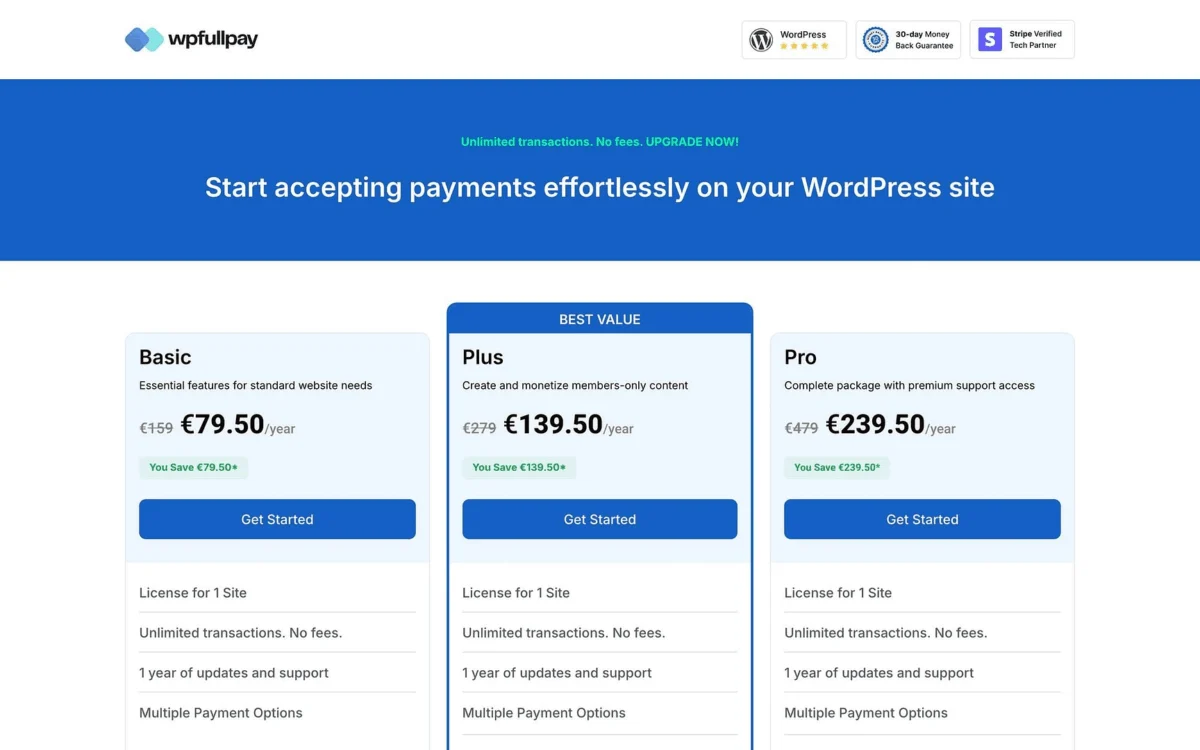
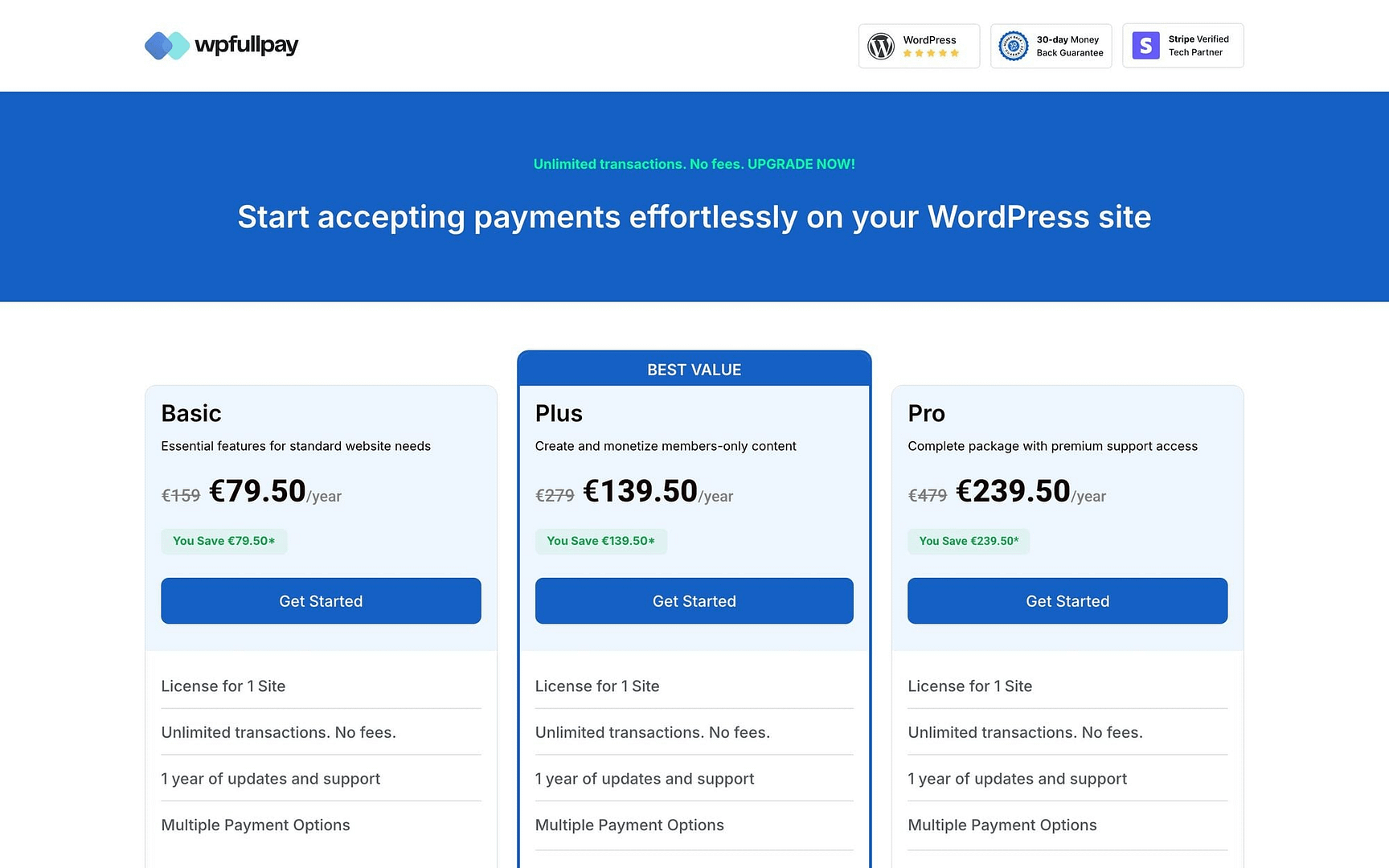
| WPFullPay Free Tier | 5% per transaction | Basic license: €79.50/yr intro, €159 renewal |
| WP Simple Pay Lite | 3% per transaction | Personal license: $49.50/yr intro, $99 renewal |
A Note on Layer 1 Physics
It is vital to acknowledge the fixed 30-cent component in Stripe’s standard processing rate. Because of this fixed fee, tiny payments carry a disproportionately heavier percentage burden than large ones.
- A $10 donation effectively costs approximately 5.9% in total Stripe gateway fees.
- A $100 invoice effectively costs approximately 3.2%.
Nothing in Layer 2 alters this underlying financial physics. Therefore, if a site collects numerous low-value transactions, overall financial health must be judged by the average payment size rather than headline rates.
Official Responses and Strategic Industry Insights
Industry analysts and plugin developers point out that free tiers are not inherently predatory; rather, they serve a specific segment of the digital economy.
When Free Tiers Deliver Real Value
Representatives from leading WordPress product ecosystems emphasize that "free" does not automatically mean "crippled." For instance, free versions of prominent Stripe plugins often support critical features such as recurring subscriptions and donation processing. Creators launching a new venture, testing a business concept, or operating on a shoestring budget can leverage these free tiers to validate an idea without incurring fixed overhead.
The Danger of Stale Metrics
Financial advisors working with digital creators warn against complacency. A common pitfall is establishing a payment plugin during the launch phase, choosing the free tier because initial revenue is low, and never revisiting the math as the business scales.
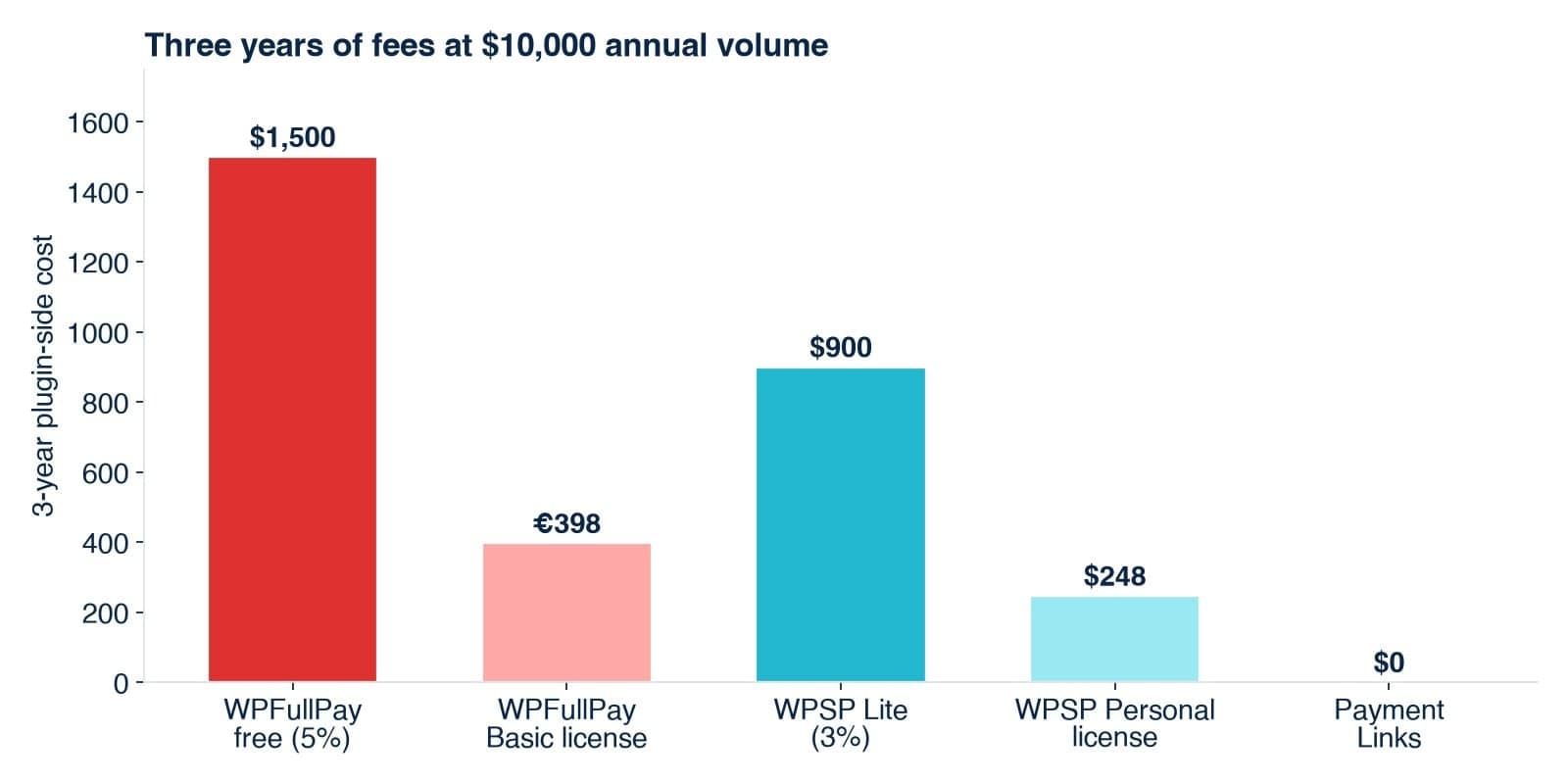
The Golden Rule of Software Economics: Percentage fees scale directly with your success, while software licenses remain fixed. At scale, three years of percentage-based plugin fees will typically buy a permanent commercial license multiple times over.
Practical Implications: Three Real-World Business Scenarios
To translate formulas into actionable insights, consider how different operational models dictate the optimal payment architecture.
Scenario 1: The Weekend Bakery
- Annual Volume: $3,600
- Profile: Takes online preorders for weekend pickups. Requires simple checkout fields but no complex membership portals.
- The Math: At $3,600 a year, a 3% or 5% fee tier ($108 to $180 annually) exceeds the cost of a basic software license. However, because a bakery preorder form does not strictly require an advanced embedded onsite form, the optimal path is Stripe Payment Links ($0 plugin fee via a hosted page).
Scenario 2: The Independent Consultant
- Annual Volume: $24,000
- Profile: Invoices corporate or individual clients for retainer services and project work.
- The Math: At this volume, a 3% plugin fee results in $720 in annual overhead—nearly seven times the cost of a standard license. Because B2B clients are accustomed to paying via secure external links, invoices easily tolerate a hosted redirect page. The consultant should either switch to Stripe Payment Links or purchase a flat-rate plugin license.
Scenario 3: The Small E-Commerce Shop
- Annual Volume: $96,000
- Profile: Sells physical or digital goods directly through high-converting, on-site sales pages with embedded forms.
- The Math: Payment Links are off the table because the shop requires a seamless on-domain checkout experience. At $96,000 in annual volume, a 5% free-tier fee amounts to a staggering $4,800 lost every year. Purchasing an annual license is virtually free by comparison.
The Break-Even Formula and Five-Minute Worksheet
Merchants can easily calculate their optimal path without complex spreadsheets using a single, definitive equation:
$$textBreak-Even Volume = fractextAnnual License PricetextPlugin Fee Rate$$
Taking less than this threshold per year means the free tier wins. Exceeding it means a paid license is the financially sound choice.
Your Five-Minute Audit Worksheet
Grab your financial figures from the previous fiscal year (or your projected numbers for the coming year) and fill in the blanks:
- A. Average monthly card volume: $__
- B. Annual volume ($A times 12$): $__
- C. Your free plugin’s fee rate ($3%$ or $5%$): __%
- D. What the free tier costs you yearly ($B times C$): $__
- E. The license that removes it (use full renewal price): $__
Final Verdict: If $D > E$, purchase the license immediately. If $D < E$, remain on the free tier.
Conclusion
Navigating the financial architecture of WordPress e-commerce requires moving past the illusion of the "free" label. While zero-cost plugins play a crucial role in lowering barriers to entry for early-stage entrepreneurs, failing to audit transaction fees as a business scales results in an unnecessary financial leak. By applying straightforward break-even formulas and conducting annual reviews, site owners can ensure their payment infrastructure supports their bottom line rather than quietly eroding it.



