










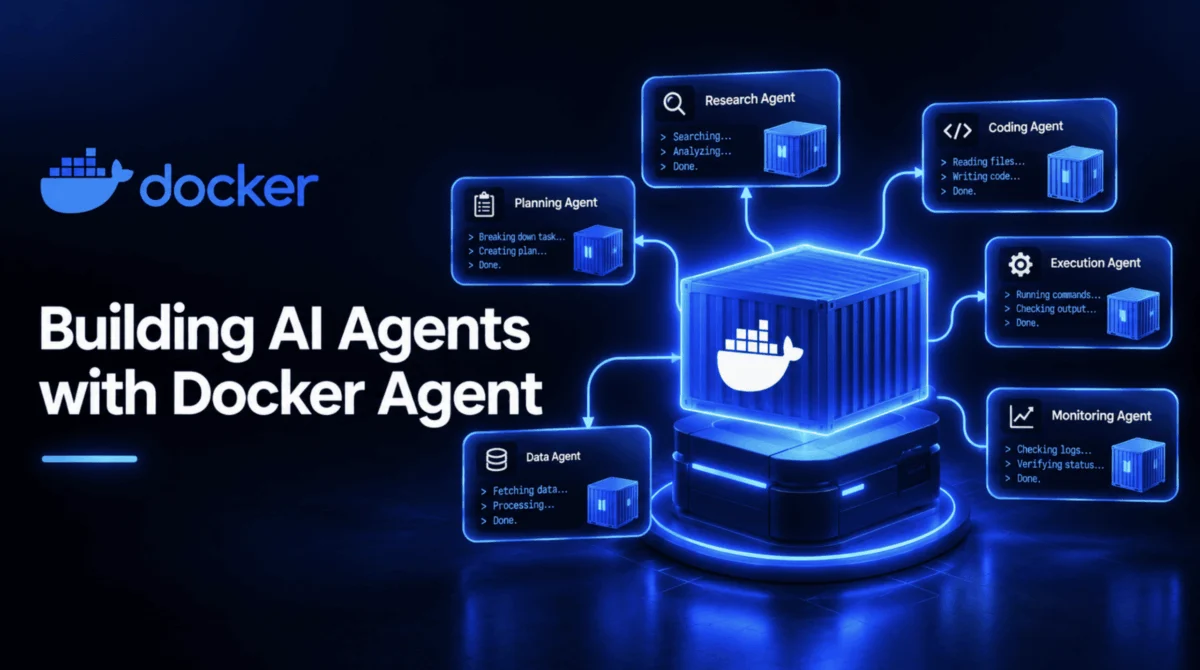
The software industry has long operated under the mantra of "write once, run anywhere." Since the inception of Docker, containerization has provided a standardized, immutable way to package and deploy applications. Today, as the landscape of artificial intelligence shifts from simple prompt-based chat interfaces to complex, autonomous multi-agent systems, a critical problem has emerged: how do we version, share, and maintain these intelligent entities?
Docker’s answer is Docker Agent, an open-source CLI plugin that applies the principles of OCI (Open Container Initiative) registries to the world of AI. By defining agents through declarative YAML configurations rather than opaque, sprawling codebases, Docker is effectively "containerizing" intelligence, allowing developers to treat AI agents with the same rigor and reliability as traditional backend services.
The Genesis of Docker Agent: A Chronology of Integration
The arrival of Docker Agent was not a sudden pivot but the culmination of a deliberate, multi-year strategy by Docker Engineering to bridge the gap between container orchestration and agentic workflows.
2025: Laying the Groundwork
The momentum began in earnest throughout 2025. In July, Docker made waves by announcing an extension to Docker Compose specifically designed to support agents and AI models. This was a significant departure from the standard "container-first" architecture, signaling that Docker viewed AI not as an external API call, but as a first-class citizen within the infrastructure. Following this, the introduction of "Docker Model Runner" provided a necessary bridge, allowing developers to execute models locally—bypassing the latency and privacy concerns of cloud-only API calls.
2026: The Rise of the Plugin
By March 2026, the Docker Agent project emerged as a dedicated Go-based CLI plugin. With early tagged releases hitting the public domain, the project saw an immediate surge in community interest. In a remarkably short period, it garnered over 3,300 stars on GitHub and pushed nearly 10,000 commits, reflecting a high-velocity development cycle that characterizes successful open-source infrastructure projects.
Supporting Data and Technical Architecture
Docker Agent is governed by the Apache 2.0 license, ensuring it remains an accessible tool for enterprise and individual developers alike. Unlike monolithic AI frameworks that require deep Python knowledge, Docker Agent relies on declarative configuration.
Why YAML and HCL?
By utilizing YAML (or HCL) for agent definition, the tool democratizes the creation of AI systems. A developer—or even a technically inclined project manager—can define an agent’s "personality," its constraints, and its toolset without writing a single line of procedural code.
Provider-Agnostic Flexibility
The architecture is intentionally modular. Docker Agent is not locked into a specific vendor ecosystem. It currently integrates with:
- Commercial Leaders: OpenAI, Anthropic (Claude), Google (Gemini), and xAI.
- Enterprise Solutions: AWS Bedrock.
- Local Execution: Through Docker Model Runner, allowing for offline, air-gapped agent operations.
MCP: The Secret Sauce
The tool’s integration with the Model Context Protocol (MCP) is perhaps its most powerful feature. By enabling agents to connect to local or remote MCP servers, Docker Agent allows for a "sidecar" pattern of tool usage. Agents can access filesystem data, run shell commands, or query databases within isolated containers, ensuring that an agent’s operational environment is as secure as the infrastructure it runs on.
Implementation: From Single Agent to Multi-Agent Teams
To understand the practical implications of this technology, we must look at how it scales from a simple coding assistant to a specialized workforce.
The Single-Agent Paradigm
Creating a basic agent requires a single agent.yaml file. This file acts as a manifest, similar to a docker-compose.yml.
agents:
  root:
    model: anthropic/claude-sonnet-4-5
    instruction: "You are an expert developer..."
    toolsets:
      - type: filesystem
      - type: shell
This simplicity allows for versioning via Git. When the agent’s instructions are updated, the change is tracked in source control, providing an audit trail that is notoriously difficult to maintain in traditional "prompt-engineering" workflows.
The Multi-Agent Orchestration
The true power of Docker Agent lies in its sub_agents functionality. In a complex workflow, a "Coordinator" agent can delegate tasks to specialized "Researcher" and "Writer" agents. This mimics a microservices architecture:
- The Researcher focuses solely on gathering data using a web-search MCP tool.
- The Writer focuses on synthesis and formatting, using filesystem tools.
- The Coordinator manages the state and validates the output.
Because each agent is defined independently, a developer can assign different models to different tasks—using a high-reasoning model like Claude 3.5 for the coordinator, while utilizing a cost-effective model for the researcher.
Official Perspective and Industry Implications
Docker’s pivot to agentic infrastructure addresses a growing pain point in the AI industry: reproducibility.
The Registry Advantage
The most profound implication of Docker Agent is the ability to push agents to OCI-compatible registries. By running docker agent run myorg/researcher:v1.2.0, a team can ensure that every developer, CI/CD pipeline, and production server is running the exact same version of the agent.
By pinning agents to an immutable SHA256 digest, organizations can guarantee that an agent’s behavior will not "drift" due to upstream model updates or configuration changes. This is a game-changer for enterprise compliance and security, where the "black box" nature of AI has previously prevented widespread adoption in mission-critical systems.
Implications for DevOps
With Docker Agent, we are witnessing the birth of "AgentOps." We are moving toward a future where:
- Agents are built as artifacts: They are tested in CI/CD pipelines alongside the software they manage.
- Infrastructure as Code (IaC) meets Intelligence: The same tools used to provision a database are now used to define the agents that query that database.
- Isolation: By running MCP servers in containers, the risk of "prompt injection" leading to system-wide host compromise is significantly mitigated.
Conclusion: A New Standard for AI Distribution
Docker Agent does not attempt to reinvent the wheel of model inference. Instead, it provides the "chassis" upon which those models can be built, tested, and shipped. By abstracting the complexity of agentic orchestration into a standardized, container-friendly format, Docker has moved the industry one step closer to treating AI as a reliable, predictable component of the modern technology stack.
For developers and organizations looking to bridge the gap between experimental AI prototypes and production-ready intelligent systems, Docker Agent provides the necessary framework to turn chaotic, disparate scripts into a cohesive, versioned, and scalable workforce. As the ecosystem continues to grow, we can expect the OCI registry to become the central marketplace for not just software images, but for the intelligent agents that build and manage them.
About the Author:
Shittu Olumide is a software engineer and technical writer dedicated to translating complex, emerging technologies into actionable insights for the developer community. His work focuses on the intersection of infrastructure, AI, and distributed systems.



