










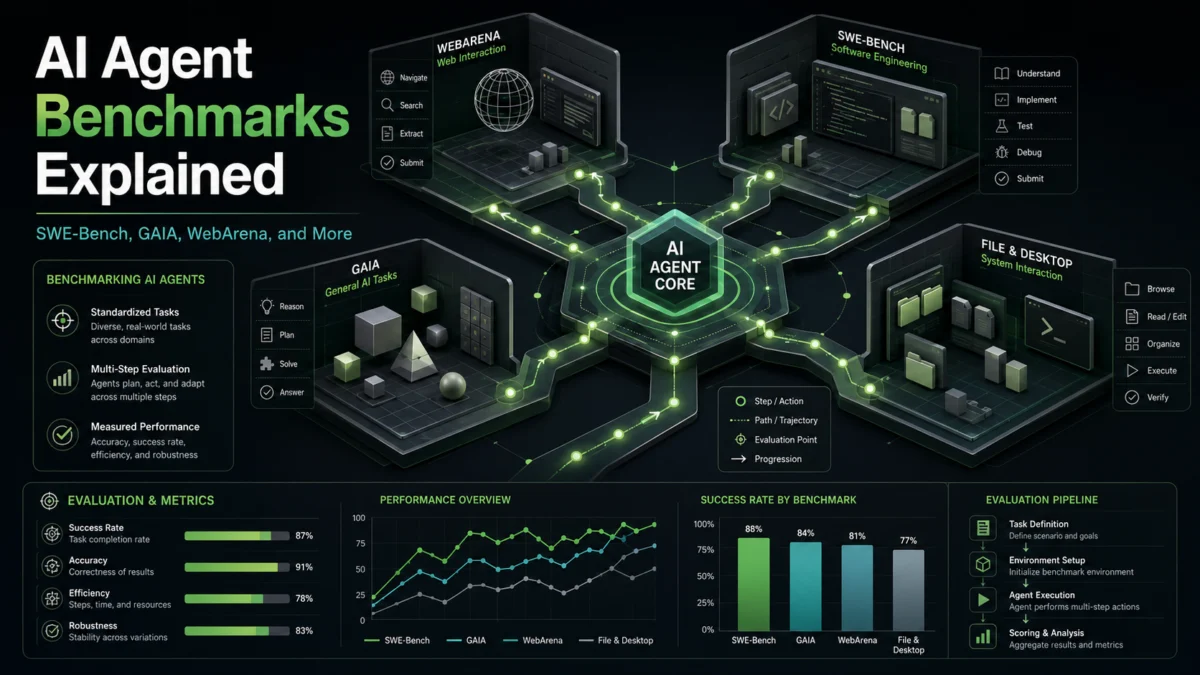
Every AI provider currently claims their agent is "state-of-the-art." Marketing landing pages glow with impressive percentages, and leaderboards update with frantic velocity, suggesting that we are on the precipice of total automation. But for the engineer or product manager tasked with deploying AI agents in a live production environment, the noise of these scores often rings hollow. The question that matters is not, "Does this agent have the highest score on a public leaderboard?" but rather, "Will this system reliably execute the business-critical workflows I am hiring it to perform?"
This guide aims to cut through the marketing fog. We will examine what major AI agent benchmarks actually measure, why each captures only a specific slice of capability, and how to effectively utilize these evaluations as directional signals rather than absolute guarantees of production success.
The Fundamental Shift: Agent vs. Model Benchmarks
Before dissecting specific evaluations, it is essential to distinguish between traditional model benchmarks and modern agent benchmarks.
Traditional benchmarks, such as MMLU (Massive Multitask Language Understanding) or HumanEval, are designed to test a model’s ability to generate a correct, static response in a single turn. You provide a prompt, the model generates an output, and a judge (either programmatic or human) scores the result. These tests are vital for measuring raw language understanding, logical deduction, and syntactic knowledge. However, they are inherently "closed-loop"—they say nothing about a system’s capacity to interact with the messy, unpredictable nature of the real world.
Agent benchmarks introduce a categorical shift. They drop an AI model into an environment where it must perform a series of actions over multiple steps. It must utilize external tools, adapt to failure, handle shifting contexts, and pursue a goal that cannot be reached in a single burst of text. Failure in these benchmarks isn’t just a "wrong answer"; it is a stuck loop, a corrupted file, or a workflow abandoned in frustration. While a traditional benchmark is a written exam, an agent benchmark is a live work simulation where the candidate must navigate real friction and genuine surprises.
A Chronology of Evaluation: From Static Code to Desktop Control
The evolution of these benchmarks reflects the increasing ambition of the field. Initially, the community focused on coding tasks (SWE-bench), then moved to multi-modal reasoning (GAIA), followed by browser interaction (WebArena), and finally, full desktop control (OSWorld).
1. SWE-bench and SWE-bench Verified
SWE-bench is arguably the gold standard for software engineering agents. It presents the agent with real-world GitHub issues from major repositories like Django and scikit-learn, requiring the agent to navigate the codebase and produce a patch that resolves the issue. Success is binary: the patch must pass the repository’s existing unit tests.
The introduction of SWE-bench Verified addressed a critical flaw in the original dataset—the existence of ambiguous or unsolvable tasks. By curating a subset where humans confirmed the tasks are solvable and the test suites are accurate, the industry gained a more reliable metric. However, a major caveat remains: passing a unit test is not synonymous with writing "good" code. An agent might pass a test while introducing a memory leak, a security vulnerability, or by creating a fragile solution that breaks secondary features.
2. GAIA (General AI Assistants)
GAIA was designed to move beyond code. It focuses on the ability to answer complex, multi-step questions that require reasoning across diverse modalities. A typical GAIA task might involve looking up a document, cross-referencing it with live web data, performing a calculation, and synthesizing the final answer.
GAIA’s genius lies in its design: the tasks are trivial for a human with basic internet access but notoriously difficult for current AI. It forces the agent to coordinate web browsing, file handling, and multi-step deduction. The limitation here is the "single correct answer" bias. Real-world assistant workflows are rarely so clean; they involve ambiguity, shifting goals, and context that no search engine can fully capture.
3. WebArena and BrowserGym
As agents moved toward browser-based tasks, WebArena and BrowserGym became essential. WebArena provides sandboxed environments (e-commerce platforms, forums, CMS) where an agent must act like a human: clicking buttons, filling out forms, and interpreting dynamic DOM elements.
The primary challenge here is data contamination. Because many WebArena tasks have been publicly available for some time, there is a risk that newer models have "memorized" the task structures during training. A high score may represent pattern-matching capability rather than genuine autonomous interaction.
4. OSWorld: The Final Frontier
OSWorld represents the most expansive view of agent capability to date. It places an agent inside a sandboxed desktop OS, requiring it to manipulate files, navigate GUIs, and coordinate across multiple programs.
This is the most "human-like" benchmark, but it is also the most fragile. If the virtual environment suffers from a display rendering error or an application hangs, the agent fails—even if its underlying reasoning was perfect. Consequently, OSWorld scores are heavily dependent on the stability of the evaluation infrastructure itself, making it a difficult metric to replicate across different research labs.
Supporting Data and the "Hidden" Costs
While leaderboards provide a snapshot of success rates, they systematically exclude the metrics that matter most to CTOs and lead architects:
- Computational Efficiency: A model that achieves an 80% success rate on SWE-bench by brute-forcing thousands of API calls is economically different from one that hits 70% with 10% of the token usage. Leaderboards display efficacy but hide the "burn rate."
- Latency: In production, an agent that takes 20 minutes to solve a problem is often useless, even if it is technically "correct." No major leaderboard currently weights speed as a primary success factor.
- Safety and Boundary-Following: An agent that performs brilliantly but fails to respect permissioning or refuses to flag high-stakes decisions is a liability. Benchmarks rarely measure the ability of an agent to "say no" or ask for human intervention when a task enters a high-risk state.
- Automated Grading Noise: Many modern evaluations use "LLM-as-a-judge" to score outputs. This creates a feedback loop where an agent that writes confident, persuasive, but incorrect prose is scored higher than one that is accurate but succinct.
Official Perspectives: The Industry Consensus
Leading researchers, including those at OpenAI, Anthropic, and independent labs like those behind the SWE-bench project, have consistently warned against "overfitting to the leaderboard."
The industry consensus is shifting toward the idea that public benchmarks are for research, while private evaluations are for production. The official view from major AI safety organizations is that public benchmarks are intended to measure relative improvement across architectures, not absolute fitness for a commercial use case. When a company claims their agent is "number one," they are often referring to a specific, narrow task set that may have little relevance to the chaotic, custom-built environments where that agent will eventually be deployed.
Implications: The Path Forward
What does this mean for the future of AI development? The implication is that we are moving toward a more decentralized, task-specific evaluation model.
- Use Public Benchmarks as Filters: Treat leaderboards as a "first pass." If a model performs poorly on GAIA, it is likely not ready for complex research tasks. Use these scores to narrow your candidate pool from twenty models down to three.
- Build Your Own "Unit Tests" for Agents: The only way to ensure production readiness is to create a private evaluation suite that mimics your actual workflow. If your agent is intended to summarize legal contracts, your benchmark should be a set of 50 contracts from your own archives, graded by your own domain experts.
- Prioritize "Failure Recovery": Future benchmarks must shift focus from "task completion" to "error recovery." How does the agent handle a 404 error? How does it behave when a website changes its UI? The resilience of the agent is far more important than its raw intelligence.
Conclusion
AI agent benchmarks like SWE-bench, GAIA, WebArena, and OSWorld represent a historic leap in our ability to evaluate autonomous systems. They provide necessary, if imperfect, windows into the current state of machine intelligence. However, they are not a substitute for rigorous, internal validation.
The teams that will succeed in the coming years are those that understand the difference between a "benchmark winner" and a "production-ready agent." Use the leaderboards to start the conversation, but build your own private evaluations to finish it. By shifting the focus from public glory to private utility, you move from being a spectator of AI progress to an architect of its reliable, real-world application.



