









The traditional machine learning pipeline has, for over a decade, followed a rigid, well-defined sequence: collect massive datasets, painstakingly clean raw text, perform feature engineering—often using techniques like TF-IDF or word embeddings—and finally, train a specialized classifier such as a Logistic Regression or Random Forest model. For data scientists, this was the "standard drill." It was labor-intensive, required high-quality labeled data, and demanded significant compute resources for model fine-tuning.
However, the rapid ascent of Large Language Models (LLMs) has fundamentally disrupted this status quo. We have moved into an era where classification is no longer about training a model from scratch, but about prompting one that already understands the complexities of human language. Yet, a friction point remains: shifting from the structured, programmatic workflows of classical machine learning to the fluid, often unpredictable world of prompt engineering.
Enter Scikit-LLM, an innovative Python library designed to bridge this divide. By wrapping the formidable capabilities of pre-trained LLMs within the familiar scikit-learn interface, Scikit-LLM allows developers to leverage the power of state-of-the-art AI using the syntax they have used for years—specifically, the standard fit() and predict() methods.
The Evolution of Text Classification: From Scratch to Few-Shot
The Traditional Paradigm
Historically, text classification was a bottleneck for many organizations. To build a system that could categorize support tickets or sentiment, teams needed thousands of labeled examples. If the domain was niche—such as medical diagnostics or legal contract analysis—the model’s performance was often mediocre unless the training data was perfectly curated. The "training" phase involved optimizing weights through backpropagation, a process that is both time-consuming and computationally expensive.
The Rise of LLMs and the "Prompt" Era
The advent of LLMs like GPT-4, Llama, and Mistral changed the rules. These models possess a latent understanding of language that allows them to perform tasks with little to no training.
- Zero-Shot Classification: The model classifies text without any examples, relying solely on its internal training.
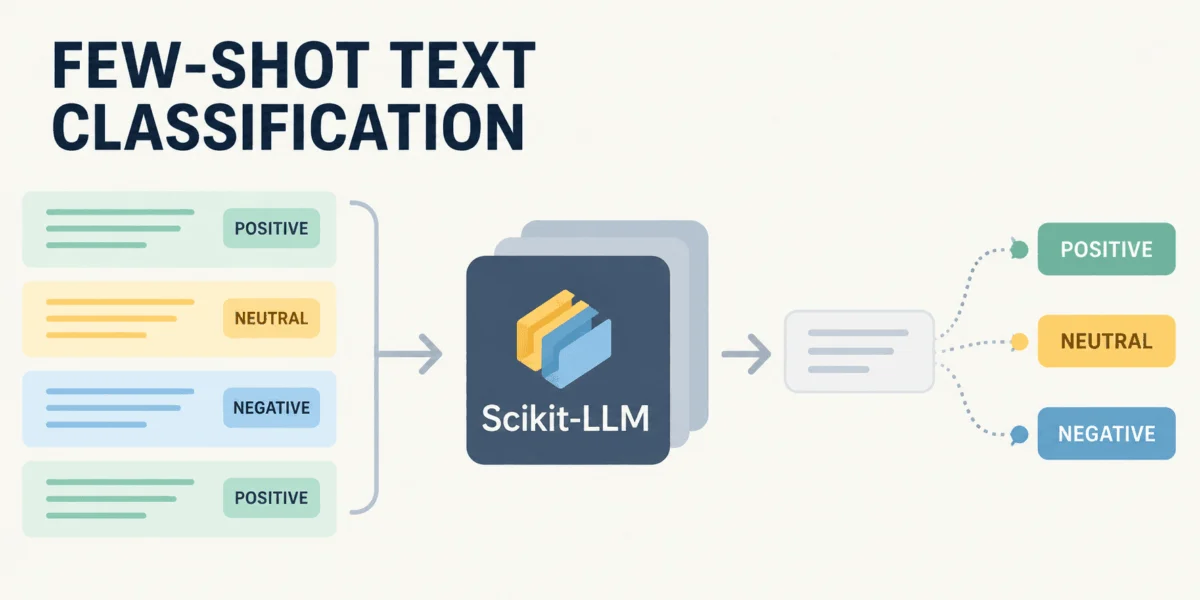
- Few-Shot Classification: The model is provided with a handful of examples (typically 3 to 5) to establish the context, tone, and classification rules.
For domain-specific tasks where jargon or nuanced sentiments are prevalent, few-shot classification has emerged as the "gold standard." It provides the model with just enough guardrails to ensure accuracy without the overhead of full-scale model retraining.
Chronology of Development: Why Scikit-LLM Matters
The inception of Scikit-LLM represents a milestone in the "MLOps" journey. The developer community recognized that while LLMs were powerful, they lacked integration with the data science ecosystem.
- The Integration Phase: Initial LLM usage was fragmented, involving API calls scattered throughout custom scripts.
- The Wrapper Revolution: Libraries like Scikit-LLM began to appear, aiming to treat LLMs as "estimators." This allows data scientists to swap out a Random Forest classifier for an LLM-powered classifier with minimal changes to the existing production code.
- The API Democratization: With platforms like Groq offering high-speed, cost-effective access to powerful open-weights models, the barrier to entry has dropped significantly, making few-shot classification accessible to hobbyists and enterprise teams alike.
Supporting Data: Efficiency Through Few-Shot Learning
Why do we prefer few-shot learning over zero-shot? The data suggests that providing a model with a small "context window" of labeled data drastically reduces hallucinations and improves alignment with business logic.
In a typical support ticket scenario:
- Zero-shot might confuse "Access" issues with "Software" issues if the model has never encountered specific company jargon (e.g., "The VPN tunnel is unresponsive").
- Few-shot allows the developer to provide examples like: "The VPN tunnel is unresponsive" -> "Access".
By mapping inputs to outputs, the model effectively learns the "taxonomy" of the user’s specific business environment. The result is a highly accurate, maintainable, and agile classification system that can be updated in seconds by simply modifying the X_train list—no GPU cluster or training time required.
Technical Implementation: A Step-by-Step Guide
Implementing Scikit-LLM is designed to be seamless. The following guide assumes the use of a Google Colab environment and the Groq API, which provides efficient access to high-performance open-weights models.
Step 1: Configuration and Environment Setup
First, install the library:
!pip install scikit-llm -qSecurity is paramount. By using Google Colab’s "Secrets" manager, you can store your GROQ_API_KEY without exposing it in your code. Once configured, the setup is straightforward:
from google.colab import userdata
from skllm.config import SKLLMConfig

groq_key = userdata.get('GROQ_API_KEY')
SKLLMConfig.set_gpt_url("https://api.groq.com/openai/v1")
SKLLMConfig.set_openai_key(groq_key)
Step 2: Preparing the Few-Shot Dataset
We define a small set of representative examples. Note that the quality of these examples dictates the quality of the model’s performance.
X_train = ["My screen is flickering.", "I forgot my password.", "Excel keeps crashing."]
y_train = ["Hardware", "Access", "Software"]
Step 3: Initializing and "Fitting" the Model
Unlike traditional models, the fit() method here is essentially a "prompt-building" phase. It structures the examples into a format that the LLM uses as a reference during inference.
from skllm.models.gpt.classification.few_shot import FewShotGPTClassifier

clf = FewShotGPTClassifier(model="custom_url::openai/gpt-oss-20b")
clf.fit(X_train, y_train)
Step 4: Prediction
Finally, you call predict() on your unseen data. The LLM processes the input based on the examples provided during the fit() stage, resulting in highly context-aware classifications.
Implications for Industry
The shift toward Scikit-LLM has profound implications for how businesses deploy AI:
1. Reduced "Time to Market"
Companies no longer need to spend weeks collecting and labeling thousands of rows of data to get a functional prototype. A project that once required a dedicated data engineering team can now be handled by a single developer in an afternoon.
2. Domain Adaptability
Because few-shot learning is highly context-dependent, businesses can deploy different "versions" of a classifier for different departments (e.g., HR vs. IT) without retraining a base model. You simply change the few-shot examples.
3. Cost Efficiency
By utilizing API-based models like those hosted on Groq, companies avoid the massive overhead of managing their own GPU infrastructure. They pay for what they use, making AI applications financially viable even for smaller enterprises.
4. Maintainability and Auditability
Since the "logic" of the classifier is stored in the examples (the X_train list), it is transparent and easy to audit. If the model starts misclassifying tickets, developers can simply review the examples and update the dataset, rather than trying to interpret hidden weights in a neural network.
Conclusion: The Future of Scikit-LLM
The library serves as a vital bridge in the AI evolution. By abstracting the complexity of LLM interaction into the familiar scikit-learn paradigm, Scikit-LLM democratizes access to sophisticated AI technologies. Whether you are an AI researcher or a business analyst looking to automate ticket triage, the ability to turn text classification into a simple, few-shot task represents a fundamental leap forward.
As models continue to grow in capability, the role of the developer will increasingly move away from "training" and toward "teaching"—curating the right examples and refining the prompts that define intelligence for their specific business domains. With Scikit-LLM, that future is not just arriving; it is already here, ready to be integrated into the next generation of intelligent software.
About the Author: Iván Palomares Carrascosa is a recognized leader, writer, and advisor in the fields of Artificial Intelligence and Machine Learning. Dedicated to bridging the gap between theoretical research and practical industry applications, he empowers organizations to leverage LLMs effectively in the modern digital landscape.



