







The modern e-commerce ecosystem is defined by a paradox: the easier it is to purchase, the more complex it becomes to manage the lifecycle of the product once it reaches the consumer. While the “buy now, pay later” era and seamless one-click checkouts have revolutionized consumer convenience, they have ushered in a secondary, often hidden, surge: the high-volume return economy. In Europe, where digital cross-border trade is at an all-time high, returns have evolved from a peripheral logistical issue into a strategic imperative that dictates the profitability, reputation, and sustainability of online retail.
1. The Landscape of European E-commerce Returns: An Overview
E-commerce returns are no longer an anomaly; they are an integral, expected phase of the customer journey. For the European merchant, the challenge is that the continent is not a monolithic market. It is a fragmented tapestry of distinct consumer behaviors, regulatory frameworks, and logistical hurdles.
Statistical Reality: A Continental Comparison
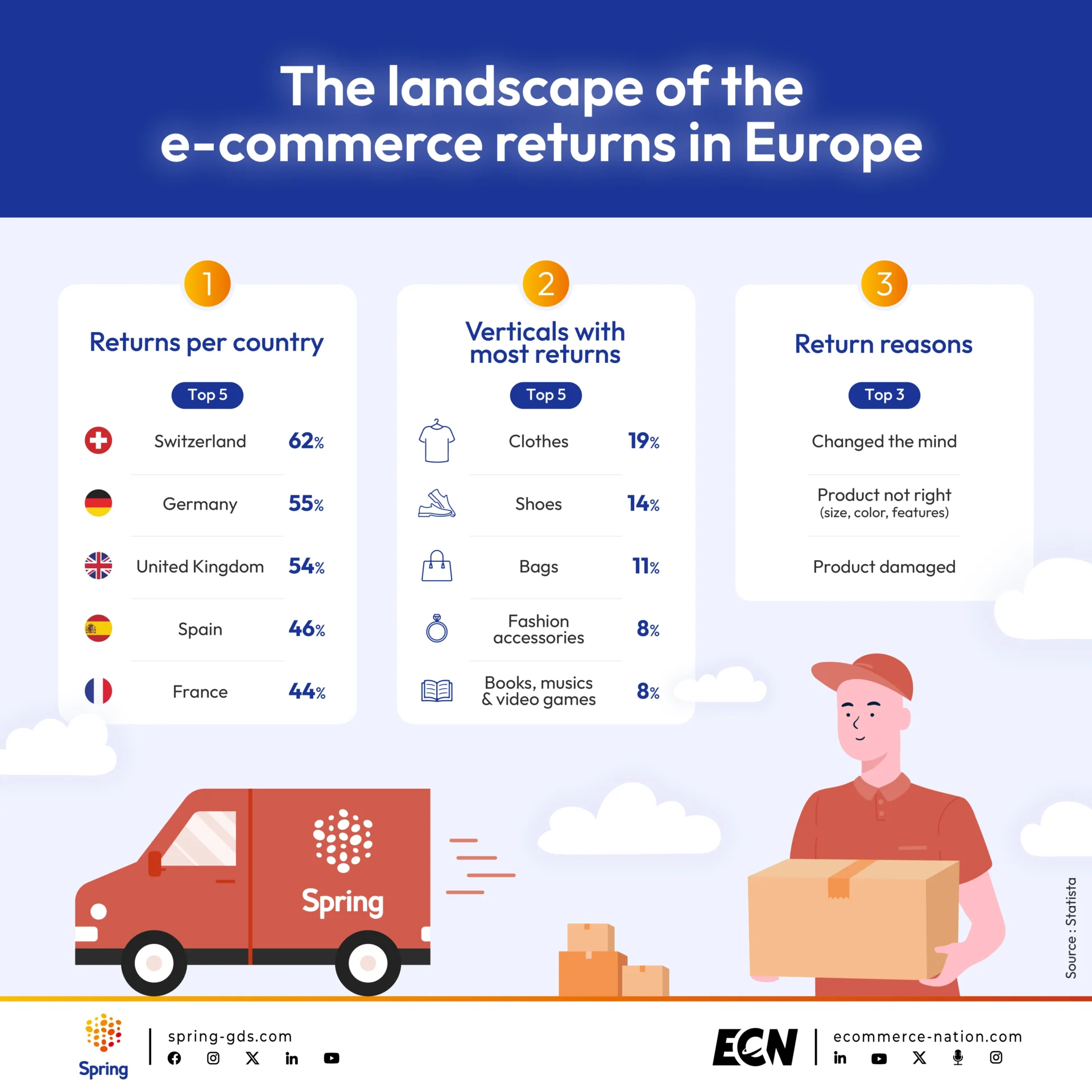
Data from recent industry studies, including insights from Statista, indicate that the average return rate in Europe fluctuates between 30% and 40%, though this figure masks significant outliers. Switzerland leads the region with a staggering 62% return rate per online buyer, followed closely by Germany (55%) and the United Kingdom (54%).
These figures are not merely vanity metrics; they represent a fundamental shift in shopping behavior. In these high-return markets, the act of returning is viewed by the consumer as a service entitlement rather than an inconvenience. This normalization of returns forces merchants to integrate reverse logistics directly into their core business model.
Sectoral Impact: Where Returns Hit Hardest
While all sectors face returns, the fashion and apparel industries remain the epicenter of the phenomenon. The inherent subjectivity of fit, style, and personal preference makes apparel highly susceptible to "bracketing"—the practice of ordering multiple sizes or colors with the premeditated intent to return most of them.
Conversely, the electronics and home goods sectors see lower, yet more complex, return rates (approximately 6%). While the volume is lower, the cost of processing these returns is often higher due to the need for technical inspections, refurbishing, and the risk of depreciation.
2. Chronology of a Return: The Lifecycle of a Package
To understand the logistical weight of returns, one must trace the lifecycle of a single returned item:
- The Trigger: The consumer initiates the return, often due to size mismatch, damaged goods, or the psychological phenomenon of "impulse remorse."
- The Logistical Handshake: The retailer provides a return label. If cross-border, this involves international shipping, customs documentation, and carrier coordination.
- The Reverse Transit: The package travels back through the logistics network, often accumulating carbon debt and handling costs.
- The Processing Stage: The warehouse receives the item. It must be inspected, cleaned, and re-inventoried. If the item is damaged or obsolete, it must be routed to liquidation, recycling, or disposal.
- The Financial Reconciliation: The retailer processes the refund, which, if delayed, triggers customer dissatisfaction, or if handled correctly, reinforces brand loyalty.
3. The Core Challenges: Logistical, Legal, and Financial
The management of these cycles presents a multifaceted challenge for European retailers.
Logistical and Regulatory Hurdles
Cross-border trade within the EU offers a single market, yet return logistics remain tethered to local regulations. Merchants must grapple with varying consumer protection laws regarding refund timelines and the responsibility for return shipping costs. Furthermore, non-EU borders (such as those involving the UK post-Brexit) introduce customs duties and VAT implications that can turn a simple return into a fiscal nightmare.
The Financial Squeeze
Profitability is under constant siege. The cost of a return involves more than just shipping; it includes the "hidden" labor of processing, the cost of repackaging, and the inevitable loss of value when a product is downgraded to "open-box" or "refurbished" status. For many low-margin items, the cost of the return process effectively wipes out the profit of the original sale.
The Ecological Conscience
Perhaps the most significant long-term challenge is the environmental impact. The "double-trip" of a product—to the consumer and back—contributes heavily to the carbon footprint of retail. Additionally, the proliferation of single-use plastic packaging and the tendency of some retailers to discard returned items to avoid the cost of restocking has drawn intense scrutiny from both regulators and eco-conscious consumers.
4. Industry Responses and Strategic Shifts
In response to these pressures, the industry has begun to pivot. We are witnessing a move away from the "free returns for all" model that dominated the 2010s.
The End of "Free" Returns
Major retailers across the UK and Germany have started to implement return fees. This is a strategic move to curb the practice of bracketing and to encourage more deliberate purchasing. Official industry discourse now emphasizes that free returns are not a right, but a premium service, and that shifting the cost—or a portion thereof—to the consumer is a necessary step toward long-term viability.
Technological Integration
Forward-thinking retailers are deploying AI-driven solutions to mitigate returns before they happen. This includes:
- Virtual Try-On Tech: Using augmented reality to help customers visualize fit and scale.
- Detailed Analytics: Mining return data to identify "serial offenders"—specific product lines or sizes that consistently underperform—allowing for corrections in product descriptions or sizing charts.
- Automated Reverse Logistics: Platforms that provide real-time tracking and instant automated refunds, which satisfy the customer’s desire for speed while keeping the warehouse team informed of incoming stock.
5. Implications for the Future: Toward a Sustainable Model
The future of e-commerce in Europe rests on the ability of merchants to transform the return process from a cost center into a competitive advantage.
Sustainability as a Differentiator
Companies that adopt "Green Returns" are finding favor with a younger, climate-conscious demographic. This involves offering "no-rush" return options (which allow for consolidated, lower-emission transport) and utilizing biodegradable packaging that the customer can reuse for the return journey.
The Data-Driven Retailer
The winners of the next decade will be those who view returns as a data goldmine. Every return is a signal. If a specific dress is returned 40% of the time, the data tells the merchant exactly where the failure is: Is the fabric quality poor? Is the size chart misleading? By closing the feedback loop between the warehouse and the product design team, merchants can reduce the root causes of returns, rather than just managing the symptoms.
Conclusion: A Strategic Balance
The European e-commerce market is maturing. The era of unchecked growth at the expense of operational efficiency is ending. To succeed, merchants must strike a delicate balance: providing a frictionless experience that builds trust, while simultaneously implementing policies that protect their bottom line and the planet.
Returns are not merely a failure of a sale; they are an opportunity to engage with the customer one last time. By optimizing the return journey through transparency, technology, and ecological responsibility, businesses can ensure that they remain relevant, profitable, and sustainable in an increasingly demanding marketplace. The goal is no longer to eliminate returns—which is impossible—but to manage them with such precision that they become a seamless part of a thriving, circular retail economy.