






For generations, the enchantment of Disney films—where clocks, candlesticks, and toys come to life as interactive companions—has been relegated to the realm of fairy tales. Yet, the boundary between the inanimate world and sentient, responsive tools is thinning. Engineers at the MIT Computer Science and Artificial Intelligence Laboratory (CSAIL) have developed a groundbreaking fabrication method that transforms static items into "self-aware" devices capable of perceiving, interpreting, and responding to human motion in real-time.
By leveraging advanced 3D-printing techniques and a novel software framework dubbed “X-Hinges,” researchers are ushering in a new era of “physical intelligence.” This technology promises to bridge the gap between digital AI agents and the physical world, allowing household objects to act as intuitive, adaptive interfaces.
The Core Innovation: Solving the Signal Interference Problem
The primary challenge in creating "smart" 3D-printed objects has historically been signal noise. In previous iterations of functional printing, engineers embedded conductive materials—acting as sensors and circuitry—directly into the plastic structure. However, because both the sensors and the "wires" (traces) were typically fabricated using identical conductive materials, the device struggled to distinguish between the two.
"It’s sort of like hearing two radio stations at the same time," explains Jiaji Li, an MIT electrical engineering and computer science (EECS) postdoc and senior author of the research. "It’s a mixup that’s hard to interpret."
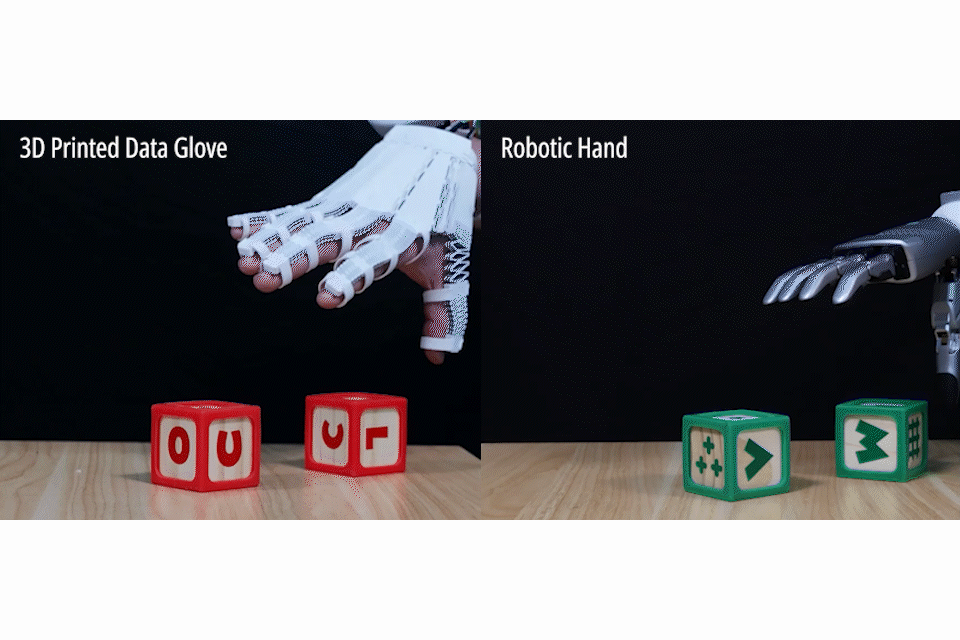
This confusion often rendered devices unreliable. For instance, a smart glove designed to relay finger-movement data to a robotic hand would often fail to filter out background "noise," leading to inaccurate angle readings and flawed execution by the robot. The X-Hinges system solves this by utilizing a sophisticated software interface that automatically embeds two distinct conductive materials during the printing process: one specifically optimized for sensing and another for low-interference transmission. This ensures that the data flow remains clean, accurate, and responsive.
Chronology of Development: From Tendons to Tactile Awareness
The journey toward X-Hinges is part of a larger, long-term research trajectory at CSAIL focused on "embodied intelligence."
- The Foundation: Under the guidance of MIT associate professor Stefanie Mueller, the team began exploring how to print mechanical systems that could mimic biological movement. Earlier work by Li included the development of 3D-printed tendon-driven mechanisms, which gave objects the ability to move through artificial muscles and ligaments.
- The Breakthrough: Realizing that movement without perception is limited, the team shifted their focus to sensing. In collaboration with researchers from Tianjin University (TJU), including lead author and PhD student Xiang Chang, the team worked to integrate sensing directly into the printing process rather than attaching sensors as an afterthought.
- Refining the Logic: Throughout 2023 and 2024, the team developed the X-Hinges software, which allows users to map multi-axis movement—up to three degrees of freedom (compressing, vertical, and lateral)—into a single design.
- The Future Vision: With the sensing layer now established, the team’s current roadmap involves merging these two capabilities. The ultimate goal is a "single-print" fabrication process where actuation (movement) and sensing (perception) are born simultaneously, effectively creating fully functional robotic components in one pass.
Supporting Data and Technical Capability
The versatility of the X-Hinges platform is perhaps its most compelling feature. Unlike traditional 3D-printed electronics, which are often rigid or limited to single-axis motion, X-Hinges enables complex, multi-directional interaction.
Multi-Axis Sensitivity
The software allows designers to select up to three "axes" of movement for any given part of an object. If a user is building a robotic hand, they can designate that the joints bend both vertically and laterally. The software then calculates exactly where to embed the sensors within those joints to capture data from all angles, ensuring that the final print understands the nuance of a user’s touch.
Calibration and Precision
The researchers identified a "calibration bottleneck" during testing: because the internal layout of electrical elements can vary slightly due to the 3D-printing process, two identical-looking devices might produce different sensor readings. To overcome this, Chang and Li integrated a computer vision system that recalibrates the output, ensuring that data is normalized across identical devices. While this currently requires an external software fix, the team is actively working on developing an autonomous, built-in signal recalibration mechanism.
Official Responses and Researcher Insights
The research team, which includes TJU graduate Haiyang Yan, emphasizes that this technology is about more than just convenience; it is about changing how humans relate to the physical environment.
"It’s kind of like adding a conscious element to everyday objects," says Jiaji Li. "In the same way an AI agent is programmed to make certain decisions based on our instructions, these creations have built-in sensing to adaptively react to human touch."
Xiang Chang, the lead author, notes that the ability to record data in multiple areas simultaneously is what sets X-Hinges apart from the state of the art. "Most methods only allow for one axis of motion, often due to signal interference. X-Hinges enables your 3D-printed item to move from three angles. Ultimately, you get a design with the intended movement you want," Chang explains.
The team’s paper, which will be presented at the ACM Symposium on User Interface Software and Technology this November, highlights several successful proofs-of-concept:
- The Adaptive Glove: A training tool that records the precise bending of human fingers and translates that data to a robotic hand, enabling rapid training for industrial or home-care robots.
- The Origami Lamp: A portable, paper-like light source that recognizes the pressure of a human pinch to adjust its brightness levels dynamically.
- Tactile Recognition Systems: An assembly platform capable of identifying objects placed on its surface—such as fruit or office supplies—by processing tactile data, providing a potential low-cost solution for automated logistics in grocery stores or airports.
Implications: A New Era for Human-Object Interaction
The implications of X-Hinges extend far beyond the laboratory, potentially disrupting industries ranging from healthcare to consumer electronics.
Embodied Intelligence
By moving intelligence into the objects themselves, we reduce the computational load on centralized servers. Instead of a camera needing to "see" a user’s hand to determine what a robot should do, the glove itself "feels" the movement. This "physical intelligence" allows for faster, more secure, and more intuitive interactions.
The Democratization of Custom Robotics
The user-friendly interface accompanying X-Hinges lowers the barrier to entry for custom hardware design. By offering templates (cylinders, rectangles, and custom outlines), the software allows non-experts to build interactive tools. The researchers demonstrated this by creating a video game controller shaped like a cartoon shark, proving that high-level functional robotics can be as accessible as designing a plastic toy.
Future Horizons
As the team looks toward the next phase of development—merging sensing and actuation into a single, seamless printing process—the vision of "living" objects becomes increasingly tangible. We are moving toward a future where our water bottles, furniture, and tools are not just static utilities, but active participants in our daily tasks.
This work, supported by the MIT-GIST Program and postdoctoral fellowships from Zhejiang University, stands as a testament to the power of interdisciplinary research. By combining materials science, mechanical engineering, and computer vision, the MIT CSAIL team is not just printing objects; they are printing the next generation of our physical world.
As the academic and industrial communities prepare for the upcoming presentation at the ACM Symposium, one thing is clear: the line between the "magical" objects of our childhood movies and the tangible technology of tomorrow has never been more blurred. The inanimate is beginning to wake up, and it is ready to work.