Beyond the Prompt: Inside HubSpot Blog’s High-Stakes Transition to an AI-First Writing Model
BOSTON — When the blog writing team at HubSpot made the definitive switch to an AI-first editorial model in June 2025, the reaction from leadership was a complicated mix of optimism and profound anxiety. On one hand, managers could clearly identify legacy bottlenecks in their production pipeline that artificial intelligence was uniquely positioned to solve. On the other hand, the human element—the foundational trust in creative ownership, team morale, and the core integrity of the writing craft—hung in the balance.
For industry watchers, the shift represents a critical case study. As content teams worldwide grapple with the temptation to flood search engines with automated output, HubSpot’s year-long experiment offers a sobering reality check: AI content at scale is effortless, but AI content worth reading is remarkably difficult.
Main Facts: The Reality of the AI-First Editorial Shift
The transition to an AI-first writing framework is rarely a simple "plug-and-play" efficiency win. According to internal tracking data from HubSpot’s blog management team, the integration of large language models (LLMs) like Claude, ChatGPT, and NotebookLM fundamentally altered how blog posts were constructed, researched, and verified.
While AI successfully accelerated the initial drafting phase, it did not necessarily reduce the total time required to ship a competitive, high-performing article. Instead, the time saved in drafting was systematically reabsorbed by more rigorous demands: deeper technical research, aggressive multi-step fact-checking to counteract AI "hallucinations," and heightened quality assurance (QA) protocols.
Key takeaways from the shift include:
The "Slop" Trap: Flooding the web with low-effort, automated volume leads to severe penalties in organic traffic, echoing findings by SEO experts who tracked catastrophic traffic losses across websites relying purely on unedited AI generation.
The Rise of Dedicated Fact-Checking: Due to fabricated statistics and outdated competitor data, fact-checking evolved from a minor final polish into a formal 30-to-60-minute standalone production phase.
The Immutable Importance of E-E-A-T: Google’s emphasis on Experience, Expertise, Authoritativeness, and Trustworthiness (E-E-A-T) meant that human insights, original quotes, and firsthand perspectives could not be outsourced to an algorithm.
Chronology: A Year of Experimentation and Course Correction
To understand how HubSpot navigated this transformation, it is necessary to examine the chronological progression of their editorial evolution from pre-AI traditions to a mature, hybridized workflow.
Pre-June 2025: The Era of Personal Craftsmanship
Before the adoption of an AI-first model, HubSpot’s editorial process was decentralized and deeply personal. Writers were hired for their creative abilities and trusted to manage their own workflows. A standard blog post typically consumed a full day (or more) of intensive labor, with the overwhelming majority of that time dedicated to drafting: structuring the narrative, finding the right words, and articulating complex ideas clearly. While editorial guidelines ensured consistency, writers retained full creative control over how they moved from a blank page to a finished piece.
June 2025: The Formative Rollout
In June 2025, the organization officially introduced AI-assisted writing tools. True to their management philosophy, leadership avoided overly rigid prescriptions. Writers were given access to platforms like Claude and ChatGPT alongside a wide berth of creative freedom to experiment. The core philosophy was simple: experimentation first, structural mandates later. Management assumed that faster drafting would immediately translate into higher publishing velocity and shorter production cycles.
Late Summer to Autumn 2025: The Bottleneck Realization
Within a few months, time-tracking data revealed a surprising paradox. While word counts hit the page faster, overall production velocity remained flat. Articles were growing longer, more detailed, and more demanding to produce. Writers spent the hours saved in drafting on software testing, sourcing expert reviews, and correcting deep research errors. Furthermore, the dual pressure of writing faster while writing more created a morale friction point that managers had to actively recalibrate.
Winter 2025 to Spring 2026: Process Refinement and Guardrails
Recognizing that AI could not police its own quality, the team instituted critical structural corrections. They developed custom QA checkers directly inside document editors to flag robotic phrasing, repetitive structures, and passive voice. Fact-checking was codified as a distinct mandatory layer to catch fabricated statistics and outdated software pricing models.
Supporting Data: The Metrics Behind the Shift
The intersection of artificial intelligence and digital marketing has generated a wealth of quantitative data regarding its efficacy and inherent risks. HubSpot’s internal tracking, paired with broader industry research from 2026, illustrates a complex performance landscape.
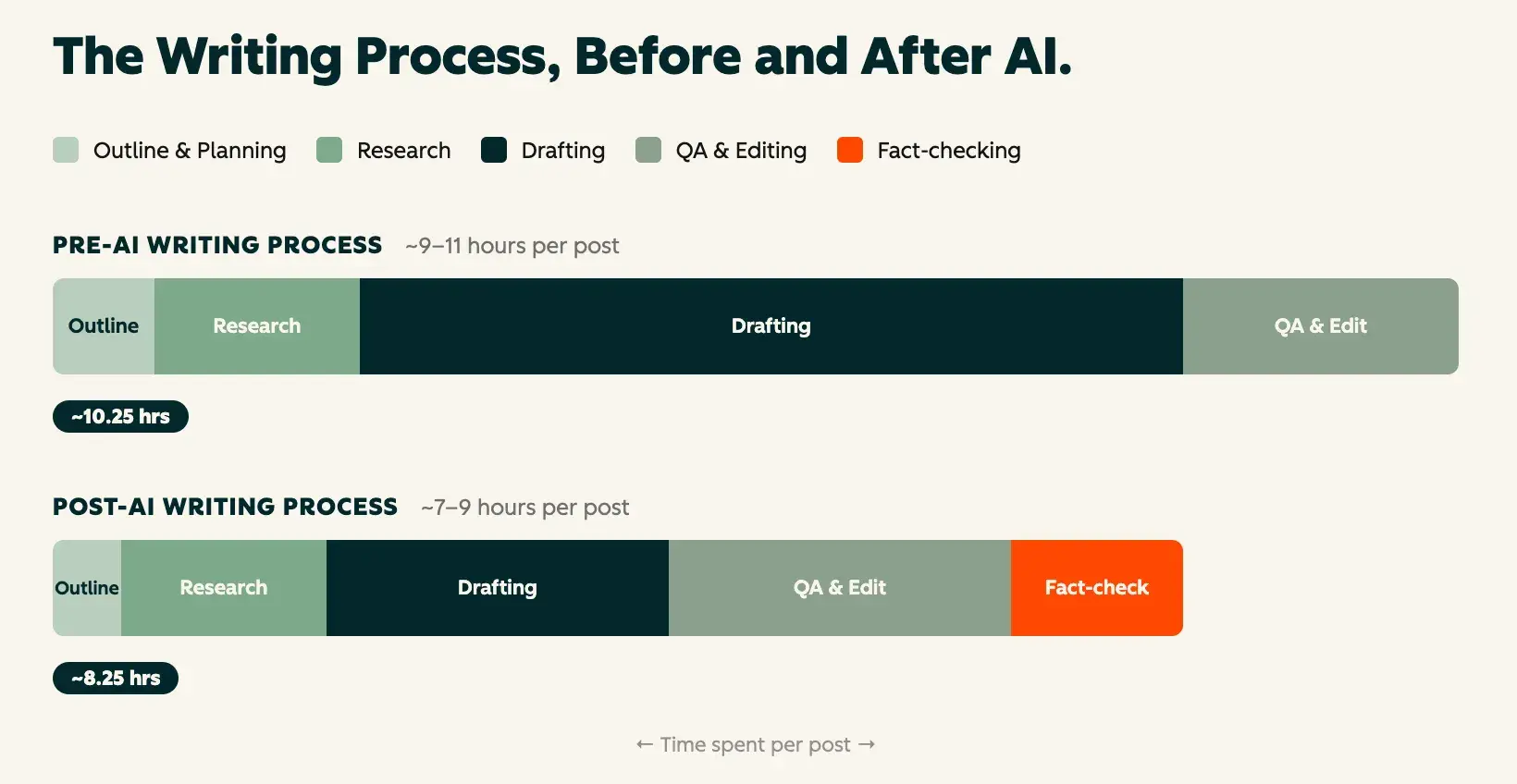
Pre-AI vs. Post-AI Time Allocation
While AI streamlined the raw writing process, it redistributed labor hours across other critical quality-control checkpoints:
Outline & Ideation: Slightly reduced due to rapid prompt-based brainstorming.
Drafting: Experienced the most noticeable reduction in hours, as LLMs rapidly generated structural blocks of text.
Research & Fact-Checking: Saw a dramatic increase in required time. Because LLMs lack real-time awareness of frequently changing variables (such as enterprise software pricing) and are prone to confident fabrications ("hallucinations"), human fact-checkers had to spend extensive time verifying foundational claims.
QA & Editorial Polish: Expanded to include checks for AI "tells"—generic phrasing, missing nuance, and a lack of original perspective.
The Macro View: The Danger of "AI Slop"
The temptation to prioritize volume over substance has yielded severe consequences across the digital publishing ecosystem.
The 2026 State of Marketing Report: According to HubSpot data, 52% of marketers believe that AI has made content so easy to create that it has paradoxically become less effective overall. Furthermore, 83% of marketers report feeling constant institutional pressure to produce more content simply because AI makes it technically possible.
The SEO Fallout: In 2026, prominent SEO analyst Lily Ray tracked over 220 websites that heavily utilized automated AI content generation platforms. Her findings revealed a recurring trajectory: a brief, aggressive surge in organic traffic followed by a steep, permanent decline. More than half of the audited sites lost at least 30% of their peak organic traffic, and nearly a quarter lost 75% or more, proving that search engine algorithms rapidly downgrade generic, low-effort "slop."
Official Responses and Industry Perspectives
Managing a creative team through a technological revolution requires acute emotional intelligence alongside structural engineering. Leaders within the content space have been vocal about the psychological and operational hurdles of this transition.
"The only truly effortless process produces slop."
— Karla Hesterberg, former Director of the HubSpot Blog
Hesterberg’s observation underscores a central truth of modern publishing: if a content workflow requires zero friction, zero struggle, and zero human intervention, the resulting product is almost universally devoid of the texture required to capture a reader’s attention.
Internal management reflections from HubSpot’s blog team highlight the dual burden placed on team leaders during the shift. Content managers suddenly found themselves split down the middle. On one technical front, they had to become master process architects, designing workflows, prompt engineering guidelines, and QA checkpoints. On the other human front, they had to navigate the emotional landscape of writers who felt their beloved craft was being undermined by automation.
Management identified two distinct profiles among creative writers during the AI transition:
Outcome-Oriented Writers: Professionals who viewed content marketing through the lens of business impact and audience reach. For this group, AI was embraced as a welcome accelerator that cleared away administrative friction.
Craft-Oriented Writers: Professionals who fell in love with writing for its own sake—the mechanics of phrasing, the rhythm of sentences, and the intimacy of individual expression. For these writers, an AI-first model frequently induced feelings of alienation, requiring empathetic leadership and explicit reassurance that human artistry remained indispensable.
Implications: What the AI Shift Means for the Future of Content
The lessons learned from HubSpot’s year-long integration of artificial intelligence provide a clear roadmap for organizations seeking to scale their content operations without sacrificing integrity.
1. Quality Standards Must Precede Tool Implementation
Organizations that fail usually adopt a "publish first, fix later" mentality, treating quality as an afterthought. Conversely, successful teams establish rigid definitions of excellence—voice, depth, accuracy, and original perspective—and then work backward to deploy AI strictly as an efficiency lever, not a creative replacement.
2. The Revaluation of the Human Writer
As generative tools democratize baseline writing competency, generic prose has become commoditized into near-worthlessness. Consequently, the value of a true writer has skyrocketed. Original reporting, firsthand interviews, unique industry data, and a distinct human point of view are no longer optional luxuries; they are the absolute baseline requirements for survival in search rankings and reader engagement.
3. A New Paradigm for People Management
Editorial management in the age of AI demands radical transparency. Leaders must create psychological safety, welcoming negative feedback from writers who push back against flawed AI workflows. Dismissing these concerns as resistance to change results in broken processes built on false assumptions.
Conclusion
Ultimately, the transformation of the HubSpot blog team proves that artificial intelligence is neither a silver bullet nor an existential death sentence for writers. It is a tool. By keeping human creators at the center of the editorial universe, holding the line on uncompromising quality standards, and refusing to settle for automated mediocrity, content teams can successfully navigate the AI era—producing work that not only ranks, but is genuinely worth reading.