








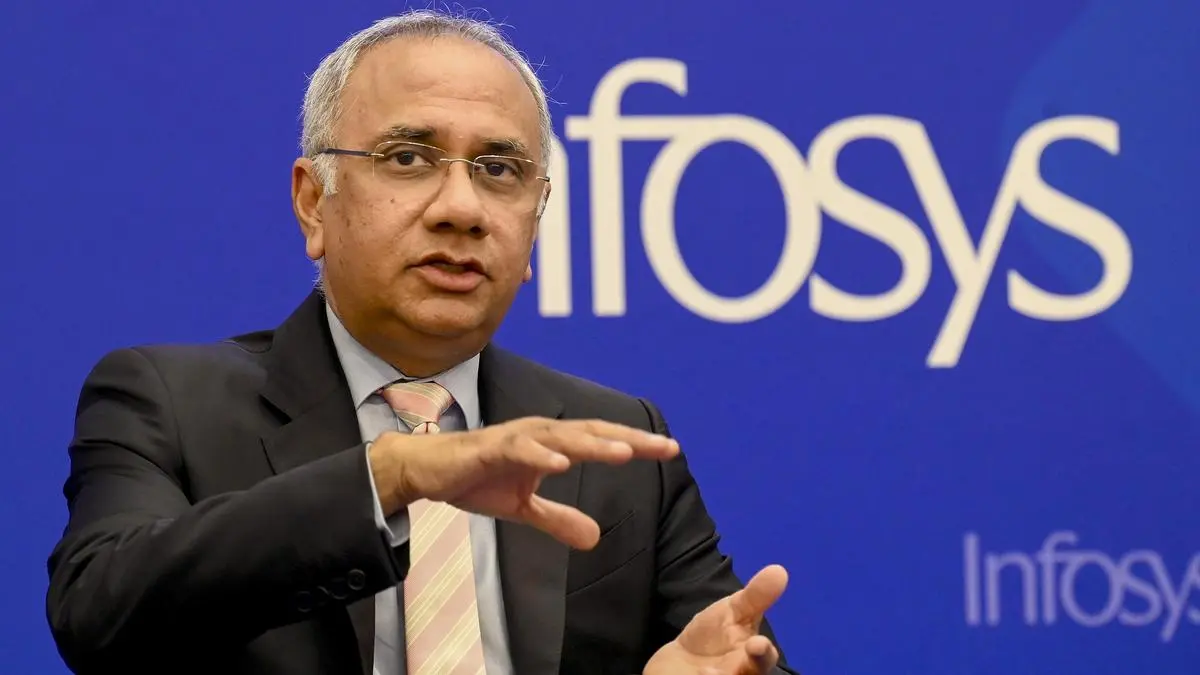
BENGALURU — Indian Information Technology (IT) bellwether Infosys has announced its financial results for the second quarter of fiscal year 2027 (Q2 FY27), showcasing a potent mix of robust large-deal momentum, rapid artificial intelligence (AI) adoption, and a steadily expanding workforce. However, the numbers also underline persistent macro headwinds and a complex industry-wide transition where a swelling order book does not immediately translate into accelerated top-line revenue growth.
During a press conference led by Chief Executive Officer Salil Parekh, the company reported total contract value (TCV) large deals amounting to $5.2 billion for the quarter—a significant leap from the $3.6 billion recorded in the previous quarter. Crucially, 62 per cent of this massive order book comprised net new business, highlighted by a single mega deal valued at over $2 billion.
Despite the stellar performance in deal acquisitions, the results have reignited conversations among industry analysts regarding the decoupling of deal volumes from rapid revenue recognition, the disruptive deflationary pressures of generative AI, and divergent regional and sectoral performances.
1. Main Facts: The Core Financial and Operational Metrics
The Q2 FY27 disclosures provide a comprehensive snapshot of Infosys’ current operational standing, balancing impressive deal-making figures with conservative growth projections.
- Large Deal TCV: Infosys secured $5.2 billion in large deals during the quarter, a sharp increase from Q1’s $3.6 billion.
- Net New Business: An overwhelming 62 per cent of the total large deal TCV represented net new business wins.
- The Mega Deal: The quarter’s figures were heavily anchored by a single mega deal valued in excess of $2 billion, which leadership notes will bolster growth well into the next financial year.
- Workforce Expansion: Total headcount climbed to 3,32,542, up from 3,28,062 in the preceding quarter, marking a net addition of roughly 4,000 employees.
- Attrition Rates: Employee attrition remained stable and healthy at 12 per cent.
- Fresher Hiring: The company onboarded 8,000 college graduates during the quarter, moving past the halfway mark of its stated full-year target of approximately 20,000 graduate hires for FY27.
- AI Revenue Milestones: AI-driven revenue experienced explosive growth, surging 29 per cent over a three-month period and now accounting for more than 10 per cent of the company’s overall business.
2. Chronology: How the Quarter Unfolded
The trajectory of Infosys’ Q2 performance reflects a deliberate, multi-year strategy pivoting toward deep enterprise automation, platform-led delivery, and aggressive capture of market share through cost-optimization mandates.
Early Q2: Pipeline Acceleration and Mega Deal Pursuit
As the quarter commenced in mid-2026, Infosys’ sales and delivery teams focused intensely on closing elongated enterprise sales cycles. Global enterprises, grappling with economic uncertainties and elevated interest rate environments, continued to prioritize cost-out initiatives, vendor consolidation, and efficiency programs over discretionary tech spending. This enterprise appetite for vendor rationalization created an ideal environment for tier-1 players like Infosys to capture large, multi-year outsourcing mandates.
Mid-Quarter: The $2 Billion Breakthrough
Midway through Q2, Infosys successfully finalized negotiations on a landmark mega deal exceeding $2 billion in total contract value. This contract—spanning digital transformation, cloud migration, and advanced AI integration—not only anchored the company’s Q2 TCV performance but also provided management with visible revenue predictability stretching deep into FY28.
Late Q2 and Results Day (October 23, 2026)
As the quarter concluded, the internal metrics were compiled, revealing a net headcount addition of 4,000 and an acceleration in fresher onboarding to meet future delivery demands. On October 23, 2026, CEO Salil Parekh formally unveiled the financial and operational results to the press, highlighting the resilience of the company’s operating margins and the systematic embedding of AI across all service lines via ecosystems such as Infosys Topaz.
3. Supporting Data: Sectoral Divergence and Geographic Shifts
A granular analysis of Infosys’ Q2 FY27 performance reveals a stark bifurcation across global markets and industry verticals. While certain sectors experienced robust expansion, others faced contraction, reflecting distinct macroeconomic pressures.
Vertical Performance
- Growth Segments:
- Life Sciences
- Energy, Utilities, Resources & Services
- Communication
- Financial Services (showing signs of sustained recovery and stabilization in discretionary spending)
- Declining Segments:
- Manufacturing
- Retail
- Hi-Tech
- Other miscellaneous segments (impacted by cautious enterprise budgets and localized supply chain realignments)
Geographic Performance
- Growth Regions:
- Europe (benefiting from complex regulatory-driven transformations and localized IT modernization)
- Rest of the World (RoW)
- Declining Regions:
- North America (traditionally the largest revenue contributor, experiencing cautious spending behavior and prolonged budget sign-offs)
- India (witnessing episodic domestic volatility)
4. Official Responses and Industry Commentary
The release of the Q2 numbers drew immediate, insightful commentary from corporate leadership and independent industry analysts who dissected the underlying mechanics of modern IT services delivery.
Leadership Perspective
Addressing the media during the earnings announcement, CEO Salil Parekh emphasized the long-term strategic value of the company’s recent wins.
"We saw very strong large deals, with one mega deal at over $2 billion, which is contributing to our growth into the next financial year also," Parekh stated.
He further underscored that Infosys is not treating AI as an isolated service offering, but is instead weaving it comprehensively into application modernization, engineering, workplace services, and core business operations.
Expert Analysis: The Deal-to-Revenue Disconnect
Praveen Bhadada, CEO & Managing Director of Neovay Global, pointed out a critical structural paradox facing the modern IT sector:

"Infosys’ AI revenue grew 29 per cent in three months and is now more than a tenth of the business. Yet, it expects to grow only 1–2 per cent this year. That gap shows the industry’s biggest challenge right now: turning deal wins and AI demand into revenue growth," Bhadada observed.
He elaborated that contemporary large deals are primarily designed to slash client operating costs, consolidate vendor ecosystems, and utilize AI to execute identical workloads with diminished human capital.
"They make revenue more secure, but they start slowly, and clients expect a share of the savings. A big order book no longer turns into revenue as fast as it used to," Bhadada added. He noted that while operating margins remain resilient, firms are increasingly leveraging productivity and automation tools rather than aggressively hiring ahead of demand.
The Ecosystem Strategy
Weighing in on Infosys’ technological positioning, Biswajit Maity, Senior Principal Analyst at Gartner, praised the company’s platform-driven approach.
"Infosys is moving beyond standalone AI initiatives and embedding AI across its services portfolio… Continued investments in the Topaz ecosystem, AI platforms, and reusable AI assets demonstrate a clear strategy to make AI a core part of service delivery," Maity noted.
He highlighted that by synthesizing proprietary, open-source, and partner technologies, Infosys is pioneering a software-enabled delivery model.
"The company’s growing focus on AI agents, automation, and productivity-led transformation suggests it is positioning itself to help clients scale AI adoption and achieve measurable business outcomes while strengthening its role as a long-term transformation partner," Maity concluded.
5. Implications: What Lies Ahead for Infosys and the Broader IT Industry
The Q2 FY27 earnings report from Infosys serves as a bellwether for the broader global IT services sector, carrying several profound implications for the future of tech consulting and software engineering.
1. The Compression of Traditional Billable Hours
As generative AI, autonomous AI agents, and advanced automation frameworks mature, the traditional "linear relationship" between headcount growth and revenue generation is fundamentally breaking down. When a company can execute complex application modernization or business process outsourcing with significantly fewer full-time equivalents (FTEs), top-line growth can decouple from a swelling order book. IT firms must successfully transition from billing based on time-and-materials to outcome-based, value-priced pricing models.
2. The Slow-Burn Nature of Cost-Optimization Deals
Mega deals valued at over $2 billion—while providing tremendous revenue backlog and long-term stability—frequently involve complex carve-outs, asset transfers, and multi-phased transitions. Consequently, the initial quarters following a deal win often witness intensive, low-margin transition and transformation work before high-margin steady-state operations kick in. This structural reality explains why a massive $5.2 billion TCV quarter coexists with modest single-digit annual revenue growth projections.
3. Talent Strategy and Fresher Onboarding
Infosys’ disciplined approach to talent acquisition—adding 4,000 net employees and absorbing 8,000 college graduates in Q2 while remaining on track for its 20,000 fresher target—indicates a calculated long-term bet. Rather than engaging in aggressive, panic-driven lateral hiring to meet immediate spikes in demand, the company is systematically building a native cadre of digital and AI-fluent engineers. Maintaining a stable 12 per cent attrition rate further points to improved employee engagement and normalization in the post-pandemic labor market.
4. Strategic Imperatives for the Future
Over the next few quarters, the definitive test for Infosys leadership will not merely be its ability to land billion-dollar contracts, but rather:
- Velocity of Conversion: How quickly newly acquired large deals can be transitioned into active revenue-generating streams.
- Cannibalization Management: Ensuring that high-margin, emerging AI and automation practices scale rapidly enough to offset the structural deflationary pressures eating into legacy application maintenance and traditional infrastructure management.
- Sectoral Rebound: Navigating the persistent softness in North American discretionary budgets while leveraging structural strengths in European markets and resilient verticals like Financial Services and Life Sciences.
As enterprises worldwide enter the next phase of digital maturity—moving from experimental generative AI pilots to enterprise-wide, agentic AI integration—Infosys’ strategic investments in platforms like Topaz position it defensively and offensively for the road ahead. However, bridging the gap between an unprecedented order book and tangible top-line acceleration remains the defining operational challenge for the IT giant in the second half of FY27 and beyond.