



LONDON — Every single day, consumers turn to Google to articulate their needs, troubleshoot problems, and evaluate solutions in their own words. Across the globe, these inquiries accumulate into staggering volumes—exceeding five trillion searches annually on Google alone. On their own, individual search queries offer merely a fragmented snapshot of consumer behavior. However, when aggregated over time, these patterns unveil a goldmine of commercial intelligence: the exact vocabulary your target audience uses, the precise pain points they are trying to resolve, the sources they trust, and, most crucially, the underlying intent steering their digital journeys.
Despite this reality, corporate marketing departments have historically approached search engine marketing through a fractured lens. Organizations routinely ask themselves a divisive question: "Should we invest more in SEO (Search Engine Optimization) or PPC (Pay-Per-Click)?"
According to industry leaders and recent digital transformation case studies, framing the debate as an either/or proposition is fundamentally flawed. Businesses rarely achieve sustainable growth by optimizing organic and paid search in isolation. Instead, modern market dominance is achieved by recognizing what search engines have already revealed about consumer intent, and then leveraging that intelligence to drive unified, high-impact commercial decisions.
Main Facts: The Convergence of Organic and Paid Search
The core thesis reshaping modern digital marketing strategy is simple yet transformative: Organic search is a continuous, organic focus group.
If a business has invested in organic search for any meaningful duration, its website is likely already answering complex questions that a paid search campaign would otherwise have to decode from scratch. Every time a web page secures strong organic visibility, it serves as an empirical signal. It tells the enterprise that search engines recognize the content as a valuable, authoritative resource capable of satisfying user intent.
- The Problem of Siloed Budgets: In many mid-sized to enterprise-level organizations, SEO and PPC are planned, measured, and reported by entirely different teams—or even outsourced to separate agencies.
- The Shared Objective: Despite structural separation, both channels share the exact same ultimate mission: connecting the right customer with the right message at the precise moment of need.
- The Paradigm Shift: Rather than evaluating marketing investments through the narrow prism of channel-specific metrics, progressive brands are shifting toward an outcomes-based framework. The fundamental question is no longer "SEO or PPC?" but rather, "What is search already telling us about our customers, and how can we monetize those insights?"
Chronology of Evolution: From Guesswork to Evidence-Based Strategy
The evolution of search marketing has transitioned through distinct developmental phases over the past two decades, moving from rudimentary keyword stuffing to sophisticated behavioral analysis.
Phase 1: The Era of Channel Isolation (Early 2000s – 2010s)
In the early days of commercial search engines, SEO and PPC operated in separate universes. SEO practitioners focused on technical site health, link building, and keyword density. Meanwhile, PPC managers focused on bidding strategies, quality scores, and immediate direct-response conversions. Collaboration between the two disciplines was rare, leading to duplicated efforts, conflicting messaging, and wasted budgets.

Phase 2: The Rise of Data-Driven Silos (2010s – 2020s)
As analytics platforms matured, both channels became more sophisticated. However, organizational silos persisted. Paid search teams relied heavily on internal assumptions, intuition, and competitive bidding tools to test ad copy. Concurrently, organic teams chased algorithm updates, often keeping their findings locked within content marketing reports rather than sharing them with paid acquisition teams.
Phase 3: The Integrated Search Growth Loop (Present Day)
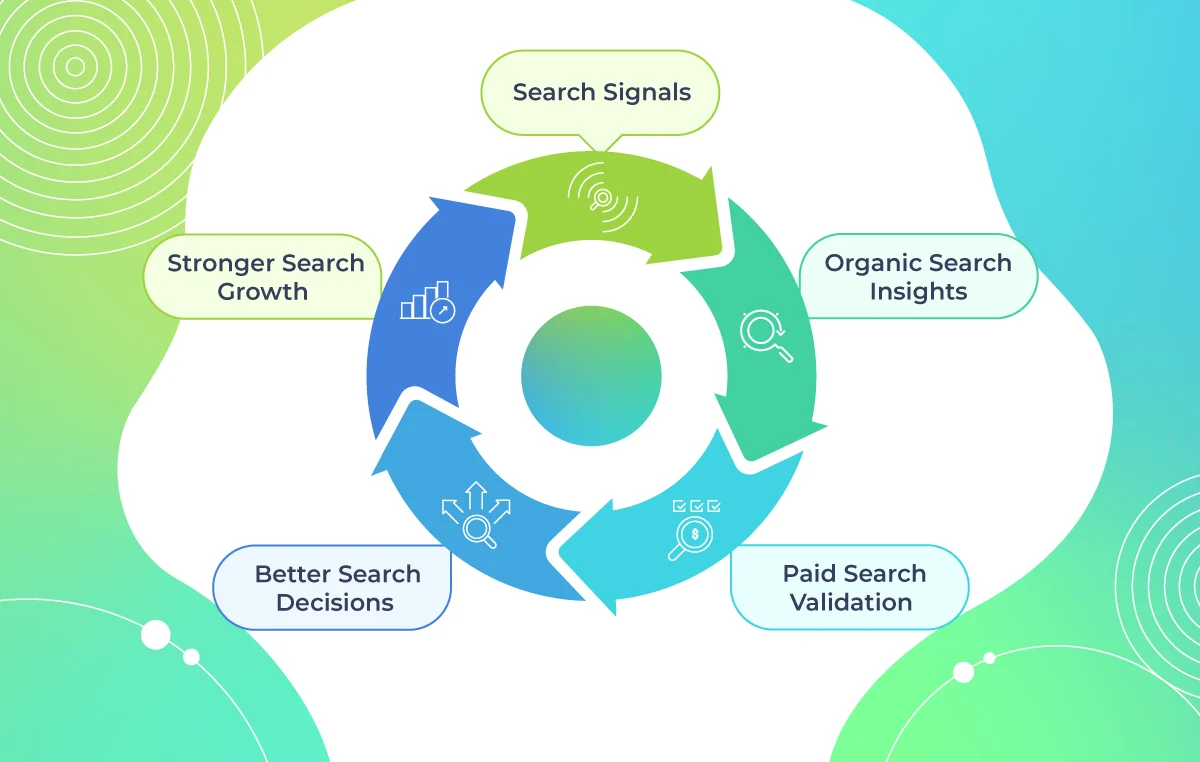
Today, forward-thinking brands are dismantling these internal barriers. Recognizing that roughly 15% of the searches Google processes every day are entirely brand-new—meaning consumer language and priorities are in a perpetual state of flux—marketers are realizing that SEO and PPC must feed into one another. By using organic data to validate demand before deploying paid budgets, and using paid campaigns to rapidly test messaging hypotheses, brands are building unified search strategies that compound in value over time.
Supporting Data and Practical Insights
To understand how organic insights translate into paid search optimization, industry practitioners look to four foundational pillars: validating demand, decoding consumer language, mapping commercial intent, and identifying high-value paid opportunities.
+--------------------------------------------------------------------------+
|                         THE SEARCH GROWTH LOOP                           |
|                                                                          |
|    [ Organic Search ] -------- Uncovers Intent & Language --------->     |
|           ^                                                    |         |
|           |                                                    v         |
|    Informs Future Strategy <---- Tests via Paid Campaigns --- [ PPC ]     |
+--------------------------------------------------------------------------+
1. Validating Search Demand
When a specific web page consistently performs well organically, it signifies much more than a simple ranking victory. It proves that a live, active market exists for that topic, product, or service.
- The Advantage: Instead of gambling paid ad spend on speculative keywords or relying purely on competitor emulation, brands can use organic performance as empirical proof of demand. This allows PPC budgets to be deployed with institutional confidence.
2. Revealing Real Customer Language
Internal product and engineering teams naturally describe offerings using corporate nomenclature or technical jargon. Customers, however, use colloquial, problem-oriented language.
- The Insight: While PPC copy is frequently used to test ad variations for SEO keyword targeting, the inverse is equally powerful. Organic search data constantly uncovers the unvarnished vernacular of the consumer base, ensuring paid ad copy reflects authentic search behavior.
3. Mapping Commercial Intent
Not all searches hold equal financial weight. For instance, an exploratory query like "What is search engine marketing?" carries vastly different intent and commercial value than a transactional query like "search engine marketing agency."
- The Application: Analyzing organic traffic trajectories reveals how user intent evolves across the buyer’s journey. This insight enables paid search teams to target users earlier in the funnel, expanding beyond traditional direct-response paradigms to capture high-value prospects before competitors do.
4. Identifying Where Paid Creates Maximum Value
Businesses often grapple with resource allocation. Organic rankings take time to build, whereas paid search yields immediate visibility.

- The Intersection: If competitors dominate paid search results for a brand’s most lucrative terms, or if consumer demand experiences sharp seasonal spikes, paid search acts as a powerful accelerant. Paid budgets are most effective when deployed to capture demand that organic search has already helped identify and validate.
Official Responses and Industry Case Studies
The real-world efficacy of this integrated approach is best illustrated through corporate transformations. A prominent case study highlighting this methodology involves Bridewell, a specialized cybersecurity firm that previously managed its organic and paid search strategies through entirely separate external partners.
The Bridewell Transformation
For years, Bridewell maintained robust investments in both SEO and PPC. While the business accumulated profound insights into customer demand through its organic search performance, virtually none of that intelligence was being funneled into its paid search operations.
When an integrated search strategy was introduced, the initial pivot was not tactical—it was structural:
- Breaking the Silos: The agency stopped treating SEO and PPC as independent workstreams. Instead, organic performance data was systematically used to validate demand pools, which in turn guided paid search messaging and commercial intent targeting.
- Rapid Results: The impact on the business was profound. By eliminating guesswork and aligning paid campaigns with pre-validated organic insights, Bridewell achieved its ambitious annual commercial targets within the first six months of deploying the new unified strategy.
- Continuous Optimization: Moving forward, new market opportunities were identified significantly faster, ad copy and landing page content evolved dynamically alongside shifting consumer behaviors, and every digital update contributed to smarter subsequent decisions.
Commercial Implications and the Future
For enterprises and mid-market companies alike, the implications of breaking down search silos are profound. The traditional debate of "SEO versus PPC" is officially obsolete.
By embracing what industry experts term The Search Growth Loop, organizations transform every click, every campaign, and every customer interaction into an actionable learning opportunity.
- Compounding Returns: As organic and paid search continuously inform one another, marketing expenditures become increasingly efficient. Wasteful ad spend decreases, conversion rates rise, and cost-per-acquisition (CPA) metrics improve.
- Organizational Agility: Teams equipped with unified search intelligence can adapt to sudden shifts in market demand or algorithm adjustments much faster than competitors trapped in departmental silos.
- Sustainable Growth: Ultimately, better search decisions naturally lead to better commercial decisions. By listening closely to what customers are already typing into Google, businesses lay the groundwork for resilient, long-term market leadership.