




SEATTLE — In a major technical leap for enterprise data architectures, Amazon Web Services (AWS) has announced a powerful new capability for Amazon Aurora PostgreSQL. The service now enables direct, zero-ETL querying of operational data alongside massive analytical datasets stored in data lakes—specifically within Apache Iceberg and Apache Parquet formats.
Powered by the embedded query engine efficiency of DuckDB—following the recent integration of the DuckLabs team into Amazon—this new feature allows developers and database administrators to query live operational tables and archived S3 data using standard, familiar PostgreSQL syntax. By eradicating the need to build, manage, and scale complex reverse-ETL pipelines, AWS is drastically reducing infrastructure costs, latency, and operational overhead for modern applications, real-time analytics, and AI agents.
Main Facts
The newly released capability fundamentally changes how applications interact with split data silos. Traditionally, enterprise data lived in two distinct worlds: high-performance operational databases (like Aurora) designed for low-latency transactional workloads, and sprawling data lakes (like Amazon S3 and the AWS Glue Data Catalog) optimized for historical analytics. Bridging this gap historically required building brittle, expensive data pipelines that duplicated petabytes of data.
With this release:
- Zero-ETL Integration: Users can execute a single SQL query that seamlessly joins live operational data (including uncommitted writes) inside Aurora PostgreSQL with historical records stored as Parquet or Apache Iceberg tables on Amazon S3 and S3 Tables.
- DuckDB Under the Hood: The efficiency of DuckDB is embedded directly inside Aurora PostgreSQL. DuckDB handles heavy analytical scans under the hood while Aurora manages operational tables, all within a single process space—eliminating additional network hops.
- Iceberg REST Catalog (IRC) Federation: Through AWS Glue Data Catalog federation, organizations can query external Iceberg tables managed by IRC-compatible catalogs without moving or duplicating data.
- Smart Optimizations: Aurora applies automated optimizations, such as predicate pushdown and column pruning, ensuring that only relevant data blocks are read from S3. Frequently accessed data is cached locally within the Aurora instance to accelerate subsequent queries.
- Availability and Cost: The capability is available today across all commercial AWS Regions and AWS GovCloud (US) Regions for Aurora PostgreSQL Major Version 17 (starting with 17.11) and Version 18 (starting with 18.6). There is no additional software charge from AWS; customers pay only for the incremental Aurora compute consumed by queries and standard Amazon S3 request and storage costs.
Chronology: The Journey to Zero-ETL Unified Queries
To understand the weight of this announcement, it helps to examine the evolution of cloud data architecture and the strategic moves made by AWS leading up to this release.
The Era of Siloed Storage (Pre-2010s to Mid-2010s)
For decades, relational database management systems (RDBMS) handled live transactional data, while data warehouses and early data lakes stored archival information. Applications requiring a holistic view of a customer—such as combining a user’s active shopping cart with five years of past purchases—were forced to write custom scripts or batch jobs to copy data nightly from operational databases into analytical repositories.
The Rise of Reverse-ETL and Data Duplication (Late 2010s to Early 2020s)
As cloud adoption matured, data lakes built on Amazon S3 became the standard for storing massive quantities of low-cost, structured, and semi-structured formats like Apache Parquet. However, application developers building modern dashboards or looking to enrich real-time transactions found themselves stuck. To feed historical context back into operational apps, engineers built "reverse-ETL" pipelines. These pipelines created rampant data duplication, bloated storage budgets, and introduced synchronization lags.

The AI Imperative (2023–Present)
The rapid acceleration of Generative AI and autonomous AI agents broke traditional architectural paradigms completely. AI agents frequently need to reason over both live operational states and vast archives of historical records simultaneously. Because it is impossible to predict or pre-replicate every dataset an AI agent might query on the fly, traditional pre-computed ETL pipelines became unviable.
Recognizing this bottleneck, AWS strategically acquired key talent from DuckLabs, the engineering team behind the high-performance analytical database engine DuckDB. By embedding DuckDB directly into Aurora PostgreSQL, AWS has bridged the operational-analytical divide, culminating in today’s launch.
Supporting Data and Technical Architecture
The technical implementation of the aurora_analytics extension is engineered for performance, simplicity, and low operational friction.
Step-by-Step Implementation
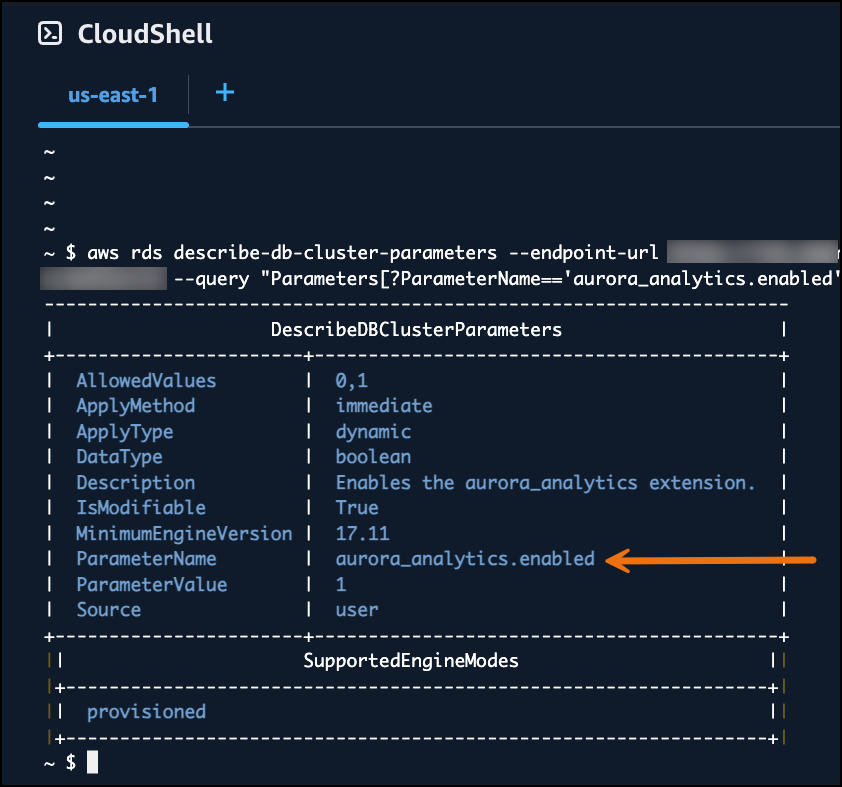
Enabling the feature requires minimal configuration:
- Cluster Setup: Provision or upgrade an Aurora PostgreSQL cluster to version 17.11+ or 18.6+.
- IAM Permissions: Attach an IAM role granting Aurora read access to Amazon S3 and the AWS Glue Data Catalog, tagged with the
AuroraAnalyticsfeature. - Extension Activation: Connect via any standard PostgreSQL client (such as
psql) and run:CREATE EXTENSION aurora_analytics; - Foreign Tables & Schema Inference: Instead of manually defining column structures, developers can point directly to data lake files. For instance:
CREATE FOREIGN TABLE transaction_history ()
SERVER aurora_analytics_server
OPTIONS (
   location 's3://<my-bucket>/finance/transaction_history.parquet',
   format 'parquet'
);
Note: The empty parentheses allow Aurora to automatically infer the schema from the Parquet file metadata. For large enterprise data lakes, administrators can bypass single-table creation using an
IMPORT FOREIGN SCHEMAcommand to bulk-import entire Glue Data Catalog databases instantly.
Query Execution in Practice
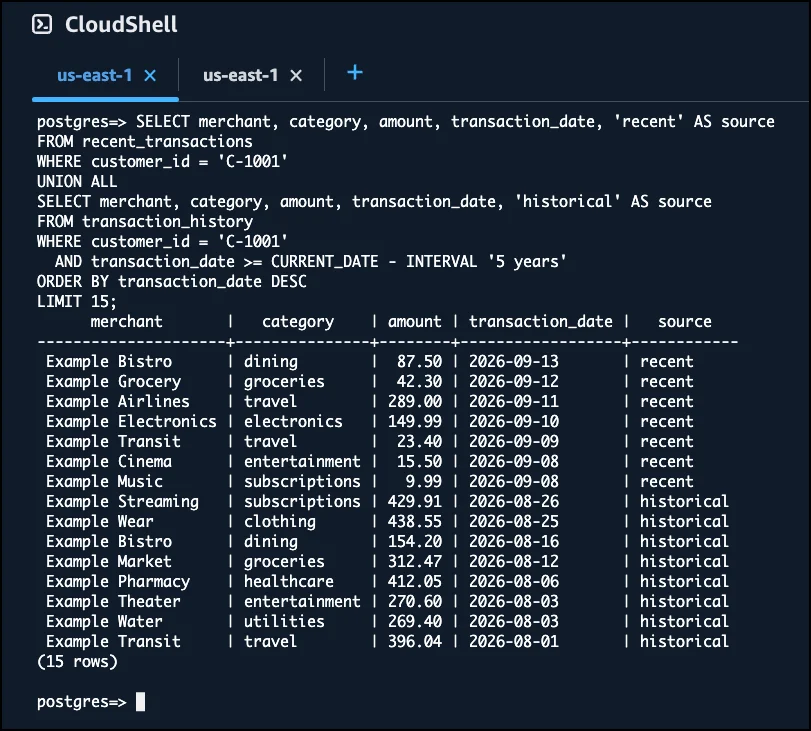
Consider a financial fraud or customer insights query combining recent transactions (stored in an active Aurora table called recent_transactions) with five years of historical logs (stored in S3 as Parquet):
SELECT merchant, category, amount, transaction_date, 'recent' AS source
FROM recent_transactions
WHERE customer_id = 'C-1001'
UNION ALL
SELECT merchant, category, amount, transaction_date, 'historical' AS source
FROM transaction_history
WHERE customer_id = 'C-1001'
  AND transaction_date >= CURRENT_DATE - INTERVAL '5 years'
ORDER BY transaction_date DESC
LIMIT 15;
In this unified query, DuckDB processes the heavy analytical scan of the historical Parquet files on S3, while Aurora manages the live operational table lookup. The results are merged smoothly into a single client response without moving data out of the data lake.

Monitoring and Materialization
Administrators can audit query performance and caching behavior using the built-in diagnostic function aurora_analytics_stat_statements(), which tracks metrics such as:
- Rows scanned
- Bytes read from Amazon S3
- Cache hit ratios
For applications requiring ultra-low, single-digit-millisecond latency on historical data, developers can easily materialize data lake subsets directly into native Aurora tables using standard SQL commands like CREATE TABLE AS SELECT or MERGE INTO, offloading analytical workloads to read replicas without disturbing primary writer nodes.
Official Responses and Industry Context
While AWS has positioned this launch as a natural evolution of its managed database portfolio, industry analysts view it as a direct shot across the bow of modern data-mesh and data-fabric competitors who have long promised unified data access without heavy data movement.
"Whether you’re powering real-time dashboards, enriching transactions with historical context, or building AI agents that reason over both live and archived data, you can now do it all through a single, familiar interface," noted AWS engineering representatives in the official documentation.
By integrating DuckDB into a premier operational engine like Aurora PostgreSQL, AWS is acknowledging a fundamental shift in developer expectations. Engineers no longer want to manage separate silos, ETL schedulers, and transformation tools just to get a holistic view of business data. By leveraging open standards like Apache Iceberg, Apache Parquet, and the AWS Glue Data Catalog, AWS is ensuring that customers retain full ownership of their storage formats while unlocking unprecedented query flexibility.
Implications for the Enterprise
The introduction of direct data lake querying inside Amazon Aurora PostgreSQL carries profound implications for multiple stakeholders across the enterprise technology landscape:
1. Drastic Reduction in Engineering Overhead
Data engineering teams spend an immense amount of time maintaining data pipelines, debugging broken ETL jobs, and managing schema drift across storage layers. By removing the dependency on reverse-ETL, organizations can reallocate engineering hours away from pipeline maintenance toward core product feature development.
2. Accelerated AI and Agentic Workflows
As enterprises race to deploy autonomous AI agents capable of executing complex business logic, data availability becomes the ultimate bottleneck. Agents constrained only to operational databases miss out on historical trends, while agents querying raw data lakes are too slow for real-time interactions. Aurora’s ability to query live operational states alongside S3 data lakes in a single sub-second query provides the ideal runtime environment for next-generation AI systems.
3. Cost Optimization
Storing petabytes of historical data in relational databases is prohibitively expensive. By keeping cold data cost-effectively stored in Amazon S3—and only pulling relevant blocks via predicate pushdown and local caching when queried—enterprises can drastically trim their cloud compute and storage budgets.
4. Zero Migration Friction
Because the capability is accessed entirely through standard PostgreSQL drivers, syntax, and extensions, development teams require zero retraining. Existing applications, microservices, and Business Intelligence (BI) tools can immediately begin querying data lake assets without rewriting database access layers.
Conclusion
With the integration of DuckDB technology into Amazon Aurora PostgreSQL, AWS has bridged the historic chasm between operational transaction processing and analytical data lakes. By enabling seamless, zero-ETL queries across live operational tables, Apache Iceberg, and Parquet data on Amazon S3, AWS is setting a new benchmark for database agility. Available today at no extra software cost across all commercial and GovCloud regions, this feature empowers developers, data architects, and AI builders to achieve unified data visibility with unprecedented simplicity and speed.