




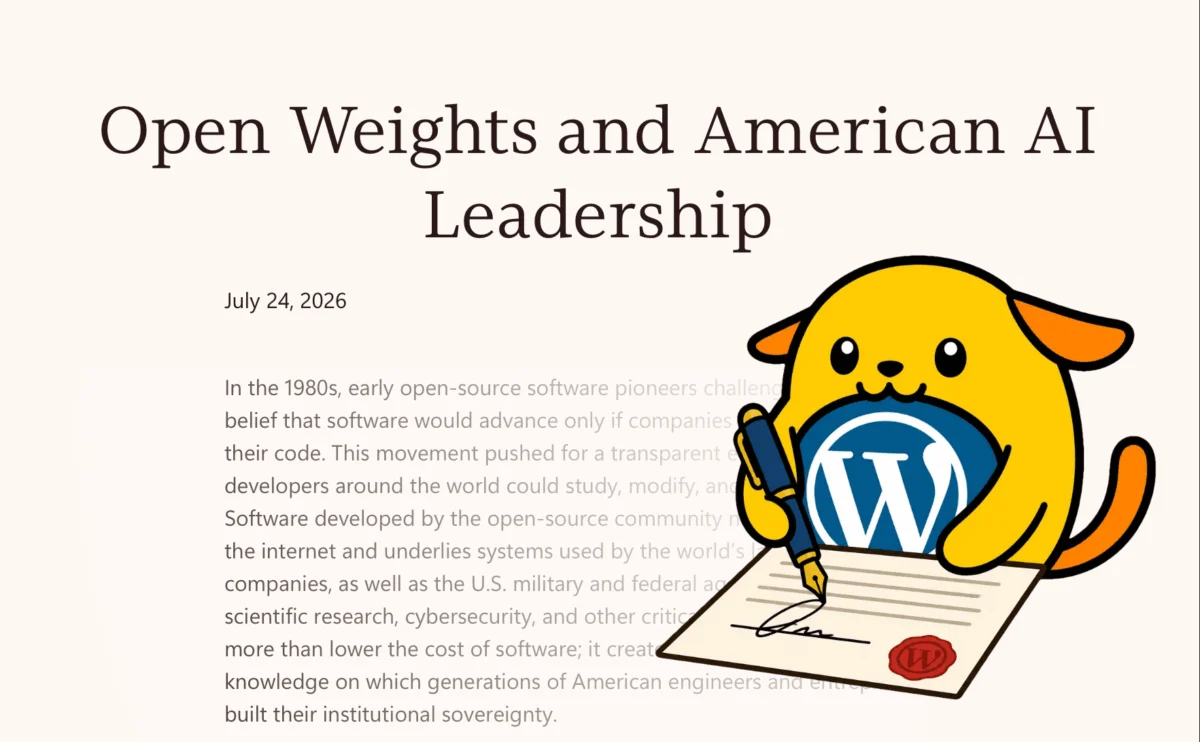
WASHINGTON — In a significant move highlighting the tech sector’s growing division over the future of artificial intelligence governance, WordPress has officially endorsed the "Open Weights and American AI Leadership" open letter. Announced globally, the initiative brings together over 270 companies, academic institutions, and organizations advocating for regulatory restraint from United States policymakers regarding open weight artificial intelligence systems.
The letter, which went public on July 24, 2026, calls on the federal government to reject early legislative and regulatory restrictions on AI models whose foundational parameters are made publicly available. For WordPress—a platform that underpins a massive share of the global internet through its open-source content management system (CMS)—the endorsement represents a natural extension of its foundational philosophy: that technology thrives on transparency, collaboration, and universal accessibility.
Main Facts
The core debate centers on the distinction between "closed" and "open weight" artificial intelligence models. Closed models, often developed by major proprietary tech conglomerates, restrict access to their underlying code and parameter weights, maintaining tight corporate control over how the technology is deployed, modified, and monetized. Conversely, open weight models allow developers, researchers, and hobbyists to download, inspect, modify, and run the software directly on their own local or private cloud infrastructure.
By signing the letter, WordPress aligns itself with a growing coalition arguing that the democratization of AI is essential for both national competitiveness and technological safety. The signatories argue that open weights function as the artificial intelligence equivalent of open-source code. Just as the open-source movement revolutionized software development over the past three decades by allowing millions of developers to identify bugs, build secure patches, and innovate rapidly, open weight AI enables a decentralized ecosystem of creators to adapt models to specific cultural, linguistic, and functional needs.
The initiative urges U.S. policymakers to view open weight AI not as a security risk to be curtailed, but as a public good that requires nurturing. Specifically, the letter outlines four primary policy requests:
- Expanding Compute Access: Providing startups, academic researchers, and independent developers with broader access to advanced computing infrastructure.
- Investing in Shared Resources: Funding public datasets and standardized evaluation tools to democratize research capabilities.
- Preserving Diversity: Preventing regulatory capture by ensuring that a diverse array of models—rather than a consolidated handful of proprietary systems—remains viable in the marketplace.
- Clarifying Legal Boundaries: Ensuring that standard development practices, such as model distillation or using synthetic data derived from one model to train another, are not mischaracterized or penalized as intellectual property theft by default.
Chronology of the Open Weight Debate
To understand the weight of WordPress’s July 2026 announcement, it is necessary to examine the rapid evolution of the artificial intelligence policy landscape over the preceding years.
- Late 2022 – 2023: The Generative AI Boom: The launch of consumer-facing generative AI tools sparked a gold rush, initially dominated by proprietary, closed models. Simultaneously, foundational open weight releases began gaining traction within the developer community, proving that smaller, publicly accessible models could often match or exceed the performance of closed giants in specific domains.
- 2024: The Regulatory Pivot: As generative AI scaled, governments worldwide began grappling with safety, copyright, and national security concerns. Calls for federal oversight intensified in Washington, leading to executive orders, congressional hearings, and early legislative drafts that occasionally threatened to impose sweeping licensing requirements or liability frameworks that favored deep-pocketed corporate monopolies.
- 2025: The Deepening Divide: Tensions grew between firms advocating for strict government gating of frontier AI models—citing hypothetical catastrophic risks—and the open-source community, which argued that security through obscurity is a failed paradigm. Open weight developers demonstrated that public auditing is the most effective way to uncover vulnerabilities and biases.
- July 24, 2026: Launch of the Coalition: The "Open Weights and American AI Leadership" letter was officially published, uniting more than 270 cross-industry entities. The coalition positioned open weights as a cornerstone of American innovation, arguing that restrictive regulations would inadvertently hand technological hegemony to foreign actors or domestic monopolies.
- July 2026 (Present): WordPress Endorsement: WordPress formally signs the letter, injecting its considerable weight as an open-source champion into the mainstream policy debate and explicitly linking the future of digital publishing to the availability of accessible AI tools.
Supporting Data and Ecosystem Analysis
The economic and structural arguments underpinning the open weight movement are backed by a shifting digital landscape. While precise figures fluctuate as the market expands, industry metrics highlight the rapid adoption and economic footprint of open-source and open-weight technologies.
- Market Penetration: Studies from developer platforms indicate that open weight models account for a rapidly growing share of downstream enterprise applications. Developers increasingly prefer models they can host locally to ensure data privacy, regulatory compliance, and cost control.
- The WordPress Footprint: WordPress powers a staggering percentage of the top 10 million websites globally. Its community spans millions of developers, designers, and small business owners across virtually every country. By tying its platform evolution to open AI, WordPress influences how a massive segment of the web publishing ecosystem interacts with emerging technologies.
- Compute Disparity: Data cited by policy analysts reveals that training frontier models requires capital expenditures reaching hundreds of millions of dollars—resources accessible to only a handful of multinational corporations. However, fine-tuning and running open weight models can be executed on modest hardware, lowering the barrier to entry for innovators globally. The coalition’s push for public compute access aims to bridge this growing divide.
- Safety and Security Metrics: Empirical cybersecurity research consistently demonstrates that open systems undergo rigorous peer review by independent academic institutions. Vulnerabilities in open models are typically discovered and patched faster than those locked behind proprietary corporate APIs.
Official Responses and Perspectives
The debate surrounding open weight AI has elicited sharp contrasts between corporate philosophy and public policy rhetoric. Proponents of openness argue that artificial intelligence is simply too powerful and foundational to be left in the hands of a few private entities.
In an official statement regarding the endorsement, WordPress Executive Director Mary Hubbard emphasized the community-driven ethos that has defined the platform for two decades:
"The next generation of innovation won’t come from models alone. It will come from millions of people building with them. Open weights help make that possible. WordPress is proud to support the Open Weights and American AI Leadership letter."
Hubbard’s sentiment echoes a broader consensus among open-source advocates who argue that true technological resilience comes from collective ownership. When code and model weights are locked away, users become passive consumers dependent on the pricing, policy shifts, and ethical frameworks of a vendor. When they are open, users become active shapers of the medium.
Conversely, some institutional voices and policymakers have expressed caution, raising concerns regarding the potential misuse of unconstrained AI models—such as the generation of deepfakes, automated malware, or disinformation campaigns. However, the coalition’s letter directly addresses these anxieties, arguing that the best defense against misuse is a robust, well-studied ecosystem where defensive tools and safety research are shared just as openly as the models themselves. Furthermore, signatories note that restrictions on domestic open weights will not stop bad actors; they will merely handicap legitimate researchers, startups, and open-source contributors who operate in the open.
Implications for the Future of the Open Web
The decision by WordPress to throw its institutional weight behind the open weight AI movement carries profound implications for the digital landscape over the next decade.
1. The Democratization of Publishing Tools
Artificial intelligence is rapidly transitioning from a novelty tool into the foundational infrastructure of content creation, search optimization, and site management. If AI models remain closed and proprietary, independent creators and small businesses may find themselves locked into expensive, centralized subscription models dictated by large tech platforms. Open weight AI allows the WordPress ecosystem to integrate native, customizable, and cost-effective AI capabilities directly into the core software, ensuring that the means of production remain in the hands of the users.
2. Regulatory Precedent in Washington
By uniting over 270 organizations—ranging from grassroots open-source projects to enterprise technology firms—the coalition provides policymakers with a unified, pragmatic counterweight to corporate lobbies pushing for protectionist and restrictive AI legislation. Lawmakers are being forced to recognize that over-regulating open weights threatens American competitiveness by stifling the exact grassroots innovation that birthed the modern internet.
3. Training the Next Generation of Builders
For over twenty years, WordPress has served as a gateway for individuals learning web development, design, and digital entrepreneurship. By advocating for open weight AI, WordPress ensures that the next generation of builders inherits a technological environment characterized by transparency and access, rather than opacity and restriction. Learners today will have the freedom to inspect how AI models function under the hood, modify them for unique cultural and linguistic contexts, and build sustainable businesses on top of public foundations.
As the legislative debate in Washington continues to evolve, the formal alignment of foundational open-source platforms like WordPress with the open weight coalition signals that the battle for the future of artificial intelligence is not merely technical—it is deeply democratic. The outcome of this policy struggle will determine whether the next era of digital innovation is controlled by a concentrated few or built freely by the many.