







WÜRZBURG, GERMANY — In a development that blurs the line between science fiction and empirical reality, an international team of researchers has engineered autonomous machines operating on a scale previously thought nearly impossible to control. These groundbreaking devices—measuring roughly 50 times smaller than the diameter of a human hair—are designed to navigate, manipulate, and tidy up the microscopic world with unprecedented precision.
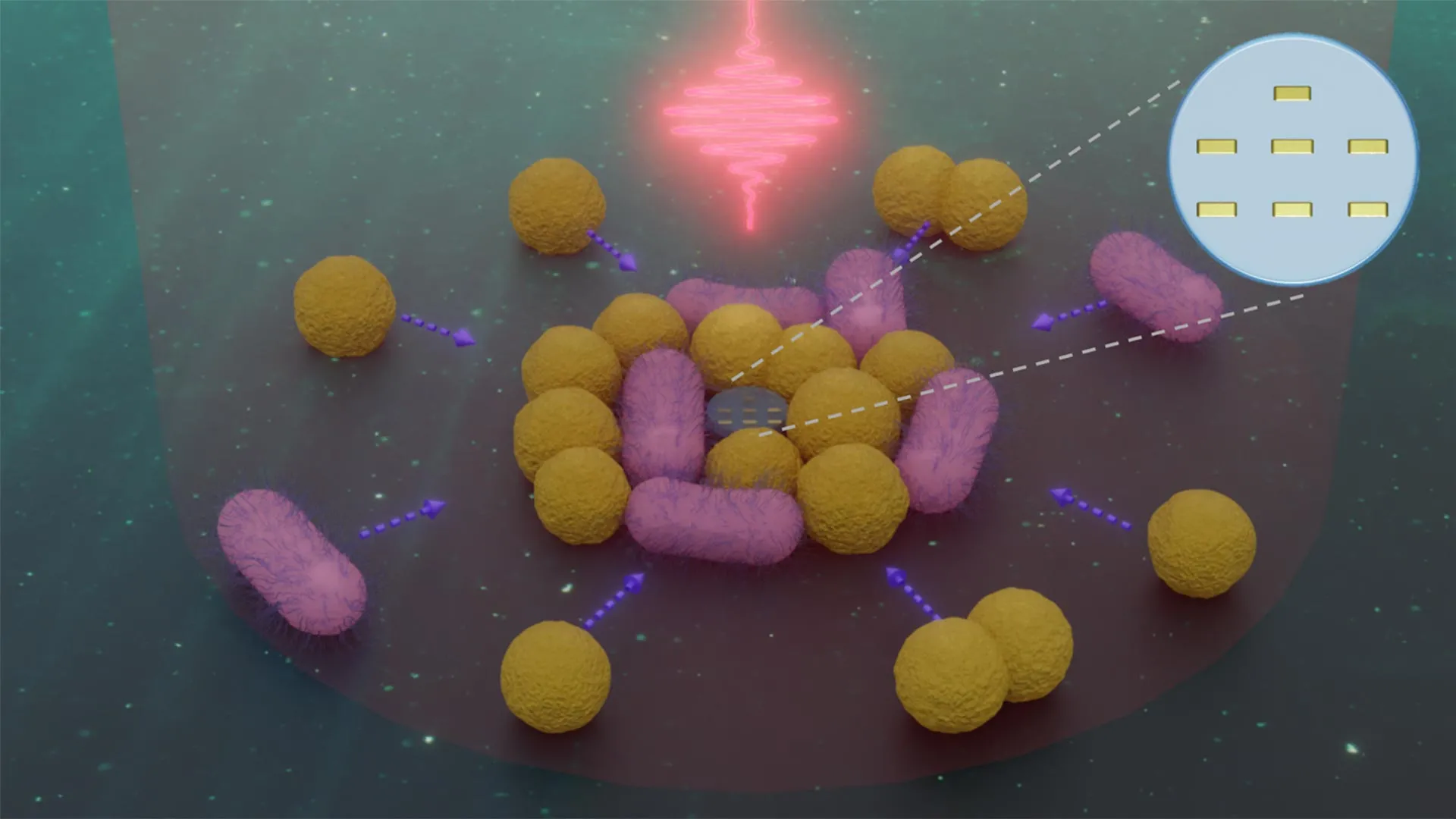
Spearheaded by Professor Bert Hecht and lead experimental scientist Jin Qin at the Julius-Maximilians-Universität (JMU) Würzburg, the research introduces a new class of light-driven nanorobots capable of interacting directly with biological matter in aqueous environments. By harnessing the fundamental physics of light momentum and photon recoil, the JMU team has successfully demonstrated the targeted capture, transport, and release of individual cells and bacteria.
This technological leap promises to transform our approach to microbiology, offering researchers a tangible mechanism to physically handle entities that have long remained untouchable, operating strictly within the realm of observation rather than physical manipulation.
Main Facts: Engineering the Infinitesimal
The newly unveiled nanorobots represent a convergence of nano-optics, fluid dynamics, and advanced materials science. Measuring under one micrometer in size, these devices are specifically calibrated to function within the microbial world.
To overcome the immense technical hurdles associated with operating at the sub-micron scale—where traditional mechanical components, batteries, and tethered wiring are physically impossible to integrate—the Würzburg team discarded conventional propulsion systems entirely. Instead, they turned to optics.
The Physics of Photon Recoil
The core innovation of the JMU microdrones lies in their utilization of photon recoil. The robots are equipped with up to four specialized plasmonic nanoantennas. These nanoscale structures are engineered to absorb light of a specific color and helicity (circular polarization), subsequently emitting that light in a controlled, directed trajectory.
When a photon is redirected, it imparts a minuscule, yet calculable, recoil force upon the antenna—a phenomenon analogous to the kickback experienced when firing a firearm. Because the mass of the microdrone is infinitesimal, these tiny cumulative forces generate substantial acceleration and velocity within fluid mediums.
Simplified Steering via Polarization
As the research team scaled the devices down to sub-micrometer dimensions, they faced the critical challenge of maintaining directional control without adding complex onboard processing units. Their solution was as elegant as it was effective: integrating nanoscale antenna wires directly into the architecture of the robot.
These wires naturally align themselves with the polarization direction of incoming laser light. By dynamically altering the polarization of the light source, operators can precisely dictate the heading of the nanorobot. Concurrently, photon recoil provides the forward thrust, establishing a dual-action steering mechanism that functions on principles similar to vector-thrust propulsion in larger aerospace vehicles.
Chronology of Discovery: From Concept to Microscopic Cleaners
The realization of light-steered nanorobots did not happen overnight; it is the culmination of years of theoretical modeling and experimental refinement in nano-optics.
Phase One: Theoretical Foundations and Macro-Scale Prototyping
For decades, the manipulation of objects at the cellular level relied heavily on optical tweezers—focused laser beams that can hold and move microscopic particles using radiation pressure. While revolutionary, optical tweezers are limited by their stationary setups and inability to execute complex, autonomous transport tasks across extended areas.
Professor Bert Hecht’s laboratory at JMU recognized that true manipulation required mobile agents—microscopic vehicles capable of navigating complex biological environments independently. Initial theoretical frameworks investigated whether light momentum could be harnessed not merely to trap particles, but to propel complex machinery.
Phase Two: Harnessing Plasmonic Nanoantennas
The breakthrough came with the integration of plasmonic nanoantennas. Researchers demonstrated that metallic nanostructures could interact with light fields in ways that generated directional scattering forces. By designing geometries capable of asymmetric light emission, the team generated net directional propulsion for the first time.
Phase Three: Scaling Down and Biological Integration
In their most recent developmental phase, the JMU team successfully reduced the footprint of their light-powered devices to under one micrometer. This reduction in scale was accompanied by a simplification of the steering architecture, allowing the devices to operate seamlessly within fluidic environments populated by living microorganisms.
Laboratory trials quickly confirmed that these sub-micron machines were capable of locating, gathering, and relocating live bacteria—effectively functioning as autonomous "microscopic cleaners."
Supporting Data and Technical Specifications
To fully appreciate the magnitude of the JMU achievement, it is necessary to examine the physical scale and performance metrics associated with these microdrones.
- Dimensional Scale: Each nanorobot measures less than one micrometer ($<1 mutextm$) in length, placing it roughly 50 times smaller than the average width of a human hair ($70text–100 mutextm$).
- Component Architecture: Devices incorporate up to four distinct plasmonic nanoantennas alongside integrated nanoscale antenna wires for polarization-based alignment.
- Maneuverability: The microdrones exhibit exceptional agility, capable of executing rapid 90-degree turns. This high degree of maneuverability allows them to systematically scan broad areas of a biological sample.
- Payload Capacity: Despite their ultra-low mass, the robots retain full maneuverability while transporting clusters of bacteria. While overall velocity experiences a measurable decrease under heavy loads due to hydrodynamic drag, cargo capacity remains remarkably robust for objects of equivalent size.
- Energy Source: Entirely powered and steered externally via specialized light fields, eliminating the need for onboard chemical fuels or micro-batteries.
Official Responses and Expert Perspectives
The unveiling of the JMU nanorobots has generated considerable excitement within the global scientific community, signaling a paradigm shift in how researchers approach micro-scale interactions.
"In essence, we have built a light-driven nanorobot that can track down and collect bacteria," notes Jin Qin, lead experimental scientist on the JMU study. "By simplifying the design, we reached a size at which these robots can operate directly in the microbial world—almost like microscopic cleaning devices."
Qin emphasizes that the ability to make sharp, 90-degree turns allows these machines to cover ground methodically, transforming random encounters with biological matter into systematic collection processes.
Professor Bert Hecht, principal investigator of the research team, underscores the broader philosophical and practical implications of the work:
"This is a striking example of how light can be used not only to observe the microscopic world, but also to actively shape it," Hecht states. "The idea of tiny robotic cleaners may sound futuristic, but we are already demonstrating the physical principles that make it possible."
Independent biophysicists and nanotechnology experts have echoed these sentiments, noting that the removal of heavy onboard power supplies represents the single most significant hurdle cleared by the Würzburg team. By outsourcing power generation and steering commands to external light fields, the researchers have bypassed the weight and power density limitations that have stalled micro-robotic development for decades.
Implications for Future Research and Industry
The successful demonstration of light-steered, bacteria-handling nanorobots opens up a vast horizon of potential applications spanning microbiology, medicine, and advanced materials engineering.
Microbiology and Cellular Research
Traditionally, isolating specific cells or bacterial strains from a mixed culture requires complex microfluidic sorting channels or biochemical markers. Light-powered nanorobots offer an active, highly localized alternative. Researchers could theoretically direct individual microdrones to biopsy specific cellular clusters, extract contaminants from a sample, or assemble synthetic microbial communities with spatial precision.
Biomedical Engineering and Targeted Therapy
While current iterations operate primarily under controlled laboratory conditions in aqueous solutions, the underlying physics point toward eventual in vivo applications. The ability to navigate complex cellular environments using harmless light fields suggests a long-term pathway toward targeted drug delivery, localized tissue repair, and the mechanical clearance of pathogens or micro-debris within the human body.
Materials Science and Nanofabrication
Beyond biology, the precise manipulation of nano-objects is a holy grail for materials science. Constructing nano-architectures atom-by-atom or molecule-by-molecule requires tools capable of exerting controlled mechanical force at the sub-micrometer scale. The principles demonstrated by the JMU team could eventually be adapted to assemble next-generation nanomaterials, electronic circuits, and photonics components directly on the nanoscale.
Conclusion
The breakthrough achieved at Julius-Maximilians-Universität Würzburg marks the crossing of a critical threshold in applied physics and nanotechnology. By mastering the delicate forces exerted by photons, researchers have transformed light from a passive tool of observation into an active instrument of mechanical control.
As development continues, these microscopic cleaners and transporters will undoubtedly bridge the gap between human intention and the invisible microbial universe, paving the way for innovations that will redefine our relationship with the smallest scales of existence.