










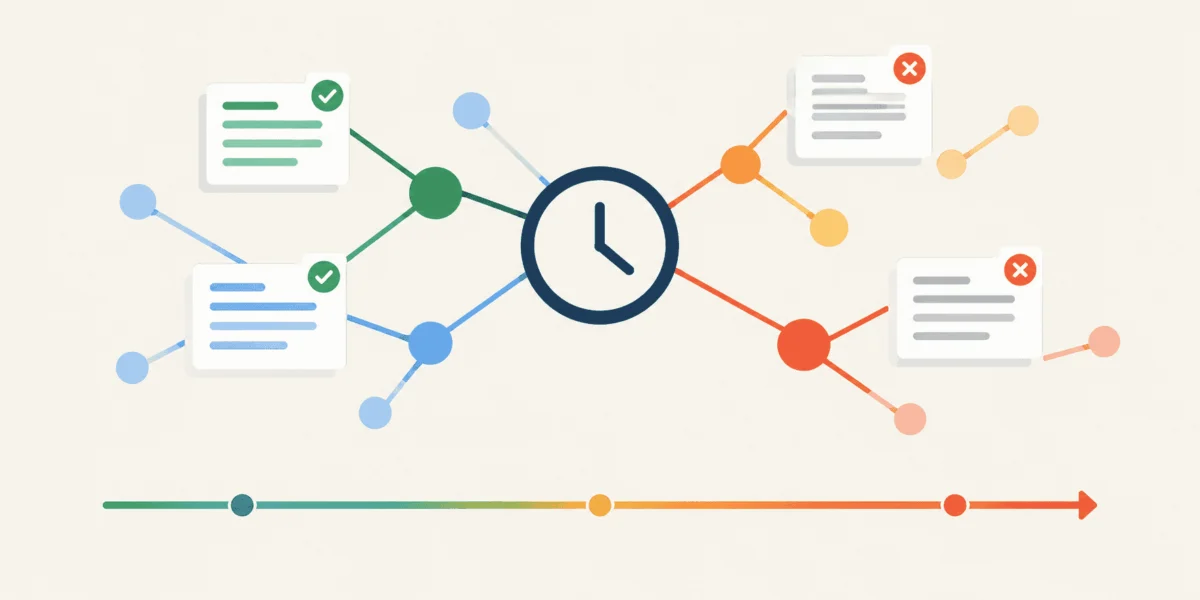
In the rapidly evolving landscape of Retrieval-Augmented Generation (RAG), the primary challenge has shifted from merely retrieving relevant information to ensuring that the retrieved information is truthful and current. As organizations deploy Large Language Models (LLMs) to navigate complex data environments, they face a silent killer of system performance: "temporal staleness."
Standard Knowledge Graphs (KGs) are fundamentally built on static Subject-Predicate-Object (SPO) triples. While elegant in theory, these triples are often "timeless," failing to account for the fluid nature of real-world facts. If an LLM retrieves a fact stating that "Alice is the CEO of TechCorp," but Alice left the role six months ago, the model will inadvertently propagate a hallucination. To move beyond this, we must evolve our architectures to incorporate a dedicated, lightweight temporal reasoning layer. This article explores the mechanics of upgrading standard knowledge bases into temporal-aware systems, ensuring your RAG architecture distinguishes between historical record and current reality.
The Core Problem: Why Standard RAG Fails in a Dynamic World
The fundamental issue with conventional Graph-RAG systems is the assumption of atomicity. When we store data as simple triples—(Subject, Predicate, Object)—we strip away the dimension of time. In a corporate or scientific database, facts are rarely static. They are snapshots of a reality that is in constant flux.
The Hallucination Catalyst
When an LLM is presented with conflicting information—such as multiple entries for the same predicate (e.g., three different individuals listed as CEO)—the model often defaults to whichever entry appears more prominently or recently in the vector embeddings, rather than the one that is chronologically the most accurate. Without explicit temporal metadata, the LLM lacks the "context of now," leading to outputs that are factually inconsistent with the user’s query timestamp.
The Deterministic Hierarchy
In our previous exploration, Building a Deterministic 3-Tiered Graph-RAG System, we established that managing conflicting information requires a hierarchy. By assigning priority to "fresh" facts, we can mitigate the risk of stale data. However, the missing link in that architecture was the engine capable of defining exactly what constitutes "freshness."
Architecting the Temporal Engine: From Triples to Quads
To solve this, we must move from SPO triples to temporal quadruples: (Subject, Predicate, Object, Timestamp). By formalizing the timestamp as a primary attribute of the fact, we enable the system to treat data not just as a static entity, but as a point on a timeline.
Implementation: The TemporalGraph Class
Building a temporal reasoning engine does not require an overhaul of your existing database; it requires a lightweight wrapper. Below is a Python-based implementation that introduces temporal awareness to your knowledge base:
import datetime
import math

class TemporalGraph:
    def __init__(self):
        # Knowledge base structure: Subject -> Predicate -> List of (Object, Date)
        self.knowledge_base =

    def add_fact(self, subject, predicate, obj, date_string):
        """Adds a time-stamped fact to the graph."""
        fact_date = datetime.datetime.strptime(date_string, "%Y-%m-%d").date()
        if subject not in self.knowledge_base:
            self.knowledge_base[subject] =
        if predicate not in self.knowledge_base[subject]:
            self.knowledge_base[subject][predicate] = []

        self.knowledge_base[subject][predicate].append((obj, fact_date))
        print(f"Added: subject predicate obj (as of date_string)")
This structure allows us to store the evolution of a subject over time. For instance, tracking the leadership transitions at "TechCorp" becomes a simple matter of logging events as they occur in chronological order.
Chronology and Decay: Calculating the "Weight of Truth"
Simply having the data is not enough; the system must understand the relevance of that data. If we ask, "Who is the CEO of TechCorp?" today, a fact from 2021 is objectively less relevant than a fact from 2023. We achieve this through exponential decay.
The Recency Weight Algorithm
We define "freshness" using a half-life formula. By setting a half_life_days parameter (e.g., 365 days), we mathematically penalize older facts. A fact asserted exactly one half-life ago receives a confidence weight of 0.5, while a fact asserted today receives a 1.0.
def calculate_recency_weight(fact_date, query_date, half_life_days=365):
    """
    Calculates a score between 0 and 1 based on how old the fact is.
    Formula: weight = (0.5) ^ (age_in_days / half_life)
    """
    age_in_days = (query_date - fact_date).days
    if age_in_days < 0:
        return 1.0
    weight = 0.5 ** (age_in_days / half_life_days)
    return round(weight, 4)
Supporting Data: Putting the Logic into Action
When querying the TemporalGraph, the system performs a multi-step filter:
- Temporal Filtering: Discard any facts with a timestamp later than the current query date (to prevent "future-gazing" errors).
- Weight Assignment: Apply the exponential decay formula to all remaining valid facts.
- Ranked Retrieval: Sort the candidates by their calculated weights.
This process ensures that the RAG pipeline provides the LLM with the most "truthful" candidate based on the specific moment in time the user is inquiring about.
Implications for Enterprise RAG Systems
The integration of temporal reasoning into a 3-tiered Graph-RAG architecture has profound implications for corporate AI reliability.
1. Contextual Precision
By passing only the top-weighted, most relevant fact to the LLM’s context window, we significantly reduce the "noise" that leads to hallucinations. The model no longer needs to guess the timeline; the truth is presented as the primary fact.
2. Tuning for Velocity
One of the most powerful features of this approach is the adjustability of the half_life_days parameter. In a stable environment (e.g., historical archives), a long half-life is appropriate. In a high-velocity environment (e.g., stock market data or IT incident management), the half-life can be reduced to days or even hours, ensuring the system prioritizes instantaneous accuracy.
3. Enabling "Time-Travel" Queries
This architecture allows for counterfactual or retrospective analysis. An organization can ask, "What was the organizational structure on November 18, 2023?" and receive an accurate answer based solely on the facts available at that time. This is invaluable for auditing, compliance, and historical trend analysis.
Conclusion: Moving Toward Temporal-Aware AI
As we move toward more autonomous AI agents, the ability to discern the "temporal truth" of a statement will become a baseline requirement for enterprise-grade systems. The lightweight approach detailed here—extending triples to quadruples and applying exponential decay—provides a robust, scalable, and highly interpretable method for managing the chaos of changing facts.
By adopting this temporal reasoning layer, developers can ensure that their Graph-RAG systems are not just "smart," but fundamentally reliable. In an age where information is produced at an overwhelming velocity, the ability to identify the most current fact is the ultimate competitive advantage. Start by adjusting your half_life_days parameter to match your domain’s volatility, and witness the immediate improvement in your model’s fidelity. The future of RAG is not just about retrieving more data; it is about retrieving the right data, at the right time.



