










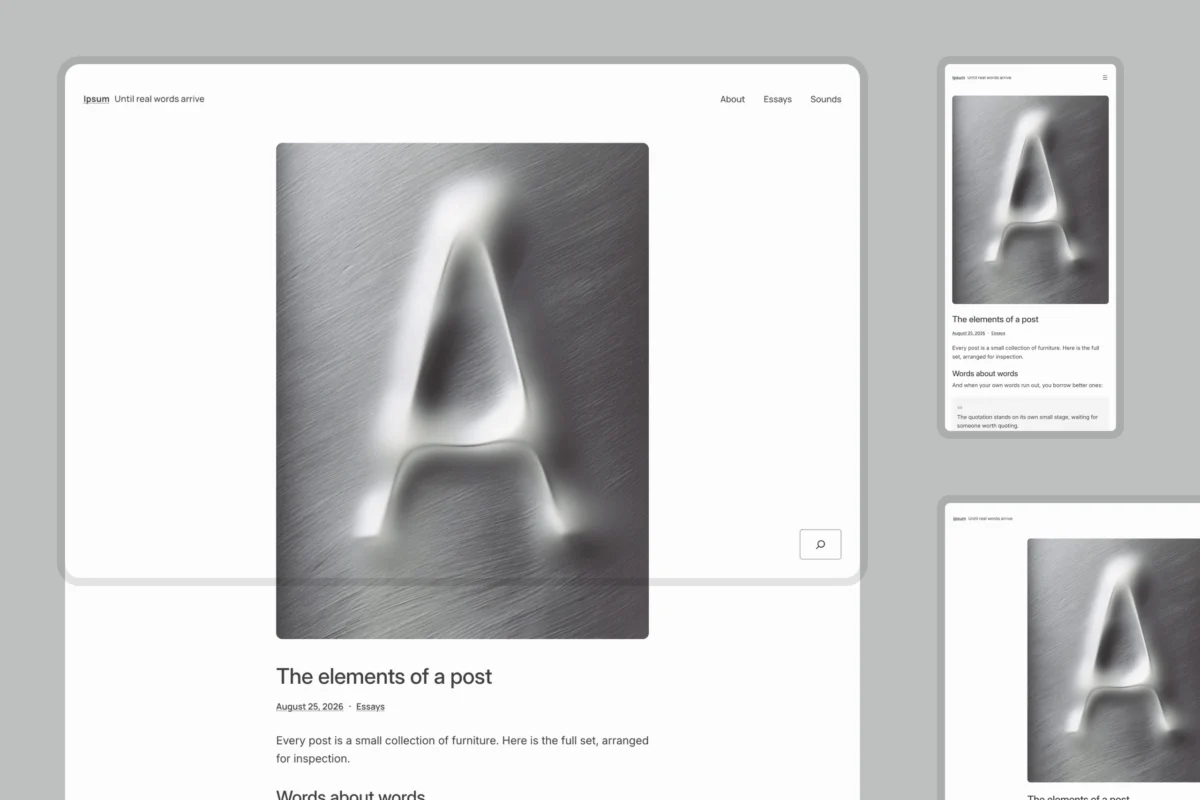
The WordPress core development team has officially announced its next generation of default themes, breaking a tradition that has spanned over a decade and a half. Dubbed "Ipsum," this new design proposal is slated to debut as the default template in WordPress 7.2, the final major software release of 2026. However, the introduction of Ipsum marks a historic structural shift: default themes will no longer be named after their launch year, effectively retiring the "Twenty Twenty-something" nomenclature.
The announcement, published on the official Make WordPress Core blog by designer Henrique Iamarino, outlines a minimalist, content-first approach tailored for writers, creators, and publishers. Yet, the road to Ipsum involved an eleventh-hour pivot from a previously developed concept, revealing ongoing debates within the ecosystem regarding the fundamental purpose of default WordPress themes.
Main Facts: What is Ipsum and Why Does it Matter?
Set for integration into WordPress 7.2—scheduled for release between December 8 and 10, 2026—Ipsum is a block-based theme engineered to act as a silent canvas. Derived from the traditional typographic placeholder text lorem ipsum, the theme’s philosophy is built around restraint: it provides structural composure out of the box, yet recedes into the background the moment a user begins typing real content.
Core Highlights of the Ipsum Project:
- The Death of the Year-Based Naming Convention: Since Twenty Ten, WordPress has systematically named its default themes after the calendar year of their release. Ipsum shatters this tradition, establishing a new precedent where future default themes will carry unique brand names and remain active until a redesign is strategically necessary.
- Minimalist Architecture: The design leans heavily on global styles, utilizing the absolute minimum amount of CSS possible. All visual properties are mapped directly within the
theme.jsonfile, allowing modifications to be managed natively through the Site Editor without writing custom code. - Typographic and Visual Restraint: Visual elements include distinct dotted underline links reminiscent of a copyeditor’s pencil, restricted typographic pairings, and cohesive colorway variations—such as Blue Hour and After Hours—that dynamically adjust the tone of the entire page, images included.
- Accessibility-First Standards: The design team has confirmed that all default colorways and typographic combinations target compliance with WCAG AA accessibility standards, subject to rigorous testing throughout the development cycle.
The project is spearheaded by Henrique Iamarino, with development led by Carolina Nymark, Maggie Cabrera, and Juanfra Aldasoro. Currently sitting at version 1.0.0, the theme is distributed under the GNU General Public License (GPL v2 or later), with its typography licensed under the SIL Open Font License.
Chronology: From Mêtis to Ipsum
The path to Ipsum was not a straight line. When the dedicated default theme team formed in April 2026, they did not start with Ipsum. Instead, they spent months building an entirely different concept named Mêtis.
The Evolution of the 2026 Theme Cycle:
- April 2026: The default theme team is assembled, immediately bypassing traditional static Figma mockups to build directly within the Site Editor using live demonstration pages.
- Mid-2026: The team develops Mêtis, a high-personality theme aimed at writers and thinkers, designed explicitly to showcase the absolute bleeding edge of Gutenberg’s design capabilities.
- Late Summer 2026: During a strategic review with project co-founder Matt Mullenweg, the directive changes. Mullenweg—who continues to act as the release lead for WordPress 7.2 despite being temporarily removed from his position as CEO of Automattic by the company’s board earlier in the month—argues for a simpler approach.
- September 16, 2026: The pivot is made public. Mêtis is shelved as the core default theme (though it will be released independently at a later date), and Ipsum is officially introduced as the new candidate for WordPress 7.2.
- Late 2026 (Upcoming): With the Beta 1 phase locked for October 20-22 and the Release Candidate slated for November 17-19, Ipsum faces a compressed two-month window to transition from design concept to core integration.
The decision to abandon Mêtis at the eleventh hour was defended by the core team using a classic software development maxim popularized by Apple: "Real artists ship." Rather than over-engineering a high-concept template that might alienate novice users, the team prioritized the lowest possible barrier to entry.
Supporting Data & Technical Specifications
Under the hood, Ipsum is a masterclass in modern WordPress engineering. It embraces the full potential of Full Site Editing (FSE) while deliberately shrinking the codebase footprint.
Technical Breakdown:
- Core Dependency: Requires WordPress 7.1 and PHP 7.4 or higher for optimal performance.
- Code Optimization: Following the architectural philosophies seen in predecessors like Twenty Twenty-Five, Ipsum pushes the boundaries of zero-CSS development by routing every design token through
theme.json. - Collaboration Pipeline: The design team collaborates directly with Gutenberg contributors to request and implement missing design tools within the core editor.
- Testing Surfaces: The development repository on GitHub currently invites community testing across three specific domains: style variations, archive pattern packs, and sidebar-enabled templates.
Safe Testing Methods for Developers:
Because Ipsum is currently an un-reviewed development build, deploying it on live production websites is strongly discouraged. Instead, the core team has outlined three primary environments for safe testing:
- WordPress Playground: For rapid, browser-based execution without local configuration.
- Dedicated Staging Environments: Isolated servers running local development builds of WordPress 7.1/7.2.
- Official Demonstration Hubs: Hosted preview instances managed by the core contributor team.
Contributors who link their GitHub accounts with WordPress.org are eligible for official project recognition (props) for bug reports, pattern submissions, and pull requests.

Official Responses and Ecosystem Reactions
The announcement of Ipsum and the permanent retirement of year-based naming conventions have ignited passionate discussions across the global WordPress community.
The End of an Era: Rethinking Default Themes
For fifteen years, desde Twenty Ten to Twenty Twenty-Five, the annual naming scheme served as a chronological anchor for millions of self-hosted websites. Anyone visiting a site could instantly gauge its age simply by looking at the default template.
Proponents of the change argue that year-based naming imparted an artificial expiration date to the software. A site running a theme named Twenty Sixteen in the year 2026 immediately felt obsolete to visitors, even if the underlying code was secure and up to date. By transitioning to independent, evocative names like Ipsum, WordPress is repositioning its default templates as timeless brand identities rather than disposable calendar markers.
The Core Debate: Does WordPress Even Need a Default Theme?
The release proposal also resurrected a deeper, philosophical debate regarding the necessity of default themes altogether. In the comments section of the official announcement, several prominent developers questioned whether WordPress should continue bundling a default theme at all. One commenter suggested that a streamlined, highly polished onboarding wizard that leaves the user with a literal blank canvas would be superior to forcing a pre-designed template.
Anne McCarthy, speaking on behalf of the WordPress core team, swiftly pushed back against this notion. McCarthy argued that the core software cannot possibly anticipate or engineer a universal onboarding experience that satisfies every conceivable use case. Instead, the objective of a default theme is to provide a rock-solid, highly accessible baseline that removes the intimidation factor of a completely empty screen while demonstrating the native capabilities of the block editor.
This sentiment was echoed by numerous community members who noted that beginning with an utterly blank slate routinely overwhelms non-technical users. A well-crafted default theme teaches users what is structurally possible within the ecosystem without requiring them to install third-party frameworks immediately.
Implications for Developers, Designers, and Agencies
The introduction of Ipsum and the structural policy changes surrounding core themes carry significant implications for the broader WordPress ecosystem:
- Agency Workflow Adaptation: Agencies and freelance developers who rely on default themes as child-theme foundations or wireframing bases must adjust to a non-chronological naming taxonomy. Documentation, client training, and internal boilerplate setups will need to pivot away from year-based assumptions.
- Design Philosophy Shift: The embrace of "silent design"—where elements like sidebars, headers, and advanced layouts remain hidden until explicitly summoned by content creation—signals a maturing Gutenberg ecosystem. Themes are no longer loud, opinionated wrappers; they are quiet enablers of user expression.
- Accelerated Release Pressures: With the final release candidate window closing in mid-November 2026, the tight integration timeline for Ipsum places immense pressure on the core design team. The software’s success will serve as a bellwether for how efficiently WordPress can execute rapid design pivots without sacrificing core stability.
As the development cycle accelerates toward the December release of WordPress 7.2, all eyes will be on GitHub pull requests and community testing logs. Whether Ipsum successfully redefines the standard for out-of-the-box publishing remains to be seen, but one thing is certain: the era of the "Twenty" themes has officially closed its chapter.



