








Introduction: The Ancient Art of Knowledge Transfer
Throughout human history, the propagation of complex information has relied heavily on lineage and mentorship. Long before the invention of writing in ancient Mesopotamia—where cuneiform tablets recorded laws, commerce, and mythological epics—societies preserved their cultural heritage orally. Elders passed down survival instructions, histories, and folktales from generation to generation through direct storytelling.
As civilizations evolved, formal systems of mentorship emerged. Historical milestones trace a direct cognitive lineage across antiquity: Socrates instructed Plato, who subsequently founded the Academy in Athens and mentored Aristotle for two decades. Aristotle’s intellectual framework went on to revolutionize Western science, formal logic, and political philosophy.
In the twenty-first century, this pedagogical paradigm has found a direct parallel in deep learning artificial intelligence. During the latter half of the twentieth century—a period colloquially known as the "AI winter," when enthusiasm for neural networks plummeted due to perceived theoretical dead ends—a small community of academic mentors kept the discipline alive. Geoffrey Hinton, widely recognized as one of the founding fathers of modern deep learning, operated a laboratory that nurtured prodigies like Yann LeCun (inventor of convolutional neural networks) and Ilya Sutskever (co-founder of OpenAI).
While human-to-human knowledge transfer is intuitively understood, the twenty-first-century AI landscape has mastered an equally transformative feat: machine-to-machine knowledge transfer. Known formally as model distillation, this technique bridges the gap between massive, computationally intensive frontier models and the lightweight networks required for everyday deployment.
The Core Mechanics: What is Model Distillation?
Model distillation—often referred to as knowledge distillation—is an algorithmic compression technique designed to transfer the learned behaviors, generalizations, and decision-making processes of a large, highly accurate model (the "teacher") to a smaller, computationally efficient model (the "student").
The primary objective is to allow the student network to achieve a level of predictive performance that closely approximates the teacher, while operating with a fraction of the parameters. This makes the resulting model vastly superior for practical deployment on resource-constrained hardware.
Why Model Distillation is an Industrial Necessity
Modern foundational models—ranging from open-source weights to proprietary large language models—are routinely trained on trillions of parameters. These internal configuration variables are adjusted automatically during training to recognize complex patterns across vast corpora of text, imagery, or audio.
However, running inference on models of this scale presents severe engineering hurdles:
- Exorbitant Computational Costs: Serving models with hundreds of billions of parameters requires specialized, enterprise-grade hardware clusters equipped with numerous high-end GPUs.
- Massive Energy Consumption: The carbon footprint and power draw associated with hosting frontier models make them economically unviable for high-frequency, low-latency edge computing.
- Latency Bottlenecks: Real-time applications—such as autonomous vehicle navigation, mobile assistant applications, and real-time speech translation—cannot tolerate the latency inherent in querying massive cloud-based LLMs.
By distilling the capabilities of these frontier models into compact architectures, developers can democratize access to high-performance AI, enabling sophisticated intelligence to run locally on consumer-grade hardware, mobile devices, and edge infrastructure.
Chronology and Evolution of Distillation Techniques
The conceptual framework of transferring knowledge between neural networks has matured significantly over the past decade. The evolution of model distillation can be categorized into several distinct methodological approaches, each targeting different layers of information transfer.
1. Response-Based Distillation (The Foundation)
Introduced formally by Geoffrey Hinton and his colleagues in their seminal 2015 paper, Distilling the Knowledge in a Neural Network, response-based distillation represents the classic teacher-student paradigm.
To understand this method, one must distinguish between hard labels and soft labels:
- Hard Labels: These represent absolute categorical targets. When an image of a dog is fed into a traditional classifier, the hard label assigns a probability of $1.0$ to the "dog" class and $0.0$ to all other classes (such as "cat" or "horse"), providing zero nuance regarding visual similarities.
- Soft Labels: Generated by the teacher model, these represent rich probability distributions across all output classes. For instance, the teacher might evaluate the same image and output an 85% probability that the subject is a dog, a 10% probability that it resembles a cat, and a 5% probability of a horse.
This nuanced secondary output is frequently described as dark knowledge. By training the student model on these soft targets rather than rigid hard labels, the student absorbs not just the correct answer, but the underlying relational structure perceived by the teacher.
While response-based distillation is computationally stable and easy to implement, its primary limitation is its "black-box" nature: it focuses exclusively on the final output layer, ignoring the intermediate computational pathways the teacher utilized to reach its conclusions.
2. Feature-Based Distillation
To overcome the limitations of looking solely at final outputs, feature-based distillation forces the student model to mimic the internal representations and hidden layer activations of the teacher network.
In this paradigm, the training process utilizes mathematical metrics such as Mean Squared Error (MSE) to measure the discrepancy between the hidden feature maps of the teacher and the student. Consequently, the student is penalized not only for missing the final classification target, but also for failing to replicate the teacher’s internal feature extraction process.
While highly effective in convolutional neural networks (CNNs) and vision transformers (ViTs), feature-based distillation introduces significant memory overhead, as the system must store and process high-dimensional internal activations across every training iteration.
3. Attention Distillation
Particularly prominent in modern transformer architectures, attention distillation focuses on copying where a model "looks" rather than the absolute values of its neurons.
Transformer models utilize self-attention mechanisms to weigh the importance of different input tokens (or image regions) relative to one another. Attention maps explicitly demonstrate which contextual cues the model prioritizes. By forcing the student model to replicate these attention distributions, developers can guide smaller networks to focus on the exact semantic triggers utilized by the teacher.
4. Self-Distillation
In self-distillation workflows, the network acts as both teacher and student. Knowledge is transferred either iteratively from an earlier version of the model to a later version, or across different layers within the same network architecture. This allows models to incrementally refine their internal representations without requiring a separate, vastly larger teacher model.
Implementing Knowledge Distillation: A PyTorch Walkthrough
To ground these theoretical principles in reality, we can construct a complete knowledge distillation pipeline using PyTorch. For this implementation, we utilize the classic MNIST dataset, which comprises 70,000 grayscale images of handwritten digits ($28 times 28$ pixels).
While MNIST is relatively small, it provides an ideal sandbox for demonstrating the end-to-end distillation workflow, which scales identically when applied to massive multi-modal or natural language datasets.
Project Architecture
A clean, modular directory structure ensures separation of concerns across data loading, network definitions, loss calculations, training engines, and evaluation scripts:
knowledge-distillation/
├── data/
├── models.py
├── engine.py
├── losses.py
├── train_teacher.py
├── train_student.py
├── train_distilled_student.py
├── evaluate.py
├── visualize.py
├── utils.py
├── requirements.txt
└── README.md
1. Defining Neural Network Architectures (models.py)
We define two distinct architectures: a deep, over-parameterized TeacherNet equipped with multiple hidden layers, and a streamlined, lightweight StudentNet.
import torch
import torch.nn as nn
import torch.nn.functional as F

class TeacherNet(nn.Module):
    def __init__(self):
        super().__init__()
        self.flatten = nn.Flatten()
        self.fc1 = nn.Linear(28 * 28, 1024)
        self.fc2 = nn.Linear(1024, 512)
        self.fc3 = nn.Linear(512, 256)
        self.fc4 = nn.Linear(256, 128)
        self.fc5 = nn.Linear(128, 10)

    def forward(self, x):
        x = self.flatten(x)
        x = F.relu(self.fc1(x))
        x = F.relu(self.fc2(x))
        x = F.relu(self.fc3(x))
        x = F.relu(self.fc4(x))
        logits = self.fc5(x)
        return logits

class StudentNet(nn.Module):
    def __init__(self):
        super().__init__()
        self.flatten = nn.Flatten()
        self.fc1 = nn.Linear(28 * 28, 128)
        self.fc2 = nn.Linear(128, 10)

    def forward(self, x):
        x = self.flatten(x)
        x = F.relu(self.fc1(x))
        logits = self.fc2(x)
        return logits
2. Engineering the Distillation Loss Function (losses.py)
The heart of knowledge distillation lies in combining traditional cross-entropy loss (against ground-truth hard labels) with Kullback-Leibler (KL) divergence (measuring the difference between softened teacher and student probability distributions).
import torch
import torch.nn as nn
import torch.nn.functional as F

cross_entropy = nn.CrossEntropyLoss()

def distillation_loss(student_logits, teacher_logits, labels, temperature=4.0, alpha=0.5):
    """
    Computes Geoffrey Hinton's Knowledge Distillation Loss.

    Parameters:
    - student_logits: raw outputs from the student model
    - teacher_logits: raw outputs from the teacher model
    - labels: ground-truth categorical labels
    - temperature: scaling factor to soften probability distributions
    - alpha: balancing weight between hard label loss and soft target loss
    """
    # Hard Label Loss
    hard_loss = cross_entropy(student_logits, labels)

    # Teacher Soft Targets (scaled by temperature)
    teacher_probs = F.softmax(teacher_logits / temperature, dim=1)

    # Student Soft Predictions (log probabilities)
    student_log_probs = F.log_softmax(student_logits / temperature, dim=1)

    # KL Divergence for Soft Loss
    soft_loss = F.kl_div(student_log_probs, teacher_probs, reduction="batchmean")

    # Weighted combination of losses, scaling soft loss by temperature squared
    loss = alpha * hard_loss + (1 - alpha) * (temperature ** 2) * soft_loss
    return loss
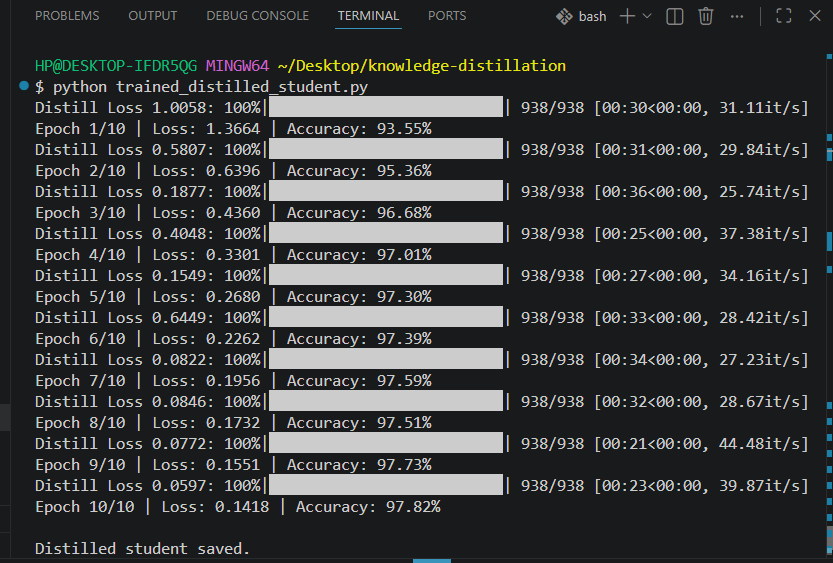
3. Training the Distilled Student (train_distilled_student.py)
In this phase, the pre-trained teacher model is loaded into memory and set to evaluation mode (teacher.eval()), freezing its weights. The student network is then trained using the custom distillation loss function.
import torch
import torch.optim as optim
from models import TeacherNet, StudentNet
from utils import get_dataloaders
from engine import train_distillation_epoch, evaluate
from losses import distillation_loss

device = torch.device("cuda" if torch.cuda.is_available() else "cpu")
train_loader, test_loader = get_dataloaders()

# Load frozen Teacher model
teacher = TeacherNet().to(device)
teacher.load_state_dict(torch.load("teacher.pth", map_location=device))
teacher.eval()

# Initialize Student model
student = StudentNet().to(device)
optimizer = optim.Adam(student.parameters(), lr=0.001)

epochs = 10
for epoch in range(epochs):
    loss = train_distillation_epoch(
        teacher, student, train_loader, optimizer, device,
        distillation_loss, temperature=3.0, alpha=0.7
    )
    accuracy = evaluate(student, test_loader, device)
    print(f"Epoch epoch+1/epochs | Distillation Loss: loss:.4f | Student Accuracy: accuracy:.2f%")

torch.save(student.state_dict(), "student_distilled.pth")
print("nDistilled student weights saved successfully.")
Empirical Results and Comparative Analysis
To evaluate the efficacy of model distillation, three distinct neural network configurations were trained for 10 epochs each on the MNIST dataset:
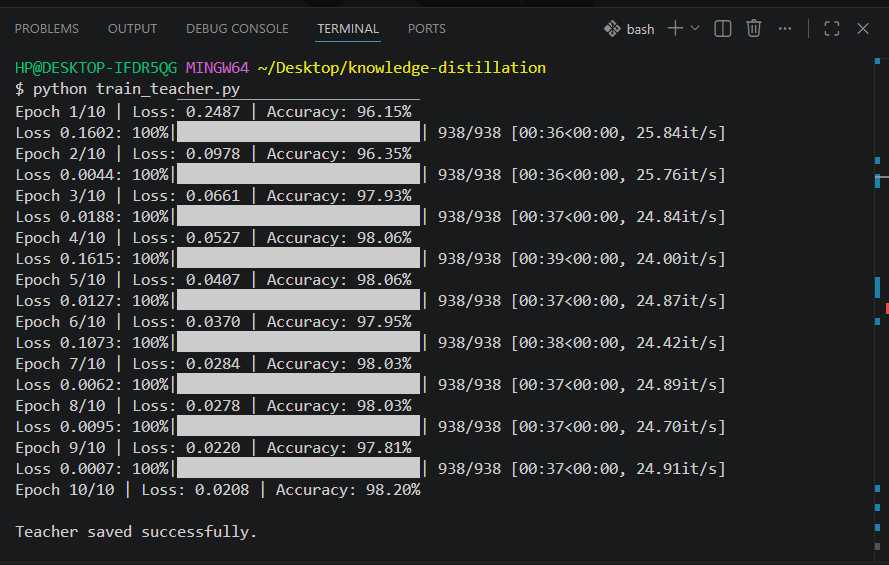
- Teacher Network: Deep fully-connected architecture ($1024 to 512 to 256 to 128$).
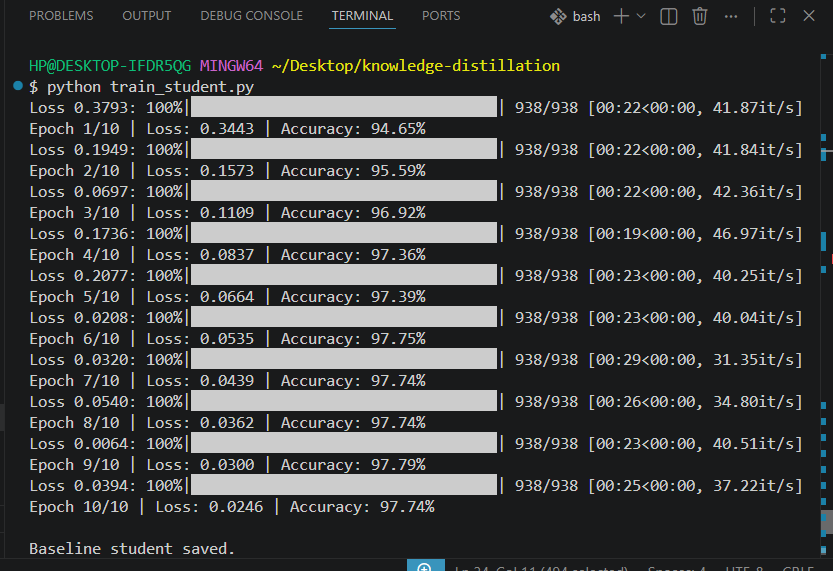
- Baseline Student Network: Lightweight architecture trained exclusively on hard ground-truth labels.
- Distilled Student Network: Identical lightweight architecture trained via response-based distillation using the frozen teacher.
Performance Breakdown
- Teacher Network Accuracy: Achieved 98.20% baseline accuracy across test partitions.
- Baseline Student Network Accuracy: Achieved 97.74% accuracy without external guidance.
- Distilled Student Network Accuracy: Achieved 97.91% accuracy, demonstrating a measurable performance recovery by absorbing the dark knowledge of the teacher model.
+--------------------------+-------------------+--------------------+
| Model Configuration      | Parameter Count   | Test Accuracy (%)  |
+--------------------------+-------------------+--------------------+
| TeacherNet               | ~950,000          | 98.20%             |
| Baseline StudentNet      | ~115,000          | 97.74%             |
| Distilled StudentNet     | ~115,000          | 97.91%             |
+--------------------------+-------------------+--------------------+
These empirical data points validate that knowledge distillation enables significantly smaller architectures to approach the high-water mark of much larger teacher models, optimizing the accuracy-to-compute trade-off.
Alternative Model Compression Methodologies
Model distillation is just one tool in a broader ecosystem of optimization techniques designed to mitigate hardware constraints. Developers frequently contrast distillation with three other primary methodologies:
1. Quantization
Quantization focuses on reducing the bit-precision of numerical weights and activations within a neural network.
- Mechanism: Rather than storing weights as standard 32-bit floating-point numbers (
FP32), quantization compresses them into 16-bit (FP16), 8-bit integers (INT8), or even lower precisions. - Analogy: If model compression were analogous to publishing a textbook, distillation acts as a professional summarization that condenses chapters, whereas quantization retains the exact same text but prints it using a compressed, highly efficient typeface to save physical space and memory bandwidth.
2. Pruning
Pruning operates on the premise that large neural networks contain substantial redundancy, with many synaptic connections contributing marginally to final outputs.
- Mechanism: Developers analyze weight magnitudes or gradient sensitivities during training and permanently sever connections (or zero out entire channels and attention heads) that fall below a designated threshold.
- Analogy: Pruning is akin to editing a textbook by physically tearing out pages, chapters, or appendices deemed non-essential to the core subject matter.
3. Low-Rank Factorization
Low-rank factorization applies linear algebra—such as Singular Value Decomposition (SVD)—to decompose massive weight matrices into multiple smaller, lower-rank matrices. This reduces the total number of floating-point operations required during matrix multiplication passes.
Strategic Selection
Choosing the appropriate optimization technique depends entirely on the operational bottleneck:
- Quantization is optimal for mitigating memory footprint and bandwidth constraints.
- Pruning and Distillation are designed primarily to reduce computation time, lower latency, and compress the architectural complexity of the network.
Implications and Future Outlook
The maturation of model distillation carries profound implications for the commercial deployment of artificial intelligence. As frontier models scale into hundreds of billions—and potentially trillions—of parameters, the economic and environmental costs associated with inference grow increasingly unsustainable.
Knowledge distillation provides a viable, empirically validated pathway to decouple high-end capability from massive hardware infrastructure. By distilling complex reasoning capabilities into compact models, organizations can:
- Deploy sophisticated AI systems directly onto consumer mobile devices, smart home appliances, and industrial IoT sensors without relying on continuous cloud connectivity.
- Guarantee low-latency responses essential for mission-critical applications like automated medical diagnostics and robotics.
- Drastically lower operational inference costs, democratizing AI access for smaller enterprises and independent developers.
Ultimately, knowledge transfer remains as fundamental to artificial intelligence as it is to human civilization. Just as historical intellectuals relied on the shoulders of giants to advance scientific inquiry, modern machine learning relies on distillation to pass the accumulated intelligence of frontier models down to the efficient architectures of tomorrow.