







In the hyper-competitive landscape of digital marketing, online coaching, and automated sales funnels, hosting live webinars remains one of the most lucrative conversion tools available. Among the crowded field of webinar software, WebinarJam has long established itself as an industry standard. However, choosing the right subscription tier requires a careful balance between upfront capital expenditure, projected audience size, and essential marketing features.
This deep-dive analysis evaluates WebinarJam’s current pricing matrix, examining its trial structures, monthly versus annual billing models, tier-by-tier breakdowns, and the broader economic implications for content creators, enterprises, and small business owners.
Main Facts: The Current WebinarJam Pricing Structure
At its core, WebinarJam operates on a tiered subscription model designed to scale with a business’s audience size and technical requirements. The platform provides a low-barrier entry point through a 14-day trial, followed by four distinct ongoing paid tiers: Starter, Basic, Professional, and Enterprise.
The Entry-Level Trial
Prospective users can test the platform via a $1, 14-day trial. Crucially, this trial does not lock users into a restricted sandbox environment; instead, it unlocks high-level functionality equivalent to the Basic tier. This includes room for up to 500 live attendees, a two-hour session limit, and support for up to two simultaneous hosts. If a user decides the platform does not align with their operational needs, they can cancel before the 14-day window expires to avoid transitioning into a paid subscription.
The Four Paid Tiers (Monthly vs. Annual Rates)
When paying month-to-month, WebinarJam’s pricing scales significantly based on capacity:
- Starter Plan: $49 per month (Supports 100 attendees, 1 host, 1-hour session limit).
- Basic Plan: $99 per month (Supports 500 attendees, 2 hosts, 2-hour session limit).
- Professional Plan: $299 per month (Supports 2,000 attendees, 4 hosts, 3-hour session limit).
- Enterprise Plan: $499 per month (Supports 5,000 attendees, 6 hosts, 4-hour session limit).
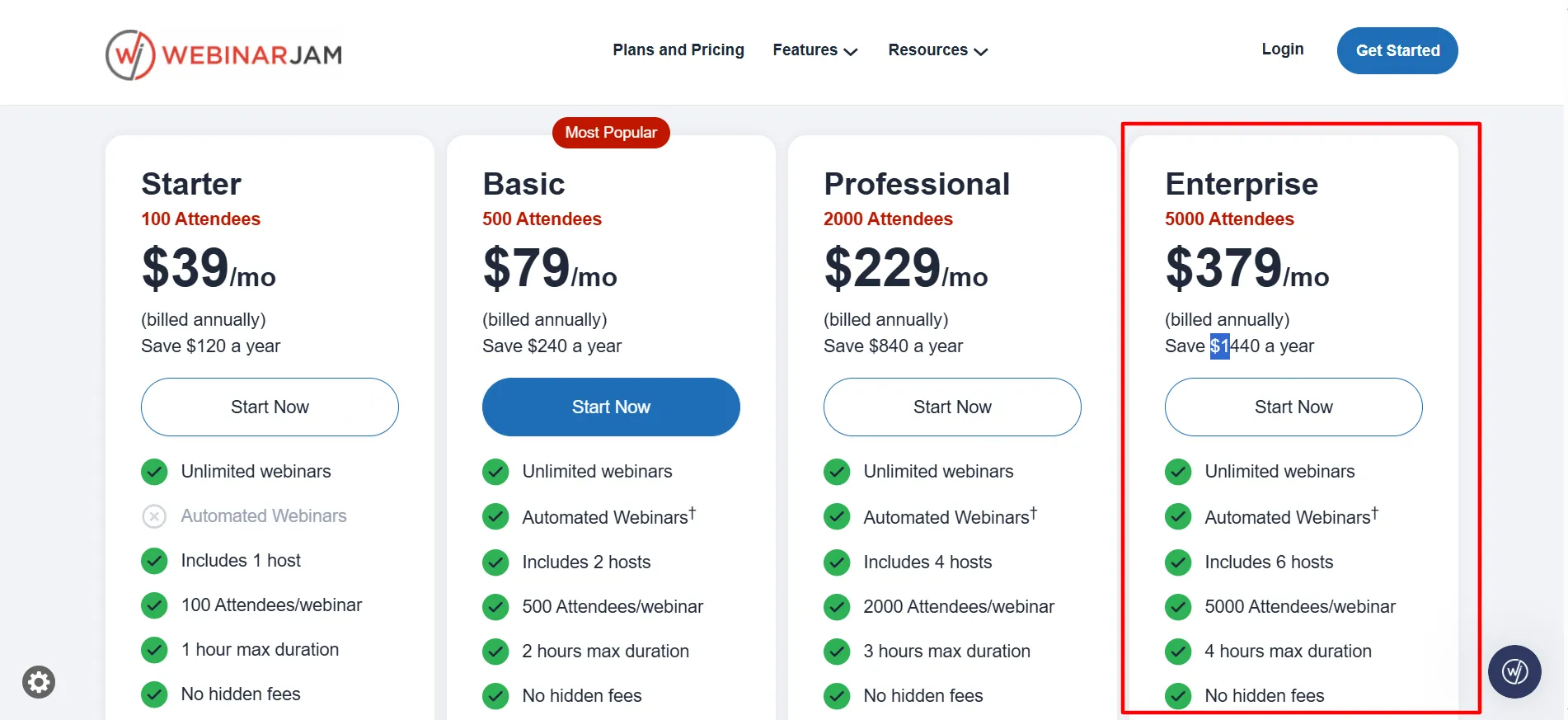
For businesses committed to long-term digital marketing campaigns, switching to annual billing slashes the effective monthly cost by roughly 20% to 24%, yielding considerable annual savings:
- Starter (Annual): $39 per month (Saves $120 annually; total $468/year).
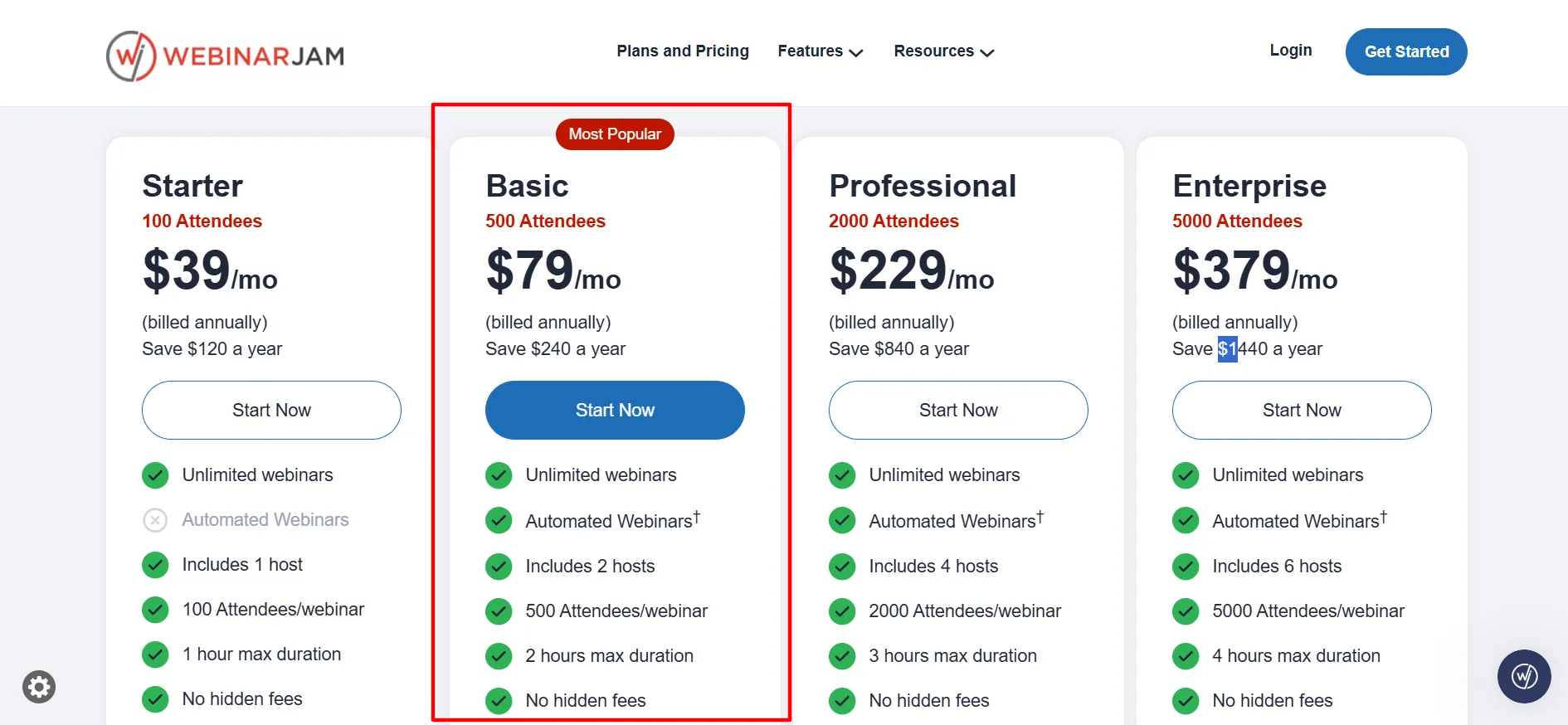
- Basic (Annual): $79 per month (Saves $240 annually; total $948/year).
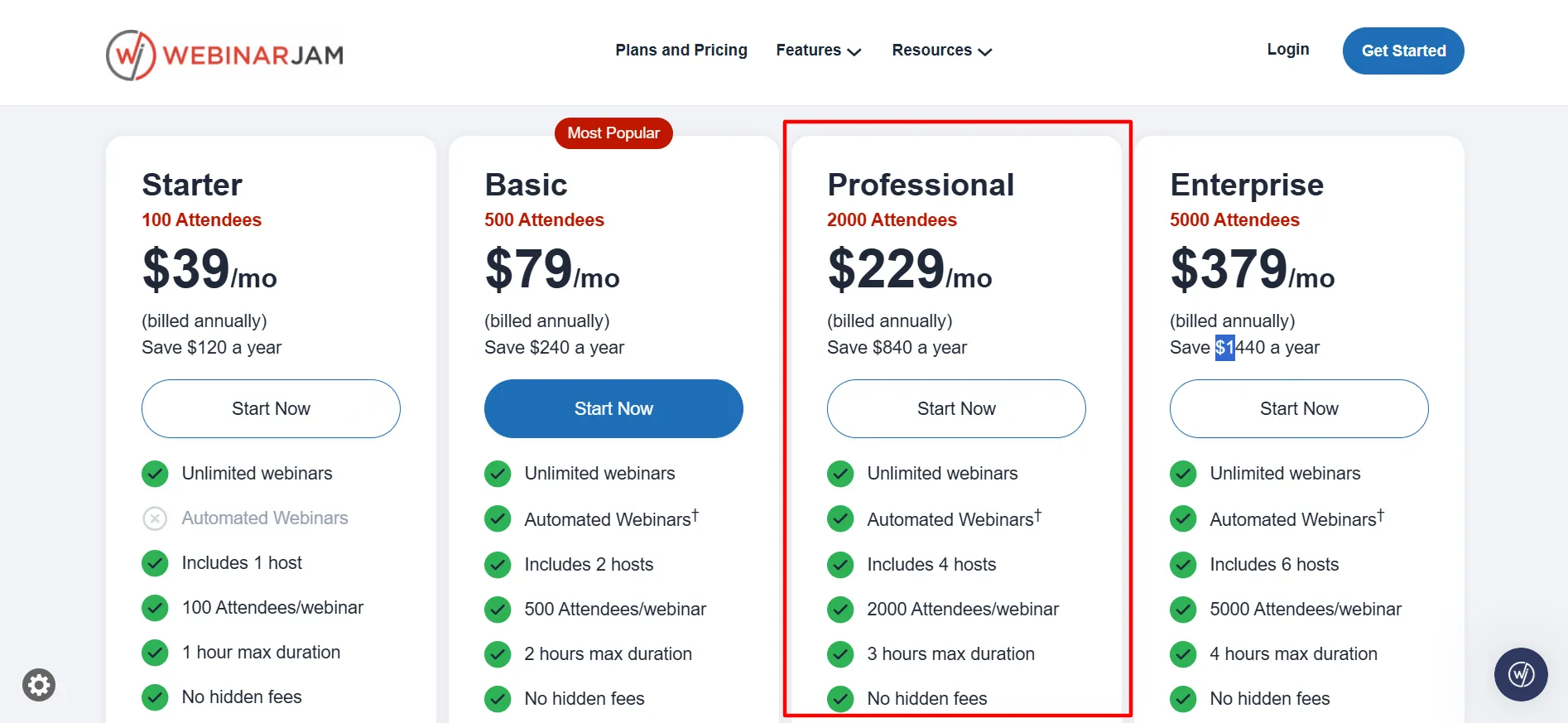
- Professional (Annual): $229 per month (Saves $840 annually; total $2,748/year).
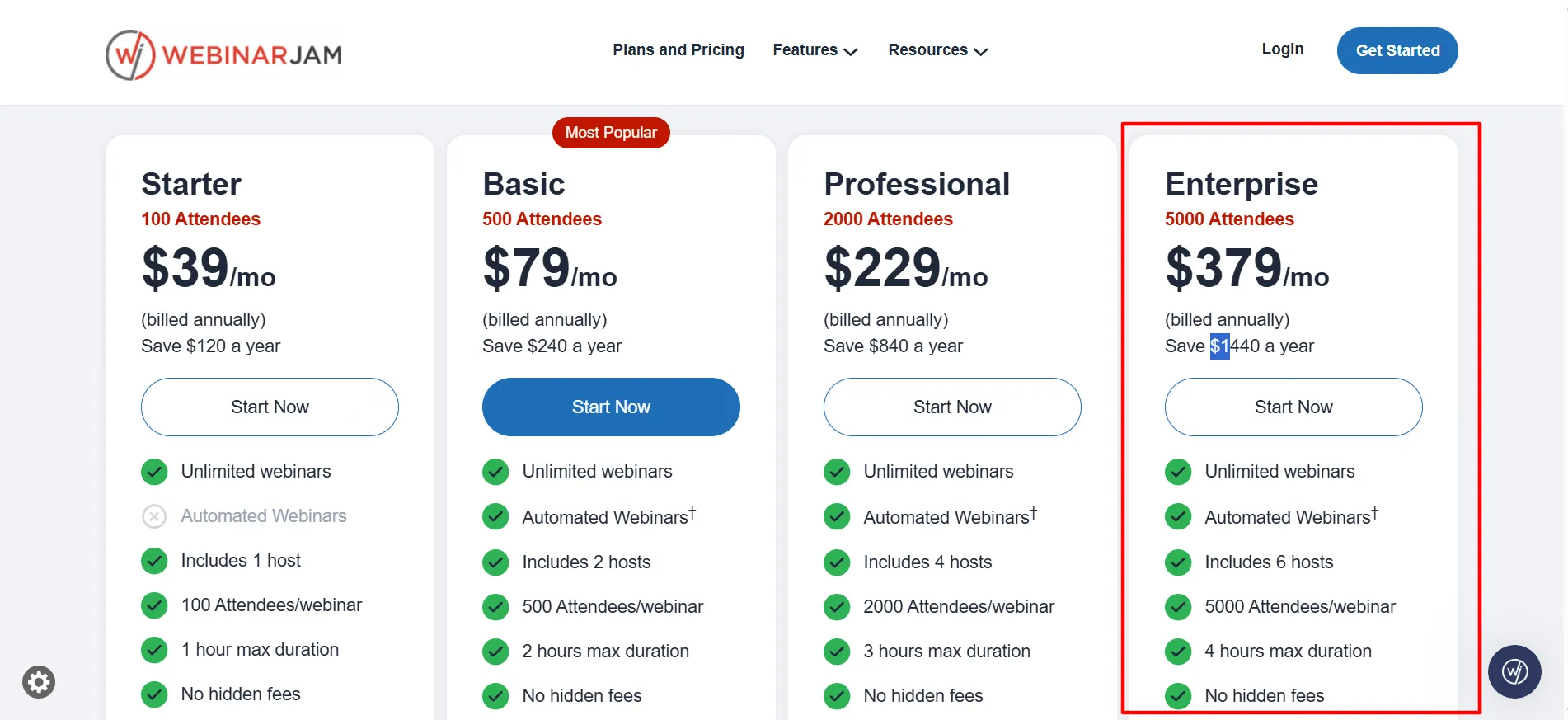
- Enterprise (Annual): $379 per month (Saves $1,440 annually; total $4,548/year).
Furthermore, all paid plans are backed by a 30-day money-back guarantee, providing a safety net for users who commit to an annual plan but discover structural mismatches during their initial month of active broadcasting.
Chronology: How WebinarJam’s Pricing Has Evolved to Meet Market Demands
The evolution of WebinarJam’s pricing tiers mirrors the broader maturation of the webinar software industry. Early iterations of live-streaming software typically charged flat fees or tied costs strictly to data bandwidth. However, as digital marketing matured into automated funnels, course launches, and evergreen webinars, user requirements fractured into distinct use cases.
- The Era of Fragmented Tools: In the early days of online marketing, hosts were forced to stitch together multiple software solutions—paying separately for landing page builders, email autoresponders, video hosting, and live-streaming codecs.
- The All-in-One Pivot: WebinarJam responded to this friction by bundling core marketing tools—such as customizable registration pages, A/B testing, SMS and email reminder sequences, and interactive chat features—directly into the webinar subscription.
- Integration of Evergreen Automation: With the acquisition and integration of sister tools like EverWebinar, mid-tier and upper-tier WebinarJam subscriptions began absorbing automated webinar functionalities. This allowed hosts to record a live session once and leverage it as an ongoing, automated lead-generation asset.
- Current Scaled Pricing: Today’s pricing matrix reflects a calculated effort to capture both bootstrapped solopreneurs (via the Starter and Basic tiers) and high-volume corporate launch engines (via the Professional and Enterprise tiers). By adjusting seat limits, session lengths, and team member permissions, WebinarJam ensures that users only pay for the infrastructure they actively consume.
Supporting Data: Granular Tier Analysis and Cost-Per-Attendee Metrics
To truly evaluate whether WebinarJam’s pricing is cost-effective, one must examine the cost-per-seat metrics and evaluate the specific operational limits assigned to each tier.
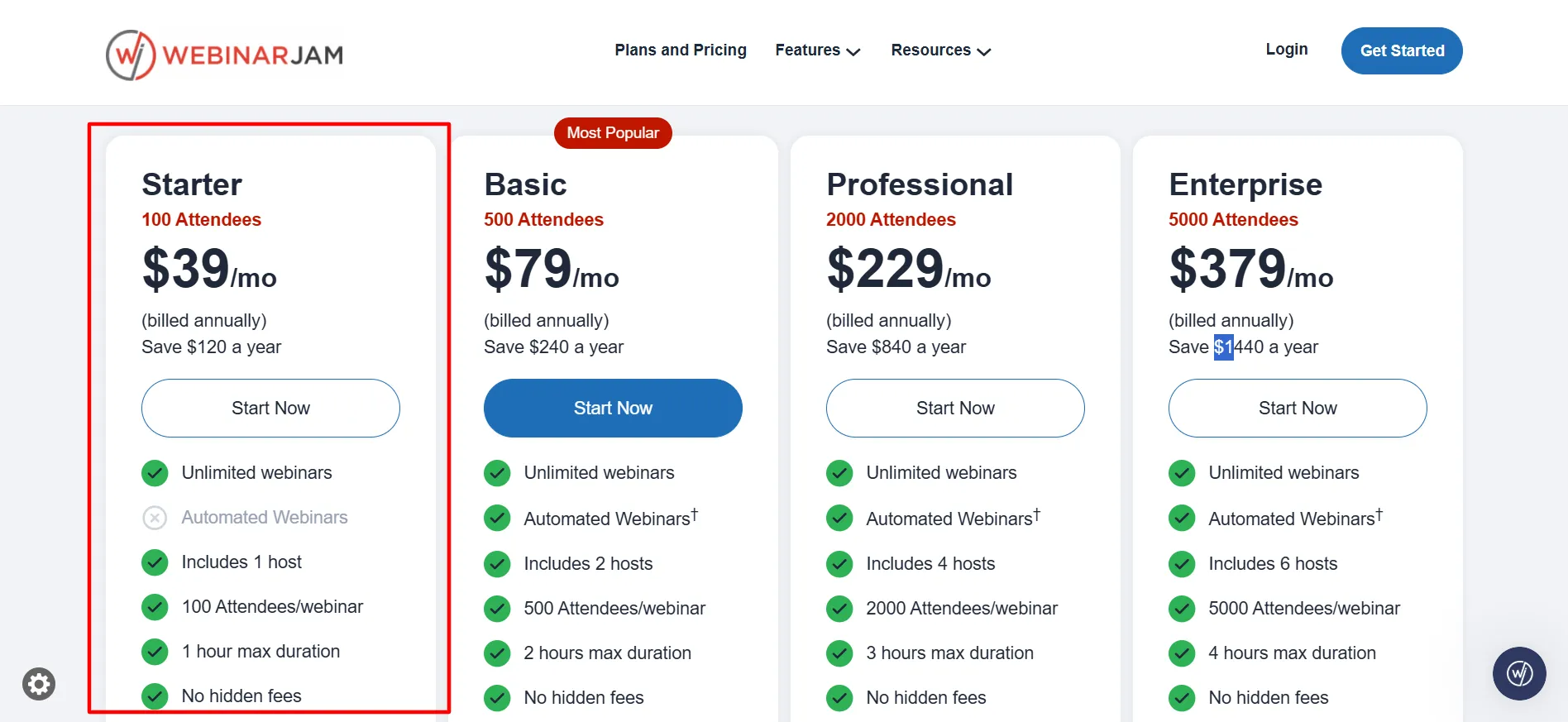
1. The Starter Plan ($39–$49/month)
- Capacity: 100 attendees
- Hosts: 1 host (plus 1 team seat)
- Session Limit: 1 hour
- Automated Replays: Not included
- Target Audience: Solopreneurs, career coaches, and consultants running occasional short workshops or introductory sales calls. Because automated replays are excluded, this tier is best suited for strictly live, real-time engagement.
2. The Basic Plan ($79–$99/month) — The Market Sweet Spot
- Capacity: 500 attendees
- Hosts: 2 hosts (plus 5 team seats)
- Session Limit: 2 hours
- Automated Replays: Included (via EverWebinar integration)
- Target Audience: Small businesses, established course creators, and educators. This is widely considered the most popular tier because it introduces automated webinar capabilities, allowing users to run evergreen funnels without purchasing separate software.
3. The Professional Plan ($229–$299/month)
- Capacity: 2,000 attendees
- Hosts: 4 hosts (plus 10 team seats)
- Session Limit: 3 hours
- Automated Replays: Included
- Target Audience: Mid-sized companies scaling up their digital product launches. The jump in price is substantial, making it economically unviable unless regular event attendance consistently eclipses the 500-attendee ceiling of the Basic plan.
4. The Enterprise Plan ($379–$499/month)
- Capacity: 5,000 attendees
- Hosts: 6 hosts (plus 25 team seats)
- Session Limit: 4 hours
- Automated Replays: Included
- Target Audience: Enterprise-level organizations and high-ticket marketing agencies. At this level, the cost is easily justified if a single large-scale product launch generates tens or hundreds of thousands of dollars in revenue.
The Economics of Cost-Per-Attendee
An analysis of the annual rates reveals an interesting efficiency curve. On the annual Basic tier, the cost breaks down to roughly 16 cents per potential attendee seat. By contrast, on the Enterprise tier, that figure drops closer to 8 cents per seat. While the headline monthly price is higher, high-volume users achieve greater economies of scale as their audience size expands.
Official Responses and Platform Capabilities: What Your Money Buys
When evaluating software subscriptions, consumers frequently question whether the feature set justifies the recurring monthly expenditure. WebinarJam’s official product documentation and user community responses emphasize that the subscription fee covers an entire ecosystem of marketing and broadcast utilities:
- Browser-Based Accessibility: Attendees are not required to download heavy desktop applications or plugins. They can join live sessions with a single click directly from any modern web browser.
- Interactive Engagement Tools: Every paid tier includes live chat moderation, interactive polls, surveys, on-screen whiteboards, and timed product offers that pop up at critical junctures during the presentation to drive immediate conversions.
- Conversion-Optimized Landing Pages: Users gain access to a library of customizable registration page templates equipped with built-in A/B testing capabilities, enabling marketers to iteratively optimize their sign-up conversion rates.
- Omnichannel Reminders: Automated email and SMS reminder sequences are managed from a centralized dashboard, a feature consistently cited by users as vital for reducing drop-off rates and increasing live-room attendance.
- Robust Analytics: Comprehensive post-webinar reporting tracks registration sources, attendance duration, peak drop-off moments, and final sales conversions, providing actionable data for future marketing campaigns.
Implications: Who Benefits, and Who Overpays?
The financial implications of adopting WebinarJam vary dramatically depending on a business’s revenue model, technical maturity, and marketing strategy.
Who Finds the Pricing Reasonable?
- Digital Course Creators & High-Ticket Coaches: For professionals who sell products, masterminds, or consulting packages via live training, the math is overwhelmingly favorable. Converting even a tiny fraction of a 300-person live audience on the Basic plan can easily cover the monthly subscription fee many times over.
- Marketers Consolidation Tech Stacks: Hosts who previously paid separate fees for standalone landing page software, email marketing schedulers, SMS alert gateways, and webinar hosting find that consolidating these tools into WebinarJam often reduces their total monthly software expenditures.
- Non-Technical Entrepreneurs: Because the platform relies on browser-based streaming and intuitive drag-and-drop templates, non-technical users can deploy complex sales funnels without hiring dedicated developers or video engineers.
Points of Friction and Potential Overpayment
- Rigid Session Caps: Exceeding time limits (e.g., attempting a 90-minute workshop on the 60-minute Starter plan) or overcrowding a room beyond its maximum attendee cap can disrupt live events or trigger overage penalties. Careful capacity forecasting is required before launching major marketing campaigns.
- Redundancy for Advanced Enterprises: Businesses that already utilize enterprise-grade marketing automation suites (such as HubSpot or ActiveCampaign combined with custom video delivery networks) may find that they are paying for redundant landing page and email features embedded within WebinarJam.
- Support Latency During Peak Hours: During massive, industry-wide product launch windows, technical support response times can occasionally lag. High-stakes enterprise users are advised to execute comprehensive dry runs and stress-tests several days prior to going live.
Frequently Asked Questions (FAQs)
1. What are the exact monthly and annual rates for WebinarJam?
Monthly rates are $49 (Starter), $99 (Basic), $299 (Professional), and $499 (Enterprise). Opting for annual billing reduces those effective monthly rates to $39, $79, $229, and $379, respectively.
2. Is there a free trial available?
WebinarJam offers a 14-day trial for $1. This trial grants full access to Basic-level features, including a 500-attendee capacity, two hosts, and a two-hour session limit.
3. Are automated webinars included across all plans?
Automated webinar tools (powered by EverWebinar integration) are included for free on the Basic, Professional, and Enterprise plans. They are excluded from the Starter tier.
4. Can I cancel my trial before being charged for a full subscription?
Yes. If you cancel your account before the 14-day trial period concludes, your paid subscription will not activate, and you will not incur further charges.
5. What is the refund policy for paid subscriptions?
Paid plans are protected by a 30-day money-back guarantee. If the platform proves to be an ill fit, users can request a full refund through customer support within 30 days of their initial paid transaction.
6. How are attendee limits enforced?
Limits count the precise number of concurrent human participants present in the live room at any given moment. Exceeding this cap during a live broadcast can result in locked rooms or unexpected overage fees, making tier selection a critical pre-launch task.
Final Notes on WebinarJam Pricing
Ultimately, WebinarJam’s pricing model is engineered for revenue-generating hosts who rely on live interaction to drive sales, client onboarding, and community growth. The $1 trial provides a risk-free environment to test live engagement with a real audience, while annual billing offers a straightforward way to trim roughly 20% off operational overhead.
For the vast majority of digital creators, small business owners, and online educators, the Basic plan strikes the optimal balance between attendee capacity, team permissions, and built-in automation features. By carefully auditing your expected audience size, session lengths, and funnel requirements, you can select a tier that maximizes your return on investment while keeping software expenditures securely under control.
Affiliate Disclosure: In full transparency, some of the links on this website are affiliate links. If you use them to make a purchase, we will earn a commission at no additional cost to you whatsoever.