Global Report — In an era where digital literacy is as fundamental as reading and writing, educational initiatives are bridging the gap between theoretical computer science and practical, real-world application. Fueled by a shared open-source ethos, the global WordPress education ecosystem is experiencing unprecedented growth.
From the bustling classrooms of Kishoreganj, Bangladesh, where students rapidly built 108 websites in a single fortnight, to an innovative workshop in eastern Uganda that successfully pivoted despite a total lack of electricity, young learners across the globe are discovering the power of the web. These initiatives—specifically WordPress Campus Connect and WordPress Credits—are transforming novices into creators, proving that geographic and economic barriers are no match for community-driven education.
Main Facts: A Global Movement in Numbers
The July 2026 impact reports highlight a thriving, borderless network dedicated to digital empowerment. At the heart of this movement are two complementary programs designed to scale technical education seamlessly:
- WordPress Campus Connect: Delivers free, hands-on, volunteer-led WordPress workshops to schools and universities using a standardized, collaborative curriculum.
- WordPress Credits: Offers a deeper dive, placing students in structured, mentored internships where they contribute directly to the core WordPress software while earning academic credit.
Key Milestones Reached in July 2026:
- Rapid Development: Students across two campuses in Kishoreganj, Bangladesh, successfully designed and deployed 108 websites within a two-week window.
- Scaling Internships: The WordPress Credits program expanded to 226 active graduates in July (up from 199 in June), engaging 38 partner educational institutions spanning 16 countries.
- Cost-Free Access: Zero financial investment is required from participating students, many of whom touch a content management system or write code for the first time during these sessions.
- Global Diversity: Activities range from AI-assisted plugin development in Spain to localization projects in Costa Rica and student-led initiatives in Japan and Bangladesh.
Chronology of Events: A Month of Breakthroughs
The momentum of July 2026 unfolded through a series of remarkable localized events, each demonstrating the adaptability and resilience of the WordPress education framework.
Early July: The Kishoreganj Marathon (Bangladesh)
Organized by Muhibul Haque, the Kishoreganj educational series kicked off with immense energy. In the first phase, students at Kishoreganj University built 38 functional websites. Shortly after, the program moved to the Kishoreganj Polytechnic Institute. Despite logistical challenges, guest speaker Shipon Karmakar traveled over 80 kilometers to support the event. By the conclusion of the fortnight, students had constructed nearly 70 additional sites, pushing the total to 108.

Mid-July: Innovation Meets AI in Spain
In Mataró, Spain, educator Josep Morán took a high-tech approach with 100 vocational students at Escola Pia Sta. Anna. Over two intensive four-hour sessions, students leveraged WordPress Playground and artificial intelligence tools to build a fully functional plugin designed to calculate optimal shore-fishing times for the local coastal area.
Late July: The Powerless Triumph in Eastern Uganda
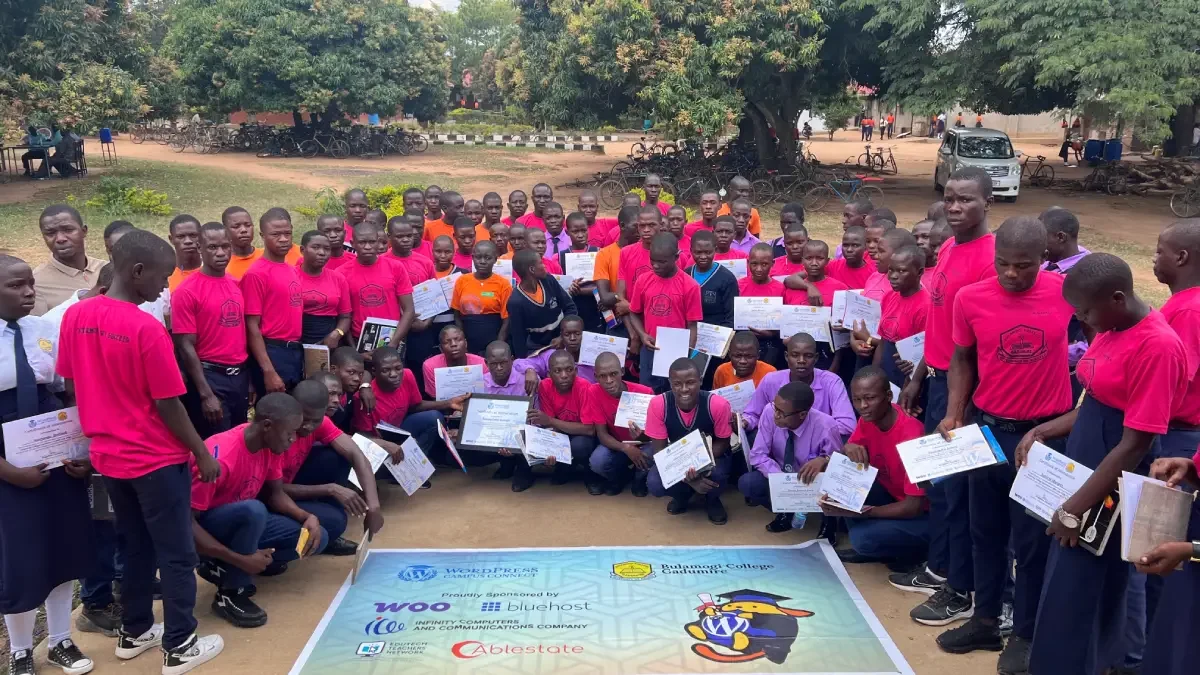
Perhaps the most striking test of the program’s resilience occurred on July 29 at Bulamogi College Gadumire in Kaliro, eastern Uganda. The event was made possible by Mariam Nairuba, a former student who advocated for her alma mater after experiencing a previous WordPress event.
When the volunteer team—led by Moses Ssebunya and first-time volunteer John Wayera—arrived with laptops, extension cables, and a projector, they were met with an unexpected reality: the school had no electricity. Rather than canceling the workshop, the educators adapted. They transformed the session into an interactive town hall, asking the more than 100 assembled learners what they knew about the web and what they wanted to build. The room engaged deeply, discussing web security, open-source economics, and career pathways while John Wayera transcribed questions and answers onto a blackboard.
Late July: Student-Led Success in Costa Rica
Rita Robles Loaiza spearheaded two distinct pilot projects in Costa Rica demonstrating peer-to-peer education. First, three students from Universidad Fidélitas designed and led a workshop for 40 high school girls at the Patrones Hermosos STEM camp (run jointly by Tecnológico de Monterrey and MIT). Achieving a 100% satisfaction rate, these university mentors documented their methodology into a replicable guide for global use. Simultaneously, 13 students at Liceo Experimental Bilingüe José Figueres Ferrer began translating WordPress into the local Costa Rican Spanish variant (es_CR) to satisfy their community service requirements.
Supporting Data and Operational Framework
The success of these programs lies in their structured, repeatable design. Rather than relying on sporadic, ad-hoc tutoring, WordPress Education relies on a formalized framework that benefits schools, volunteers, and students alike.

Program Structure Breakdown
| Program Name | Target Audience | Core Activities | Primary Outcomes |
|---|---|---|---|
| Campus Connect | High schools, vocational institutes, universities | Hands-on, volunteer-led workshops using a shared curriculum | Foundational digital literacy, website creation, completion certificates |
| WordPress Credits | Advanced vocational and university students | Mentored software contributions, open-source development | Academic credits, resume-building experience, core code contributions |
| Student Clubs | Campus-based peer groups | Ongoing collaborative meetings, localized event organizing | Long-term technical communities, peer mentorship |
Replicability and Global Reach
The creation of open-source guides—such as the Costa Rican workshop manual—ensures that knowledge is not siloed. By empowering students to teach other students, the ecosystem creates a sustainable pipeline of digital literacy that operates independently of heavy corporate sponsorship or expensive licensing fees.
Official Responses and Perspectives
The human element of these initiatives remains their strongest driving force. Organizers, institutional leaders, and student participants alike have shared profound insights regarding the psychological and professional shifts catalyzed by these workshops.
The Power of Adaptability
Reflecting on the powerless workshop in Uganda, organizers noted the raw enthusiasm of the students:
"The room exploded. Students asked whether WordPress was free, how secure WordPress sites really are, and whether they could become developers themselves."
This spontaneous engagement proved that curiosity and a desire to learn transcend technological infrastructure.
Bridging the Gender Gap in STEM
Discussing the success of the all-girls workshop at the Patrones Hermosos camp in Costa Rica, program coordinators emphasized the importance of representation:

Having recent university students teach high schoolers creates an approachable bridge into technical fields, proving that STEM careers are accessible, collaborative, and deeply creative.
Institutional Validation
At Bulamogi College Gadumire, the visit culminated in the presentation of a Certificate of Appreciation to the Head Teacher in front of the school’s governing body—signifying that open-source web technologies are increasingly viewed by traditional academic administrators as vital vocational tools rather than casual hobbies.
Implications for the Future of Web Education
The rapid expansion of WordPress Campus Connect and WordPress Credits signals a broader shift in how technical skills are acquired in the 21st century.
- Democratization of Digital Real Estate: With students in developing regions building dozens of functional websites in mere days, local businesses, community groups, and civic organizations gain a direct pipeline of young digital architects capable of bringing regional enterprises online.
- Sustainable Open-Source Contributions: By integrating software contribution into academic structures via the Credits program, WordPress secures a diverse, global pipeline of future developers who understand the value of community-maintained software.
- The Rise of Peer-to-Peer Pedagogy: The model of "students teaching students"—seen clearly in Costa Rica, Japan, and Bangladesh—subverts traditional top-down educational hierarchies. It fosters leadership, empathy, and communication skills that extend far beyond technical coding proficiency.
As captured in the July 2026 Monthly Education Buzz Report—which noted entirely student-led Campus Connect events at the Kyoto University of Advanced Science and thriving student clubs in Dhaka—the movement is no longer just about building websites. It is about building self-sufficient communities capable of shaping the digital future on their own terms.