










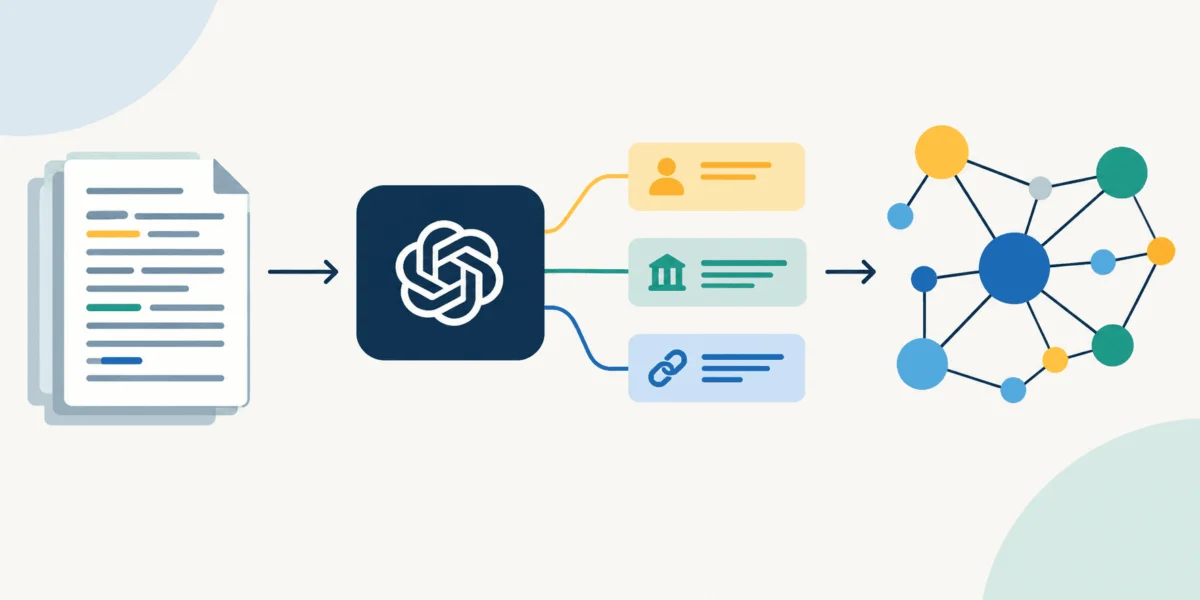
In the evolving landscape of Artificial Intelligence, the transition from unstructured data to actionable, deterministic intelligence remains a primary hurdle for developers. While vector-based Retrieval-Augmented Generation (RAG) systems have revolutionized how machines query information, they are inherently probabilistic—prone to the occasional, yet costly, hallucination. By shifting toward a Graph-RAG architecture, developers are now finding a path to ground-truth accuracy.
This article explores the end-to-end automation of populating a knowledge graph using SPOC (Subject-Predicate-Object-Context) quads, powered by local Large Language Models (LLMs) via Ollama. By removing the dependency on costly cloud APIs and opaque data processing, we can construct a transparent, local, and highly efficient pipeline for structured knowledge extraction.
The Core Challenge: Beyond Vector Search
The primary limitation of traditional vector search is its reliance on semantic similarity rather than factual accuracy. When a user queries a vector database, the system retrieves text chunks that "feel" relevant based on embedding vectors. However, the system does not "understand" the underlying relationships between entities.
This is where the 3-Tiered Graph-RAG system shines. By storing information as structured triples—or more robustly, as quads—we enable the system to perform deterministic lookups. A quad adds a fourth dimension: Context. By documenting the source of a fact, we can weight information, resolve conflicts between competing data sources, and provide citations for every claim generated by an LLM.
Chronology of the Extraction Pipeline
To transform raw text into a machine-readable graph, the process must follow a rigorous, step-by-step workflow:
- Environment Initialization: Setting up the local server environment (Ollama) and necessary Python dependencies.
- Data Acquisition: Pulling raw, unstructured text from authoritative sources, such as Wikipedia.
- Knowledge Extraction: Prompting an LLM to parse the prose and identify atomic relationships.
- Schema Normalization: Converting loose LLM output into a standardized JSON format.
- Graph Ingestion: Mapping the extracted quads into the
QuadStoredatabase engine.
Setting Up the Infrastructure
The beauty of this approach is its portability. Whether you are running an experiment in Google Colab or managing a private server in your local development environment, the architecture remains consistent.
Local Server Deployment
By leveraging Ollama, we bypass the latency and privacy concerns of commercial LLM providers. Once the Ollama server is active, we initialize the Llama 3.2 model—a lightweight, highly efficient model capable of strict JSON output.
import subprocess
import time

# Initiating the background process
process = subprocess.Popen(["ollama", "serve"], stdout=subprocess.DEVNULL, stderr=subprocess.DEVNULL)
time.sleep(3) # Allowing the handshake between the OS and the server

# Pulling the model locally
subprocess.run(["ollama", "pull", "llama3.2"])
Dependency Management
To facilitate the extraction, we require wikipedia for data gathering and requests to interface with the local API. This minimal footprint ensures that the system is not only scalable but also easily maintainable within existing production environments.
Constructing the Knowledge Engine
Central to our system is the QuadStore class. While production systems might utilize GraphDB or Neo4j, a lightweight Python implementation provides the necessary proof of concept to understand the underlying logic of quad-based storage.
The SPOC Quad Logic
A traditional triple, (Subject, Predicate, Object), lacks accountability. By appending the Context—such as the specific Wikipedia page title—we transform the data into a SPOC Quad. This structure allows us to query the graph not just by what the fact is, but where it originated, allowing for complex filtering.
class QuadStore:
    def __init__(self):
        self.quads = []

    def add(self, subject, predicate, obj, context):
        quad = (subject, predicate, obj, context)
        if quad not in self.quads:
            self.quads.append(quad)
Extracting Entities: The LLM as a Processor
The most critical component is the prompt engineering used to extract these facts. Because LLMs are inherently creative, we must enforce a "System Role" that constrains their output to strict JSON. By setting the temperature to 0.0, we ensure that the model behaves as a deterministic function, minimizing stylistic variation in the extracted predicates.
The Prompt Engineering Strategy
When sending the text to the model, we provide a concrete example of the expected schema. This "few-shot" or structured instruction approach forces the model to ignore formatting fluff and focus entirely on the subject-predicate-object structure.
  "facts": [
    "subject": "Alan Turing", "predicate": "was", "object": "a mathematician",
    "subject": "Alan Turing", "predicate": "worked for", "object": "Bletchley Park"
  ]
Implications for Data Science and RAG
The implications of this workflow extend far beyond mere data organization. By automating the population of a knowledge graph, we solve the "Cold Start" problem of Graph-RAG.
1. Enhanced Factual Accuracy
By using a local, deterministic database, the RAG system can verify every assertion. If an LLM suggests a fact, the system can perform a secondary check against the QuadStore. If the fact does not exist as a verified quad, the system can flag it as "unverified" or "hallucinated," significantly increasing user trust.
2. Conflict Resolution
In a real-world scenario, you might have two Wikipedia articles that contradict each other. Because each quad is tagged with a context label, your retrieval engine can prioritize information from more reputable or more recent sources, effectively performing "source-aware" reasoning.
3. Cost-Efficiency
Traditional RAG pipelines often involve sending massive context windows to cloud LLMs, leading to exorbitant token costs. By distilling thousands of pages of raw text into a lightweight, searchable knowledge graph, you reduce the prompt size significantly. You are querying the graph, not the entire document, which leads to massive reductions in inference costs and latency.
Practical Application: Analyzing Alan Turing
To demonstrate, we extracted data from the Wikipedia entry for Alan Turing. Within seconds, the local Llama 3.2 instance parsed two paragraphs into eleven distinct, structured facts.
Extracted Data Snapshot:
- S: Alan Mathison Turing | P: was born | O: in London | C: Wikipedia_Alan_Turing
- S: Alan Mathison Turing | P: graduated from | O: King’s College, Cambridge | C: Wikipedia_Alan_Turing
- S: Alan Mathison Turing | P: led | O: Hut 8 | C: Wikipedia_Alan_Turing
This structured data is now ready for programmatic traversal. For instance, if a user asks, "Where did Alan Turing earn his doctorate?" the system no longer needs to perform a "fuzzy" search; it performs a precise database query on the QuadStore, returning an exact, cited answer.
Future Directions: Moving Toward Autonomous Knowledge Bases
The methodology presented here is a foundational step toward truly autonomous knowledge management. As these models become more sophisticated, the "Context" field can be expanded to include metadata such as publication date, confidence score, and cross-references to other articles.
Furthermore, by chaining multiple LLM passes, we can perform "Graph Consolidation." This is a process where the model reviews the current QuadStore to merge synonyms (e.g., recognizing that "Alan Turing" and "Turing" refer to the same entity) and prune redundant or contradictory entries.
Conclusion
Automating the population of a knowledge graph is no longer a privilege reserved for large enterprises with massive engineering teams. With tools like Ollama and lightweight Python implementations like QuadStore, individual developers can build robust, private, and deterministic intelligence systems. By bridging the gap between unstructured text and structured graphs, we are effectively teaching our AI models to "read" the world with the precision of a database and the reasoning capabilities of a neural network.
The future of RAG is not just in bigger models, but in better-structured knowledge. By closing the loop on data extraction, we have moved one step closer to reliable, hallucination-free AI.



