










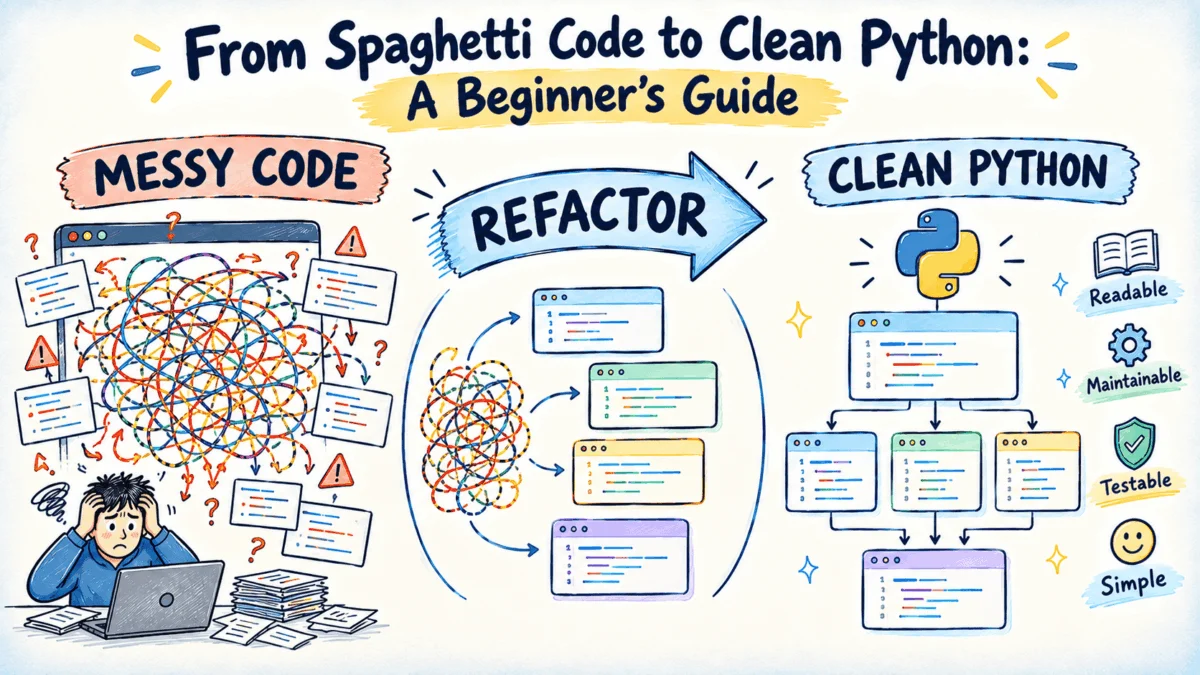
In the world of software engineering, "spaghetti code" is more than just a colorful metaphor; it is a persistent technical debt that plagues development teams and individual programmers alike. Characterized by tangled logic, obscure dependencies, and an impenetrable web of interlinked operations, spaghetti code turns simple tasks into high-stakes debugging sessions. When a single Python function attempts to handle every step of a complex process—from business logic and data mutation to side-effect management—it becomes brittle.
This article explores the journey from unmaintainable, monolithic scripts to clean, modular, and testable Python architectures. By refactoring a representative order-processing module, we will illustrate how small, deliberate changes in structure can lead to massive improvements in code health.
Main Facts: The Anatomy of a Messy Function
The primary challenge in maintainable coding is the "God Function"—a single block of code that tries to do too much. When a function calculates pricing, manages inventory, applies discounts, and triggers notifications simultaneously, it creates a "hidden coupling."
Consider the following order-processing function:
inventory = "sku-1042": 18, "sku-2077": 4

def process_order(order):
    total = 0
    for item in order["items"]:
        price = item["unit_price"] * item["quantity"]
        # The logic below is flawed: it depends on order position
        if order["customer_type"] == "vip":
            price = price * 0.85
        elif order["customer_type"] == "regular" and total > 100:
            price = price * 0.95
        total += price
        if item["sku"] in inventory:
            inventory[item["sku"]] -= item["quantity"]
        else:
            print(f"Warning: item['sku'] not found in inventory")
    # Shipping logic bundled in the same scope
    if total > 500:
        shipping = 0
    else:
        shipping = 12.99
    total += shipping
    return total
This code suffers from three critical issues:
- Side Effects: It mutates the global
inventorydictionary directly within the loop. - Logic Bugs: The discount rule for "regular" customers relies on a running
totalrather than the final calculated subtotal, creating a bug that triggers only depending on the order of items in the list. - Tight Coupling: The function is impossible to test in isolation because you cannot verify the discount logic without also modifying the inventory or calculating shipping.
Chronology: The Refactoring Process
Refactoring is not about rewriting everything from scratch; it is a systematic process of decomposition. By following a disciplined approach, developers can transform a chaotic script into a professional-grade module.
Phase 1: Decoupling Responsibilities
The first step is to extract logic into pure functions. A "pure" function is one that returns an output based solely on its input, without modifying external variables. We can break the order processor into:
calculate_subtotal()apply_discount()calculate_shipping()
Phase 2: Introducing Data Structures
Passing around loose dictionaries (e.g., order["items"]) is a recipe for runtime errors. By using Python’s dataclasses, we can enforce a formal schema. This turns "guessing" about key names into "knowing" about object attributes.
Phase 3: Error Handling over Logging
The original script used print statements to signal errors, allowing the program to continue in an unstable state. Refactoring requires shifting to raise statements, which force the application to halt or handle the error explicitly when a data integrity issue—like an out-of-stock SKU—occurs.
Supporting Data: Why Modularization Wins
The transition to clean code is not merely an aesthetic preference; it is a measurable improvement in developer productivity.
| Feature | Messy Code (Monolithic) | Clean Code (Modular) |
|---|---|---|
| Testing | Requires full environment setup | Isolated unit tests per function |
| Debugging | Time-intensive tracing | Pinpointed via stack trace |
| Maintainability | High risk of regression | Low; changes are localized |
| Scalability | Near impossible | Easy to add new logic/rules |
By utilizing frameworks like pytest, developers can test the apply_discount logic with a single line of code: assert apply_discount(200, "vip") == 170.0. In the monolithic version, testing this would require crafting an entire dummy order and mocking the inventory state, drastically increasing the overhead of the test suite.
Official Perspective: The Importance of Type Hints
Modern Python development emphasizes static analysis. By adding type hints to our refactored process_order function, we empower IDEs and linters (such as mypy or ruff) to catch bugs before the code ever runs.
When we define:
def process_order(order: Order, inventory: dict[str, int]) -> float:
We are providing a contract to other developers. If someone attempts to pass a standard dictionary instead of an Order object, the development environment will flag the mismatch immediately. This shifts the "burden of proof" from the developer’s memory to the machine’s static analysis tools.
Implications: The Long-Term Impact on Development
The implications of adopting these clean-code practices extend far beyond the immediate project.
1. Enhanced Code Review Processes
When code is broken into focused, single-responsibility functions, the "diffs" in a pull request become significantly smaller and easier to read. Reviewers spend less time untangling logic and more time verifying the business requirements.
2. Improved Onboarding
New team members can grasp the flow of a system by reading the coordinator function (the "orchestrator") without needing to parse the low-level implementation details of every calculation. It turns code into documentation.
3. Resilience to Change
When business rules change—for instance, if the shipping threshold increases from $500 to $750—the developer only needs to modify the calculate_shipping function. There is zero risk of accidentally breaking the inventory tracking or the discount application.
4. Preventing "Hidden" Bugs
The bug discovered in the original script—where regular customers only received a discount if the running total surpassed the threshold mid-loop—is a classic example of "temporal coupling." By decoupling the calculation of the subtotal from the application of the discount, we effectively eliminate the dependency on execution order, making the system deterministic.
Conclusion: Implementing the Shift
To move your own code toward this model, follow this four-step transition strategy:
- Identify the "God" function: Find the piece of code you dread editing.
- Extract to pure functions: Create small functions for each distinct mathematical or logical step.
- Formalize data models: Replace dictionaries with
dataclassesorPydanticmodels to ensure structural integrity. - Implement robust error handling: Swap
printstatements forExceptions.
As you iterate, remember that refactoring is a journey, not a destination. By focusing on single-responsibility functions, you move away from the "spaghetti" trap and toward a robust, maintainable codebase that can evolve alongside your project’s needs. Whether you are a solo developer or part of a large engineering team, these patterns are the foundation of professional-grade software development.
For those interested in exploring these concepts further, the source code and implementation examples are available on the GitHub repository for Python Basics.