










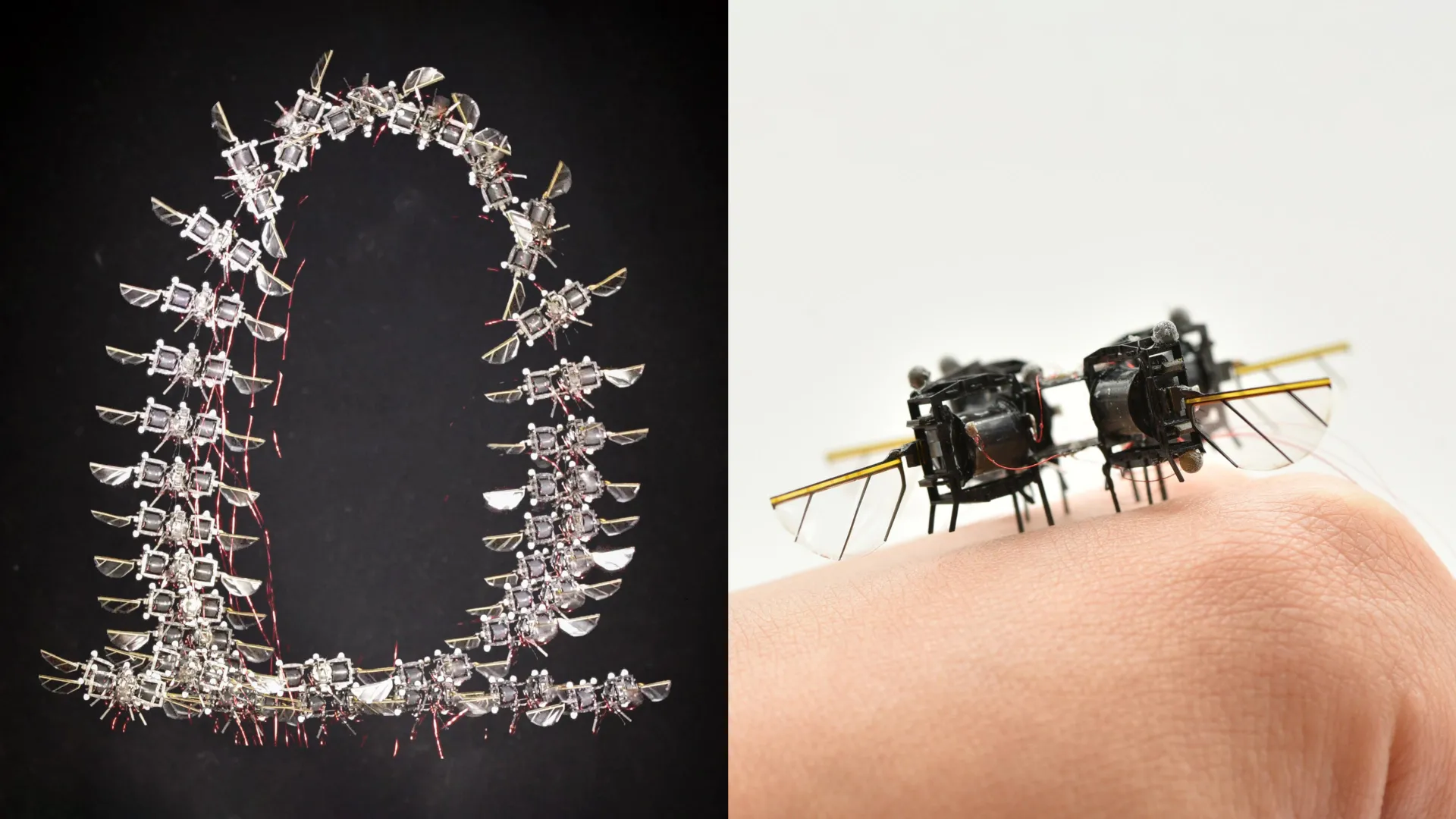
CAMBRIDGE, Mass. — In the shadowed, hazardous aftermath of a catastrophic earthquake, every second counts. When concrete slabs fracture, structural supports buckle, and subterranean spaces collapse into perilous mazes, traditional rescue operations face immediate limitations. Large search-and-rescue drones, invaluable for open-air scouting, are fundamentally too bulky to squeeze through the narrow, debris-choked crevices where survivors might be trapped.
For years, roboticists have envisioned a different class of subterranean first responders: tiny, insect-scale flying robots capable of slipping through needle-eye gaps, weaving past falling debris, and navigating environments entirely inaccessible to conventional machinery. Yet, a stubborn technological chasm has separated these mechanical marvels from their biological inspirations. While real bees, flies, and dragonflies dart, hover, and execute breathtaking aerial acrobatics with effortless precision, artificial microrobots have historically lagged far behind—constrained by sluggish flight paths, limited maneuverability, and primitive control architectures.
That paradigm is now shifting.
In a breakthrough that bridges the gap between biology and machine learning, researchers at the Massachusetts Institute of Technology (MIT) have developed a novel artificial intelligence-driven controller that endows an insect-scale flying robot with unprecedented speed, agility, and physical responsiveness. The newly engineered system allows the robotic bug to execute demanding, high-speed aerial maneuvers—including breathtaking sequences of continuous body flips—while actively resisting external wind disturbances.
Published in the journal Science Advances, the research marks a critical milestone in micro-robotics, pushing artificial flyers closer to the astonishing flight performance found in nature.
Main Facts: Engineering the Next Generation of Micro-Flyers
The newly unveiled robotic system is a testament to multidisciplinary engineering, combining cutting-edge materials science with advanced aerospace control theory.
Roughly the size of a microcassette and weighing less than a standard paperclip, the MIT robot is an exercise in extreme miniaturization. Its physical architecture relies on larger, more durable flapping wings driven by advanced soft artificial muscles. These synthetic muscles contract at extraordinary speeds, generating the rapid wingbeats required to lift the featherlight chassis into the air.
However, upgrading the hardware was only half the battle. For years, the primary bottleneck holding back aerial microrobots was their "brain"—the flight controller responsible for spatial awareness, trajectory planning, and real-time motor commands.
In previous iterations, human engineers had to painstakingly tune these controllers by hand. This manual approach proved entirely inadequate for orchestrating the fast, aggressive movements characteristic of real insects. To achieve insect-like agility, the robot needed a controller capable of navigating extreme aerodynamic uncertainties while solving immensely complex physical equations in real time.
The breakthrough came when researchers from MIT’s Soft and Micro Robotics Laboratory joined forces with experts from the Laboratory for Information and Decision Systems (LIDS). By designing a sophisticated, two-part AI-based control framework, the team achieved staggering performance gains:
- Speed Boost: The robot’s flight speed increased by approximately 450 percent.
- Acceleration Surge: Acceleration capabilities jumped by roughly 250 percent.
- Unmatched Agility: The microrobot successfully completed 10 consecutive aerial somersaults in just 11 seconds, demonstrating a remarkable capacity to recover balance even when buffeted by disruptive artificial wind currents.
Chronology of Innovation: From Concept to Breakthrough
The realization of this agile microrobot represents the culmination of more than five years of rigorous, incremental research at MIT.
Phase One: Hardware Maturation (2019–2023)
For over half a decade, Kevin Chen’s research group focused heavily on resolving the physical limitations of micro-flight. Building a robot small enough to mimic an insect meant confronting extreme scaling laws: aerodynamics at the millimeter scale behave radically differently than they do for larger quadcopters. Air feels thicker, viscous forces dominate, and traditional motors are far too heavy.
The team spent years refining the robot’s physical structure, culminating in a durable microcassette-sized chassis powered by high-frequency soft actuators. This hardware iteration successfully provided the raw physical thrust and wing-surface area required for aggressive flight maneuvers, setting the stage for software innovation.
Phase Two: The Computational Bottleneck
By early 2023, the physical hardware had outpaced the software. While the robot’s wings could theoretically flap fast enough to perform complex stunts, the onboard and external computing systems lacked a controller smart enough to exploit that physical potential without causing the robot to crash.
Standard model-predictive control algorithms—which use mathematical models to predict future behavior and plan optimal paths—possess the necessary foresight to calculate difficult maneuvers like flips and sharp turns. However, they are computationally ravenous. Running such heavy algorithms in real-time for a hyper-sensitive, lightweight flying machine was previously deemed computationally impossible.
Phase Three: The Two-Step AI Integration
To shatter this computational barrier, Chen’s laboratory teamed up with Professor Jonathan P. How’s group in the Department of Aeronautics and Astronautics (AeroAstro).
The collaborative team formulated an elegant, two-step control architecture. First, they deployed an offline "expert" model-predictive controller capable of calculating complex, high-speed trajectories, accounting for physical limits in force and torque. Next, using an advanced machine learning technique known as imitation learning, they distilled this expert planner into a deep-learning neural network policy.
This policy acts as the robot’s real-time decision-making engine. It captures the advanced planning capabilities of the heavy mathematical model but compresses them into a lightweight, ultra-fast AI algorithm capable of executing instantaneous flight corrections.
Phase Four: Demonstration and Validation
In subsequent flight tests, the integrated system was put to the ultimate test. Not only did the robot hit unprecedented speed and acceleration benchmarks, but it also proved its resilience under fire. Placed in environments subjected to unpredictable wind disturbances, the AI-controlled flyer successfully self-corrected, maintaining its designated flight path within a tight margin of 4 to 5 centimeters.
Supporting Data: By the Numbers
The quantitative leaps achieved by the MIT research team underscore the dramatic efficiency of the new AI control framework:
- 447% Increase in Top Speed: The robot shattered previous velocity limits, drastically reducing transit times across localized spaces.
- 255% Increase in Acceleration: Sudden bursts of speed now allow the machine to dart and brake with insect-like abruptness.
- 10 Flips in 11 Seconds: Demonstrating elite stability, the robot executed ten consecutive aerial somersaults without losing structural integrity or deviating wildly from its trajectory.
- 4-to-5 Centimeter Precision: Despite aggressive maneuvers and external wind interference, the machine adhered to its planned spatial corridor with millimeter-level accuracy.
- Sub-Paperclip Weight: Weighing less than a single paperclip, the robot achieves this massive behavioral upgrade without adding burdensome payload weight.
Official Responses and Expert Perspectives
The research, detailed in Science Advances, has drawn widespread praise across academic and engineering circles for bridging the gap between theoretical control systems and practical micro-robotics.
Kevin Chen, associate professor in the Department of Electrical Engineering and Computer Science (EECS) and co-senior author of the study, emphasized the biological inspiration driving the project:
"We want to be able to use these robots in scenarios that more traditional quadcopter robots would have trouble flying into, but that insects could navigate. Now, with our bioinspired control framework, the flight performance of our robot is comparable to insects in terms of speed, acceleration, and the pitching angle. This is quite an exciting step toward that future goal."
Chen also highlighted the broader philosophical shift the paper represents for the micro-robotics community:
"For the micro-robotics community, I hope this paper signals a paradigm shift by showing that we can develop a new control architecture that is high-performing and efficient at the same time."
Jonathan P. How, the Ford Professor of Engineering in AeroAstro and co-senior author, pointed to the symbiotic relationship between hardware and software development during the project:
"The hardware advances pushed the controller so there was more we could do on the software side, but at the same time, as the controller developed, there was more they could do with the hardware. As Kevin’s team demonstrates new capabilities, we demonstrate that we can utilize them."
Commenting on the mathematical rigor required to master repeated acrobatic feats like somersaults, How added:
"If small errors creep in, and you try to repeat that flip 10 times with those small errors, the robot will just crash. We need to have robust flight control… The robust training method is the secret sauce of this technique."
Yi-Hsuan Hsiao, EECS graduate student and co-lead author, noted the implications for multimodal locomotion:
"This work demonstrates that soft and microrobots, traditionally limited in speed, can now leverage advanced control algorithms to achieve agility approaching that of natural insects and larger robots, opening up new opportunities for multimodal locomotion."
Implications: The Future of Autonomous Micro-Flight
While the current iteration of the robot relies on an external motion-capture system to track its position during flight experiments, the implications of this research stretch far beyond the laboratory.
1. Search and Rescue Operations
The ultimate vision for these microrobots is deployment in disaster zones. Following earthquakes, structural collapses, or industrial accidents, swarms of insect-scale drones could be released into rubble piles. Equipped with their newfound agility, they could duck beneath fallen beams, navigate twisted reinforcement bars, and map out voids where human survivors may be trapped, transmitting vital video feeds to rescue workers stationed safely outside.
2. Onboard Sensing and Navigation
The next major engineering hurdle for Chen’s laboratory is miniaturization of perception. The team is actively working to equip the microrobots with onboard cameras and micro-sensors. This transition will free the robots from dependence on external motion-capture cameras, allowing them to operate fully autonomously in unfamiliar, GPS-denied environments.
3. Swarm Intelligence
Beyond single-robot navigation, researchers are eyeing the potential for coordinated multi-robot swarms. By integrating onboard sensing with the newly developed AI control policy, future iterations could communicate and coordinate with one another, avoiding mid-air collisions while cooperatively mapping complex, hazardous terrains.
4. Bio-Mimetic Maneuvers (Saccades)
The MIT team has already begun experimenting with complex insect behaviors like saccades—a rapid pitching motion where an insect abruptly changes its body orientation to brake or rapidly shift position. In nature, saccades help insects stabilize their vision while moving at high speeds. Mastering this behavior in robots paves the way for advanced optical navigation and environmental scanning.
Funding and Support
This groundbreaking research was supported by key scientific funding bodies, including the National Science Foundation (NSF), the Office of Naval Research, the Air Force Office of Scientific Research, MathWorks, and the Zakhartchenko Fellowship.
As these funding streams continue to fuel innovation, the boundary between natural biology and artificial engineering grows increasingly thin—bringing humanity one step closer to deploying a tireless, agile army of mechanical insects when disaster strikes.



