







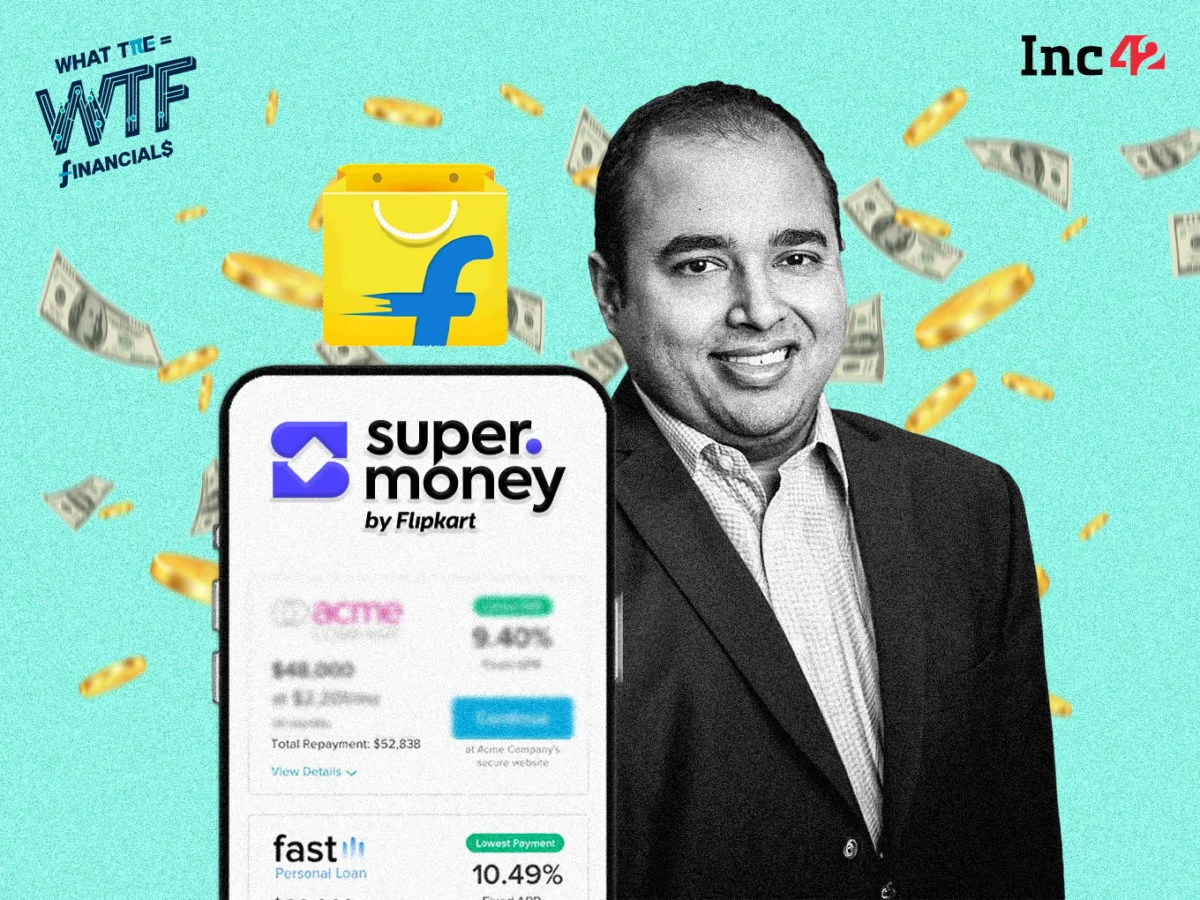
In the high-stakes arena of Indian fintech, Flipkart-backed super.money has emerged as a significant disruptor. As the startup navigates its second full year of operations, its financial disclosures for the fiscal year 2026 (FY26) paint a picture of a company in a state of hyper-growth, characterized by a massive surge in revenue, a strategic pivot toward high-margin credit products, and a substantial increase in operational burn.
The company, founded in 2024 by former Flipkart senior vice president Prakash Sikaria, has rapidly scaled its footprint. While the fintech’s expansion into loan facilitation has proven to be a primary revenue engine, the aggressive spend required to capture market share in the crowded Unified Payments Interface (UPI) ecosystem has widened its net losses.
The Financial Snapshot: Rapid Growth Amidst Rising Burn
Super.money’s FY26 financial report highlights a classic “growth-at-all-costs” strategy common among well-capitalized fintech startups in India.
The company reported a net loss of ₹263.8 Cr for FY26, marking a 78.5% increase from the ₹147.8 Cr loss incurred in the previous fiscal year. This expansion in losses was fueled by a 130% year-on-year (YoY) surge in total expenses, which climbed to ₹557.1 Cr from ₹241.8 Cr in FY25.
However, the top-line performance provides a more optimistic narrative. Operating revenue for the fintech more than tripled, soaring to ₹292.4 Cr from ₹88.8 Cr in FY25. When accounting for other income of ₹90 Lakh, the total income for the company stood at ₹293.3 Cr. After accounting for all expenses, the company recorded a total comprehensive loss of ₹262.9 Cr. The lack of tax expenses or exceptional items suggests that the losses are purely operational, stemming from deep investments in technology, customer acquisition, and infrastructure.
Chronology: From Beta Launch to Market Challenger
The journey of super.money has been swift and deliberate. Launched in 2024, the platform was incubated under the Flipkart ecosystem, leveraging the internal expertise of Prakash Sikaria. Sikaria, a veteran of the Flipkart leadership team, previously helmed key business units including the company’s advertising wing, the social commerce platform Shopsy, the travel aggregator Cleartrip, and the fashion marketplace Myntra.
2024: The Incubation Phase
The app went live in beta mode with a focus on capturing the massive UPI market. By leveraging Flipkart’s existing user base and brand trust, super.money sought to establish immediate relevance in a market dominated by incumbents like PhonePe, Google Pay, and Paytm.
2025: Diversification
Moving beyond simple P2P and merchant payments, the company began integrating value-added financial services. Recognizing that UPI payments alone offer thin margins, the startup transitioned toward becoming a comprehensive financial marketplace.
2026: The Year of Scaling
FY26 marked the period where super.money cemented its position as a top-five player in the UPI ecosystem. By September 2026, the company was processing over 40.51 Cr transactions monthly, with a total volume exceeding ₹19,613.3 Cr. This scale provided the necessary data and user traffic to fuel its pivot into loan facilitation and credit products.
Supporting Data: The Loan Facilitation Pivot
The most significant takeaway from super.money’s FY26 performance is its successful transition into a loan marketplace. While its origin lies in UPI payments, the revenue data suggests that payments are effectively acting as a customer acquisition tool, while credit is the profit driver.

- Loan Marketplace Dominance: Approximately 84.7% of the company’s total revenue is now derived from its loan facilitation services. By acting as an intermediary between borrowers and regulated entities—banks and Non-Banking Financial Companies (NBFCs)—super.money earns commissions on loan origination.
- Diversified Financial Suite: Beyond loans, the company has begun enabling users to book fixed deposits and has forged partnerships with banks to offer co-branded credit cards. This strategy aligns with the broader industry trend of "unbundling" financial services, where fintechs act as the digital interface for traditional financial institutions.
- Transaction Volume: With over 40.51 Cr UPI transactions processed in September 2026 alone, the company has achieved a critical mass that makes it an attractive partner for lenders looking to reach Tier-2 and Tier-3 India.
Analyzing the Expense Structure
To understand why the company’s losses have widened by 78.5%, one must look at the nature of its spending. The jump in expenses from ₹241.8 Cr to ₹557.1 Cr indicates heavy investment in three key areas:
- Customer Acquisition Costs (CAC): In the competitive UPI market, acquiring a user often involves incentives, cashback, and marketing campaigns. Despite the push toward credit, maintaining the UPI volume requires sustained investment.
- Infrastructure and Technology: Supporting 40+ crore transactions a month requires a robust, high-availability technical backend. The cost of cloud computing, security audits, and engineering talent constitutes a major portion of the operational expenditure.
- Regulatory Compliance and Operations: As a fintech player facilitating loans and deposits, the overhead associated with compliance, legal frameworks, and partnership management with banks is significant.
Implications: The Road Ahead for Super.money
The financial results of FY26 present a pivotal question for the management: How long can they afford to burn capital to sustain this growth?
1. The Monetization Challenge
While 84.7% of revenue coming from loans is a positive sign of diversification, it also leaves the company exposed to credit cycles. If the quality of borrowers sourced via the platform declines, or if regulators tighten norms on digital lending, the company’s primary revenue stream could face headwinds.
2. The Flipkart Connection
Being part of the Flipkart ecosystem provides super.money with an unfair advantage in terms of user trust and data access. However, it also creates a dependency. The company must prove that it can thrive as an independent financial entity, capable of retaining users even when they aren’t shopping on Flipkart.
3. Consolidation in the UPI Market
The UPI market in India is moving toward a stage of consolidation. As the fifth-largest player, super.money has successfully breached the "entry barrier," but the cost of maintaining this position against deep-pocketed competitors like PhonePe and Google Pay will remain a permanent feature of their P&L.
4. Regulatory Scrutiny
The Reserve Bank of India (RBI) has been increasingly vocal about the risks associated with digital lending. Super.money’s business model—which relies on facilitating loans between banks and consumers—places it directly under the lens of the regulator. Maintaining high standards of credit underwriting and transparency will be critical to sustaining its growth in FY27 and beyond.
Conclusion: A High-Stakes Strategy
Super.money is clearly executing a long-term play. By sacrificing short-term profitability for massive scale in the UPI space, they have built an ecosystem that they are now attempting to monetize through high-margin credit products.
The tripling of revenue to ₹292 Cr in a single year demonstrates that the model is working, but the ₹263 Cr loss serves as a stark reminder of the costs associated with rapid market penetration. For founder Prakash Sikaria, the mandate for the coming year will likely shift from "scale at any cost" to "sustainable unit economics."
Whether the company can turn the corner toward profitability while maintaining its fifth-place market standing will be the defining narrative of its next chapter. As it stands, super.money remains one of the most closely watched entities in the Indian fintech landscape—a testament to the enduring power of the Walmart-Flipkart ecosystem and the massive, untapped potential of India’s digital credit market.