









By Investigative Desk
July 19, 2026
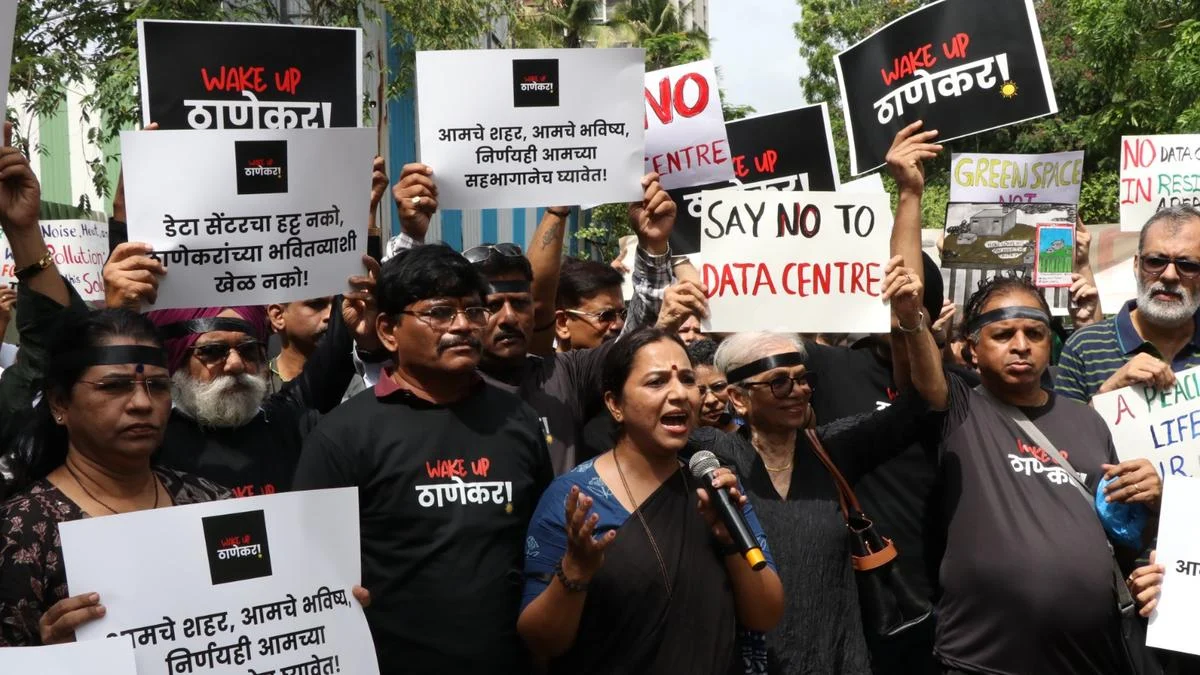
In a significant show of public resistance, nearly a thousand residents from the Thane district, located on the outskirts of Mumbai, converged at Balkum Naka this week to protest a massive industrial project. Under the banner of the grassroots collective Wakeup Thanekars (WUT), citizens voiced their staunch opposition to the construction of a 422 MW Amazon data centre, currently slated for development in the heart of a densely populated residential zone.
The protest marks a watershed moment in Indian urban activism. While data centre opposition has become a common feature of civil society in the United States and parts of Europe, this is the first instance in India where local communities have collectively challenged the placement of massive digital infrastructure within urban residential neighborhoods.
The Core Conflict: Infrastructure vs. Industrial Scale
The project, which encompasses a staggering 54.73 acres, is not merely a server farm; it is a sprawling industrial complex of significant scale. For the residents of Balkum, Majiwada, and surrounding areas, the proximity of such a facility raises existential concerns about their quality of life.
The primary grievances of the Wakeup Thanekars movement revolve around five critical pillars: water scarcity, power grid load, noise pollution, thermal emissions, and the permanent loss of green cover in a region already battling the "urban heat island" effect.
"We are not anti-progress, nor are we against technological investment," says Dayanand Nene, a prominent member of WUT. "Our movement is fundamentally about spatial planning and environmental justice. We are asking for a simple realignment: move this industrial-scale infrastructure to a designated industrial or technology zone where it belongs, rather than placing it in the middle of homes and schools."
Chronology of a Growing Divide
The friction between the tech giant and the local populace has been simmering for months. According to organizers, the path to the streets was not a first resort, but a final one after administrative avenues appeared to hit a dead end.
- June 2026: WUT formally initiates contact with Amazon, sending inquiries regarding the environmental and social impacts of the proposed facility. The company provides a generic public statement, but fails to address the specific technical questions posed by the residents.
- Early July 2026: Realizing that digital correspondence is insufficient, the collective escalates the matter, seeking the intervention of the Municipal Commissioner, Saurabh Rao.
- Mid-July 2026: A formal meeting is held between WUT representatives, Amazon officials, and the Municipal Commissioner. Residents report that the company’s responses were evasive, particularly regarding the long-term cumulative environmental impact.
- July 19, 2026: The protest at Balkum Naka takes place, drawing nearly a thousand residents. Following the peaceful demonstration, Commissioner Rao acknowledges the gravity of the situation and formally flags the residents’ concerns to higher government authorities.
The Data: Unpacking the EIA Report
The anxiety within the community is rooted in the project’s Environmental Impact Assessment (EIA) report. The sheer scale of the facility has raised alarms among local engineers and environmentalists within the residential group.
The data center’s planned 422 MW capacity is massive—roughly equivalent to the power consumption of a mid-sized town. Furthermore, the EIA details the installation of 193 diesel generators for backup power. Residents argue that the noise and emission profiles of nearly 200 diesel generators—even if used only during emergencies—pose a significant health risk to the surrounding thousands of families.
The WUT has submitted a detailed 5-page document containing 22 pointed questions to both Amazon and the Thane Municipal Corporation (TMC). Key demands include:
- Water Supply Transparency: Disclosure of the water supply agreement between Amazon and the TMC.
- Sewage Treatment Costs: Data on who bears the cost of treating the massive amounts of sewage water required for the site’s operations.
- Thermal Impact Assessment: A scientific study on the heat dissipation from the facility and its potential impact on the local micro-climate and the nearby Thane Creek ecosystem.
- Public Consultation: A mandatory, transparent public information meeting for the residents of the affected wards.
Official Responses and Corporate Stance
In response to inquiries from businessline, an Amazon spokesperson issued a detailed defense of the project, focusing on sustainability and grid independence.

"This facility will not draw or divert power from the local distribution grid that serves residential and commercial consumers," the spokesperson stated. "Instead, it will rely on its own dedicated high-voltage substation, planned in coordination with the utility provider."
Regarding the contentious issue of water, the spokesperson emphasized that Amazon has transitioned to a "water positive" status in India. "Amazon does not currently use water for cooling in its data centers in India, including our Thane site, and we do not draw from the community’s drinking or potable water for cooling purposes. We take a holistic approach to minimizing both energy and water consumption while meeting the highest health, safety, and environmental standards."
However, residents remain skeptical. They point out that while the company claims "water positivity" and "no cooling usage," the sheer volume of water required for operational maintenance and facility staff remains an unanswered question in a region already struggling with water rationing.
The Broader Implications
The Thane protest highlights a growing disconnect between India’s rapid digital transformation and the urban planning required to support it. As the nation races to become a global hub for cloud computing and AI, the physical infrastructure required—massive server farms—is increasingly coming into conflict with the realities of urban land use.
1. Urban Planning and Zoning
The case forces a re-evaluation of zoning laws. If industrial-grade infrastructure can be placed in residential zones, it sets a precedent that could erode the sanctity of urban planning across the country. The WUT movement is essentially demanding that "Industrial" and "Residential" remain distinct categories.
2. Environmental Justice
The protest is a litmus test for the effectiveness of Environmental Impact Assessments in India. Residents argue that EIAs are often treated as bureaucratic checkboxes rather than tools for community protection. By forcing a dialogue on thermal impact and local power grid integrity, the WUT is setting a high bar for future projects.
3. Corporate Accountability
For Amazon, the situation in Thane is a reminder that "global standards" must be translated into "local trust." The shift from digital correspondence to on-the-ground protest suggests that residents are no longer satisfied with corporate PR; they demand technical transparency and accountability.
What Lies Ahead?
As of mid-July 2026, the situation remains fluid. The Municipal Commissioner has elevated the matter, suggesting that the local government is under significant pressure to mediate. Whether this will lead to a relocation of the project, a significant redesign, or a standoff remains to be seen.
For the people of Thane, the protest was never just about a building. It was about the right to have a say in the environment they live in. "We are the stakeholders of this city," says one resident at the protest. "The digital world may be virtual, but our lives are very real. We will not allow our neighborhoods to become the collateral damage of the digital revolution."
As the protest concludes and the files move through the bureaucratic corridors of the TMC, the tech industry will be watching closely. If the Thane residents succeed, it could mark the beginning of a new era of community-led oversight for industrial infrastructure projects across India. If they fail, it may signal a new phase of urban development where digital infrastructure takes precedence over the residential sanctity of the city.