










In an era where digital advertising is increasingly fragmented across a labyrinth of platforms, publishers, and devices, the industry has long been plagued by a fundamental inefficiency: the inability to see the "whole" of a campaign. Brands routinely spend millions across YouTube, OTT platforms, smart TVs, and the open web, only to treat each interaction as an isolated event. This results in bloated frequency caps, wasted ad spend, and a dangerous disconnect between creative output and media performance.
Social Beat, the digital growth partner, is now addressing this systemic failure with the launch of its updated, AI-first programmatic solution: PRISM (Programmatic Reach and Impact Solution for Marketers). By merging Media Brain and SB Studio into a singular, cohesive ecosystem, Social Beat is effectively moving beyond the traditional agency model to provide a unified layer of intelligence that governs media buying, creative iteration, and performance measurement simultaneously.
The Genesis of a Problem: Why the Old Way is Failing
The modern digital media landscape has become a siloed environment. A typical brand might purchase inventory on YouTube, leverage JioHotstar for reach, engage a smart-TV OEM for premium placement, and fill the remainder via the open exchange. Because these platforms do not communicate with one another, they treat the same household as a unique, fresh target every time.
The data is startling: before migrating accounts to PRISM, Social Beat found that the average user in an Indian video buy was exposed to the same advertisement approximately 15 times. According to the agency, six exposures are sufficient to drive impact. The remaining nine impressions—nearly 60% of the total volume—represented wasted capital.
Furthermore, the "creative-media divide" has historically paralyzed campaign optimization. Media teams identify failing assets mid-week, but by the time the creative team receives the brief, processes the feedback, and ships a variant, ten days have passed. The "flight" has moved on, the budget is already spent, and the opportunity for mid-campaign correction is lost. Social Beat’s PRISM is designed specifically to collapse this timeline.
PRISM: A New Architectural Layer
PRISM is not a DSP (Demand-Side Platform), nor does it aim to replace the established giants of the advertising world. Instead, it acts as a strategic "intelligence layer" that sits above DSPs, ad servers, and publisher direct deals.
By functioning as a centralized command center, PRISM forces disparate platforms to behave as a single entity. It enforces one audience taxonomy, one unified frequency cap, and one measurement framework across all inventory—spanning YouTube, Samsung Ads, Google Display, JioHotstar, Amazon Prime, and programmatic out-of-home (pDOOH). Since Cheil South West Asia’s acquisition of Social Beat in November 2025, the integration of Samsung connected-TV (CTV) inventory has further streamlined this, removing the traditional resale chain and providing brands with direct, high-value access.
The Three Pillars of PRISM
- Unified Media Buying: An unglamorous but revolutionary approach that uses one ad server across all platforms to ensure a user is counted only once, turning deduplicated reach from an estimate into a verifiable fact.
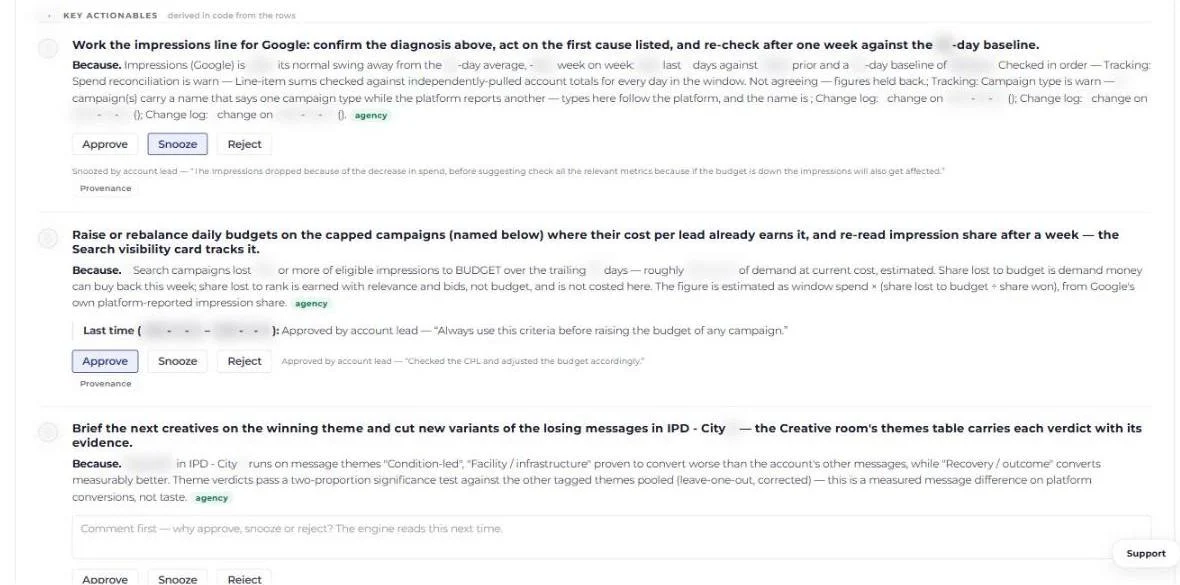
- Media Brain: An AI-native performance optimization engine that reconciles spend and conversion data nightly, providing a ranked list of "actionable insights" for account teams to execute the following morning.
- SB Studio: A creative powerhouse that leverages the Brand Brain to generate high-volume assets, allowing for rapid A/B testing and iteration based on real-time performance data.
Supporting Data: Proof of Performance
The effectiveness of the PRISM model is best illustrated through the tangible results observed across various sectors during the migration process.
| The Buy | What Changed | Result |
|---|---|---|
| Large FMCG Player | Consolidated video platforms into one plan with one frequency cap. | 372,000+ incremental unique users; 17% cost savings on flat budget. |
| Private Life Insurer | Integrated YouTube, CTV, and display; measured brand lift across all exchanges. | 14% incremental reach (6.6M users); +7.7% ad recall; 43.4 lakh saved. |
| D2C Health Brand | Deduplicated CTV-led launch across smart TVs and OTT; closed funnel with quick-commerce cohorts. | 82M+ incremental reach; 106% lift on branded search; 13% media saved. |
| Jewellery Retailer | Managed 50+ line items across 6+ platforms under one cap for Diwali. | 61.7M reach vs 38.1M planned; 36.9 lakh saved. |
On average, migrated accounts have seen a 14% reduction in media spend and a drastic drop in frequency from 15 to six exposures. Currently, 72% of Social Beat’s retained media brands have transitioned to these unified plans.
Media Brain: The Engine of Daily Tuning
The true brilliance of PRISM lies in its "Media Brain." Unlike standard dashboards that rely on platform-reported metrics—which are often skewed to favor the platform’s own performance—Media Brain creates a "single source of truth."
Every night at 02:00 IST, the system reconciles data from ad platform APIs with the brand’s own CRM. If a campaign spends money, it is accounted for; if a lead is generated, it is validated against the brand’s specific definition of "qualified." This prevents the common pitfall of branding campaigns being judged against bottom-of-funnel KPIs.
The dashboard presents ranked recommendations based on cost-efficiency. If a budget is pacing ahead of schedule or a creative asset is causing high drop-off rates, the system flags it. Crucially, the system does not act autonomously on live campaigns; it serves as a co-pilot, providing evidence-based insights that require human approval. This "human-in-the-loop" governance ensures that every change is intentional and logged.
Creative Intelligence and the "Brand Brain"
The final piece of the puzzle is the Brand Brain, a centralized store of a brand’s rules, tone, and past performance history. When Media Brain identifies that a specific hook is underperforming, it communicates directly with SB Studio.
SB Studio doesn’t just generate variations; it regenerates assets based on the specific attributes that caused the previous version to fail. If a video’s hook is too slow or the brand identity lands too late, the AI adapts the next iteration accordingly. This removes the "ten-day gap" between insight and execution.
For example, when working with a two-wheeler brand, Social Beat used AI to test model-led lifestyle films against product-centric films. The data revealed that product-centric films (where the gear was the hero) achieved a 3% CTR compared to 1% for lifestyle content. By spotting this in real-time, the team was able to shift budget mid-flight, maximizing ROI in a way that would have been impossible under a traditional siloed workflow.
Implications: The Future of Agency-Client Dynamics
Social Beat’s success with PRISM has not gone unnoticed. At the Programmatic Asia Awards 2026, the agency secured 18 awards—the highest count of any agency present—including "Programmatic Agency Innovation of the Year."
The implications for the industry are profound. We are witnessing the end of the era where "media" and "creative" are managed as separate, competing workflows. By integrating both under one AI-first layer, Social Beat is forcing a market correction: agencies that cannot prove deduplicated reach and cannot iterate creative at the speed of programmatic bidding will struggle to compete.
As Social Beat continues its "AI Level Up Journey," the roadmap includes hourly WhatsApp alerts for campaign anomalies, one-click implementation of approved recommendations, and machine-readable access for third-party martech stacks.
In conclusion, PRISM represents a shift in power. For the brand, it means more visibility and less waste. For the agency, it means moving away from the manual drudgery of reporting and into the high-value realm of strategic orchestration. By stitching together the fragmented pieces of the modern digital landscape, Social Beat has provided a blueprint for how agencies must evolve if they are to remain relevant in an AI-dominated future.



