










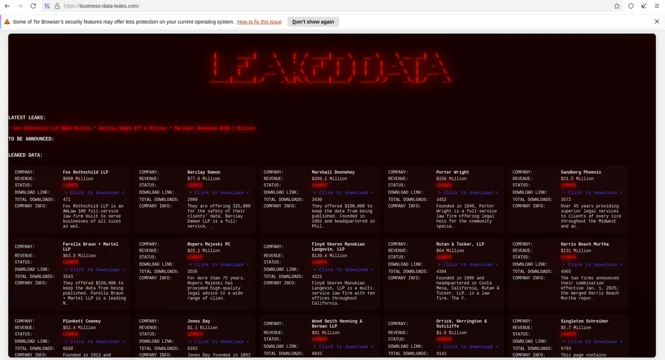
In a stark departure from the traditional ransomware landscape—where malicious payloads, complex encryption algorithms, and locked servers usually dominate the narrative—a new threat actor known as the "Silent Ransom Group" (SRG) has demonstrated that the most effective tool in a cybercriminal’s arsenal is not code, but conversation.
According to a trove of leaked internal communications spanning from August 2025 to September 2026, the SRG has allegedly extorted upwards of $207 million from 27 major law firms in just six months. By bypassing technical security measures entirely and focusing on the "human element," this group has redefined the economics of digital extortion, turning social engineering into a highly scalable, multi-million-dollar business.
The Anatomy of an Extortionist: The Silent Ransom Group Strategy
For decades, the cybersecurity industry has focused on hardening perimeters, deploying Endpoint Detection and Response (EDR) tools, and managing vulnerabilities. The Silent Ransom Group effectively rendered these multi-billion-dollar investments moot by targeting the one vulnerability that cannot be patched: human psychology.
The group’s methodology is deceptively simple: they do not infect networks with ransomware. They do not hold databases hostage through encryption. Instead, they leverage sophisticated social engineering campaigns—primarily through telephone calls—to impersonate internal IT staff, auditors, or external service providers. Once they establish a rapport with an unsuspecting employee, they manipulate them into either surrendering credentials or uploading sensitive client data directly to an external repository controlled by the attackers.
The "Sales Team" Mentality
Leaked chat logs, first unearthed by researcher Tammy Harper and analyzed by DataBreaches, reveal a group that operates less like a rogue hacking collective and more like a high-pressure sales department. With 5,692 messages spanning 13 months, the logs document a culture of performance reviews, target-setting, and internal "deal boards."
In one surreal exchange, group members discuss the purchase of luxury real estate in Moscow, the acquisition of high-end drones, and the procurement of firearms. The casual nature of these discussions—interspersed with celebratory cheers over multi-million dollar payouts—paints a disturbing portrait of a criminal enterprise that views its victims as "leads" to be closed rather than data points to be exploited.
Chronology of a Campaign: The 2026 Extortion Wave
The scale of the operation became evident when researchers analyzed internal financial records covering the period between April 3 and September 24, 2026.
- April 2026: The group initiates an aggressive push targeting elite law firms. Internal records show the first major payments trickling in, though the "deal board" quickly accelerates as the group refines its scripts and targeting lists.
- May 2026: A notable incident involving Blank Rome serves as a textbook example of the group’s tactics. An attacker, posing as a member of the firm’s internal IT department, successfully convinced an attorney to upload files to an external Google Drive. No malware was deployed, no alerts were triggered by security software, and the breach was entirely silent.
- July–August 2026: The group hits its stride. As the volume of attacks increases, the internal chats show members coordinating their efforts, sharing best practices for bypassing multi-factor authentication (MFA) via voice phishing (vishing), and celebrating the record-breaking $30 million payment from White & Case.
- September 2026: The peak of the activity. By September 24, the group’s internal ledger claimed a staggering $207 million in total extorted funds. However, discrepancies begin to emerge between the group’s "boasts" and the verifiable reality on the ground, suggesting that while the group is highly successful, their accounting may be inflated by "wishful thinking" or unfulfilled ransom demands.
Supporting Data: Following the Money Trail
The financial operations of the Silent Ransom Group offer a masterclass in modern money laundering, albeit one with significant operational security (OPSEC) failures.
The Crypto-Volatility Factor
One of the more bizarre revelations from the leak is the group’s obsession with the volatility of Bitcoin. When a $30 million ransom was paid, one leader celebrated by noting, "record gold, brother, due to the growth of the BTC exchange rate it ended up at 31.25 million." The group treats crypto-assets like day traders, highlighting a level of financial sophistication rarely seen in traditional ransomware-as-a-service (RaaS) models.
The Weakest Link: Regulated Exchanges
While the group utilized complex obfuscation tactics—including instant exchangers, cash couriers in Moscow, and "Bitcoin-to-Zelle" desks—the analysis by Crystal Intelligence points to a critical irony: the criminals were often their own worst enemies.
Many of the smaller, rapid-fire payments were directed straight to regulated cryptocurrency exchanges. These platforms require Know Your Customer (KYC) verification, linking the illicit funds to real-world identities. This "sloppy" OPSEC, contrasted against their multi-million-dollar successes, suggests that even the most profitable criminal organizations are susceptible to the human error they so effectively exploit in others.
Official Responses and Verification Challenges
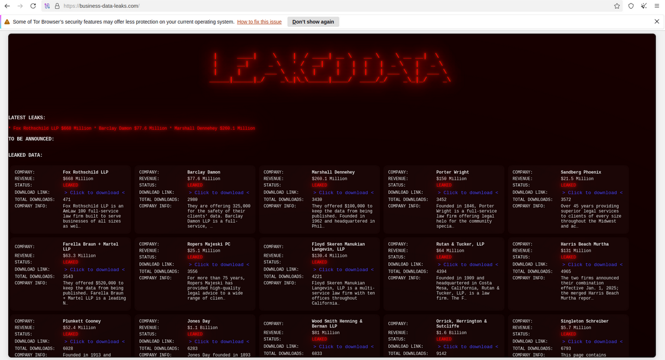
The veracity of the leaked data has been the subject of intense debate. When approached for comment, the Silent Ransom Group initially denied the existence of the leak, asserting that their internal systems were impenetrable. However, when DataBreaches published follow-up evidence—including specific chat logs that matched the timelines of publicly disclosed incidents—the group’s narrative began to crumble.
Several firms named in the leak have provided their own context. Goodwin Procter, for instance, confirmed that a single employee was indeed deceived into surrendering credentials, corroborating the group’s "no-malware" strategy.
Conversely, the data is not infallible. Investigations revealed instances where the group claimed payment from firms that, according to the chat logs, never actually responded to the ransom demand. For example, the group claimed a $6 million demand from Sheppard, yet the logs indicate complete silence from the law firm. This serves as a vital reminder: in the world of cybercrime, the "ledger" is a propaganda tool as much as it is an accounting document.
Implications: The New Frontier of Threat Intelligence
The Silent Ransom Group has fundamentally shifted the cybersecurity paradigm. Their success carries several profound implications for the legal industry and beyond:
1. The Obsolescence of Perimeter Defense
For law firms, which prioritize client confidentiality, the findings are a wake-up call. Technical controls like firewalls, endpoint protection, and encryption are essentially irrelevant when an attacker can simply ask an employee to provide access. The "human firewall" is now the only perimeter that matters.
2. The Failure of Current Training
The success of the SRG indicates that existing "security awareness training"—often relegated to annual, check-the-box videos—is woefully inadequate. Criminals are now using high-fidelity, targeted social engineering that mimics legitimate business processes. Training must evolve from generic anti-phishing tips to real-time simulations of social engineering scenarios.
3. The Need for "Zero-Trust" Culture
In a zero-trust architecture, no individual—not even a person claiming to be from the IT department—should be granted access to sensitive data without secondary verification. The ease with which the SRG manipulated high-level attorneys suggests that law firms must implement strict "out-of-band" verification protocols for any request involving sensitive data transfers.
4. A New Era of Financial Intelligence
The fact that this entire operation was exposed not by law enforcement, but by a security researcher and a data breach portal, underscores the growing role of Open Source Intelligence (OSINT) in tracking organized crime. The "Silent Ransom" saga proves that even the most elusive groups leave digital footprints—not in their code, but in their conversations.
Conclusion
The Silent Ransom Group represents a dangerous evolution in digital crime. By moving away from the "noisy" nature of malware and toward the quiet, persuasive art of social engineering, they have exploited the professional courtesy and trust inherent in the legal industry.
As the dust settles on this 13-month campaign, the takeaway for the private sector is clear: the most sophisticated security infrastructure in the world is no match for a well-placed, well-rehearsed phone call. Unless organizations fundamentally overhaul how they verify identity and manage internal communication, the Silent Ransom Group—or the many copycats their success will inevitably inspire—will continue to profit from the one vulnerability that remains forever open.



