







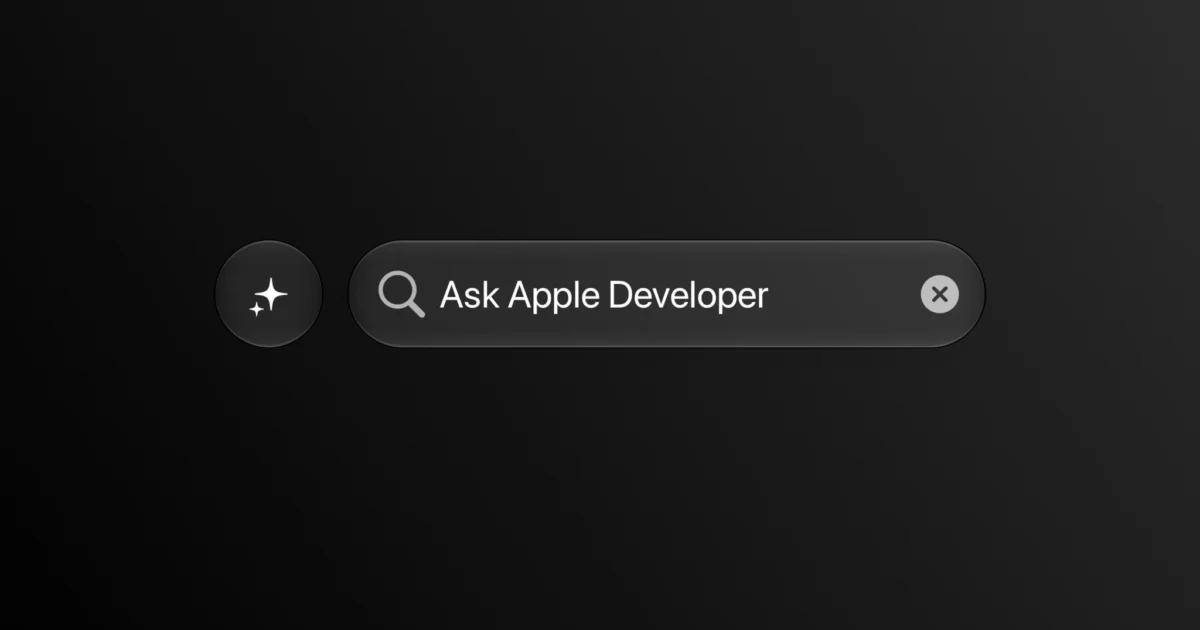
July 7, 2026 — In a move signaling a fundamental shift in how the global software engineering community interacts with technical documentation, Apple has officially launched its new generative AI-powered search tool: "Ask Apple Developer." The interface, characterized by a minimalist, dark-mode aesthetic featuring a signature multi-point sparkle icon, represents the culmination of years of internal R&D focused on large language models (LLMs) specialized for the Apple ecosystem.
This development marks a departure from traditional keyword-based search methodologies, moving toward a conversational, context-aware paradigm designed to reduce friction in the development lifecycle.
I. Main Facts: Redefining Technical Documentation
The core of "Ask Apple Developer" lies in its ability to synthesize vast swathes of Apple’s documentation, WWDC session transcripts, and API references into coherent, actionable insights. Unlike general-purpose chatbots that often hallucinate code snippets, Apple’s new tool is grounded strictly in verified developer resources.
The Interface Experience
The tool is presented as a sleek, pill-shaped search bar that floats against a charcoal gradient backdrop. The user experience is designed for seamless integration into the developer’s workflow. By clicking the sparkle icon, users can query complex problems—such as migrating from UIKit to SwiftUI or debugging specific memory management issues in Swift 6—and receive synthesized, accurate responses that include links to the original documentation for verification.
Scope and Availability
As of July 2026, the tool is integrated into the Apple Developer portal. It currently supports the full breadth of current Apple APIs, including the latest iterations of iOS, visionOS, and macOS frameworks. The system is designed to evolve in real-time, pulling updates from Apple’s engineering documentation as soon as they are published.
II. Chronology: The Road to Intelligent Search
The journey toward "Ask Apple Developer" has been a deliberate, multi-year progression.
- 2023–2024: The Foundation Phase. Apple began integrating "Ask Apple" sessions into their developer relations program, which provided the human-centric groundwork for the data sets that would eventually train their AI models.
- Early 2025: Internal Beta Testing. Apple initiated internal testing within their own engineering departments, utilizing the model to assist with internal framework development and documentation maintenance.
- Late 2025: Private Developer Preview. A small cohort of high-tier enterprise partners was granted access to the tool to stress-test the model’s ability to handle complex, proprietary codebases without compromising security.
- July 7, 2026: Public Launch. The tool was released to the global developer community, marking the first time Apple has deployed a generative AI interface specifically for its technical documentation.
III. Supporting Data: Why This Matters
For the average developer, the sheer volume of Apple’s documentation has grown exponentially. As of mid-2026, the Apple Developer portal hosts over 40,000 unique articles, thousands of hours of video transcripts, and millions of lines of API reference code.
The "Efficiency Gap"
Data provided by developer productivity surveys suggests that engineers spend approximately 25% of their working hours searching for documentation or troubleshooting API integration issues. By deploying "Ask Apple Developer," Apple aims to:
- Reduce Search Time: Early benchmarks indicate a 40% reduction in time-to-solution for common development inquiries.
- Increase Documentation Utilization: The AI interface highlights niche APIs that were previously buried in search results, increasing the adoption of newer, more efficient coding paradigms.
- Standardization: By providing uniform answers, the tool helps maintain consistency in code quality across the Apple developer ecosystem.
IV. Official Responses: The Philosophy of Precision
Apple’s leadership has emphasized that the primary goal of this tool is not to replace the developer, but to augment their capabilities.
"We have always believed that the best tools are those that disappear into the background," stated a spokesperson during the launch announcement. "With ‘Ask Apple Developer,’ we aren’t just creating a search bar; we are creating a bridge between the complexity of our platforms and the creativity of our developers. We have prioritized accuracy and privacy above all else. This model is trained on our verified documentation, ensuring that the guidance provided is as reliable as the APIs themselves."
The development team also addressed the issue of security, noting that the tool does not "learn" from private, proprietary developer codebases in a way that would expose sensitive intellectual property to other users. The model operates within a secure sandbox, respecting the boundaries of the developer’s local environment.
V. Implications: The Future of Apple Development
The introduction of this tool signals a broader strategic pivot for Apple.
1. The Death of the "Search Query"
The transition from keyword matching to natural language query processing is a profound shift. Developers are no longer expected to know the exact terminology of a framework to find it; they can now describe the problem they are facing, and the AI will identify the relevant solution. This lowers the barrier to entry for junior developers and cross-platform engineers looking to build on Apple platforms.
2. Ecosystem Retention and Growth
In a competitive landscape where developers are increasingly choosing between multiple platforms (Android, Web, cross-platform frameworks like Flutter), providing a superior developer experience is a retention strategy. If Apple can make its documentation easier to navigate and its APIs easier to implement, it creates a "sticky" ecosystem that is harder to leave.
3. The Future of AI in IDEs
While "Ask Apple Developer" is currently a web-based tool, industry analysts speculate that this is a precursor to a deeper integration into Xcode. Imagine an AI agent living directly inside the IDE, capable of suggesting architectural changes based on real-time code analysis and Apple’s documentation. This launch is the first step toward a more "aware" development environment.
4. Impact on Third-Party Resources
Historically, developers have relied on community forums and third-party blogs to fill the gaps in Apple’s documentation. While these resources remain valuable, "Ask Apple Developer" will likely become the "source of truth." This may disrupt the third-party educational content market, forcing creators to shift from "how-to" tutorials to more conceptual, high-level architectural content.
VI. Conclusion: A New Era
The July 7, 2026, launch of "Ask Apple Developer" is more than a simple feature update; it is an acknowledgment of the complexity of modern software engineering. As Apple’s frameworks—visionOS, HealthKit, Metal, and others—continue to expand, the ability for a developer to quickly extract accurate, context-aware information becomes the most valuable currency in the industry.
By combining the rigor of Apple’s documentation with the speed of generative AI, Apple has effectively handed every developer a personal technical consultant. The long-term impact on productivity, code quality, and platform innovation will likely be felt for years to come. For now, the developer community is invited to engage with the new tool, explore its capabilities, and participate in the next chapter of Apple’s software evolution.
As the industry watches closely, one thing is clear: the way we build for Apple has changed forever.
For more information on how to integrate "Ask Apple Developer" into your workflow, visit the official documentation page.