










In the early days of the internet, digital accessibility was often treated as a peripheral concern—an "afterthought" left to developers with extra bandwidth. Today, that landscape has fundamentally shifted. As the global digital ecosystem expands to encompass 1.3 billion people living with disabilities, organizations are discovering that an inaccessible website is not merely a technical oversight; it is a significant legal, financial, and ethical liability.
At the forefront of this transformation is AudioEye, a platform that has spent nearly two decades refining the intersection of AI-driven automation and human expertise. With over 127,000 organizations now relying on its services, the company is spearheading a movement to make digital inclusion the "default" state of the internet rather than a reactive legal scramble.
The Evolution of a Digital Imperative
To understand the current state of digital accessibility, one must look at its trajectory. When AudioEye was founded, the web was a Wild West of varying standards and limited oversight. Accessibility was widely viewed as a "checkbox" exercise, performed sporadically if at all.
However, the last five years have seen a sea change. The escalation of litigation—with accessibility-related lawsuits doubling since 2020—has forced a boardroom-level conversation about digital equity. Furthermore, global regulatory frameworks like the European Accessibility Act (EAA) have codified these requirements, effectively ending the era where companies could ignore accessibility to save on development costs.
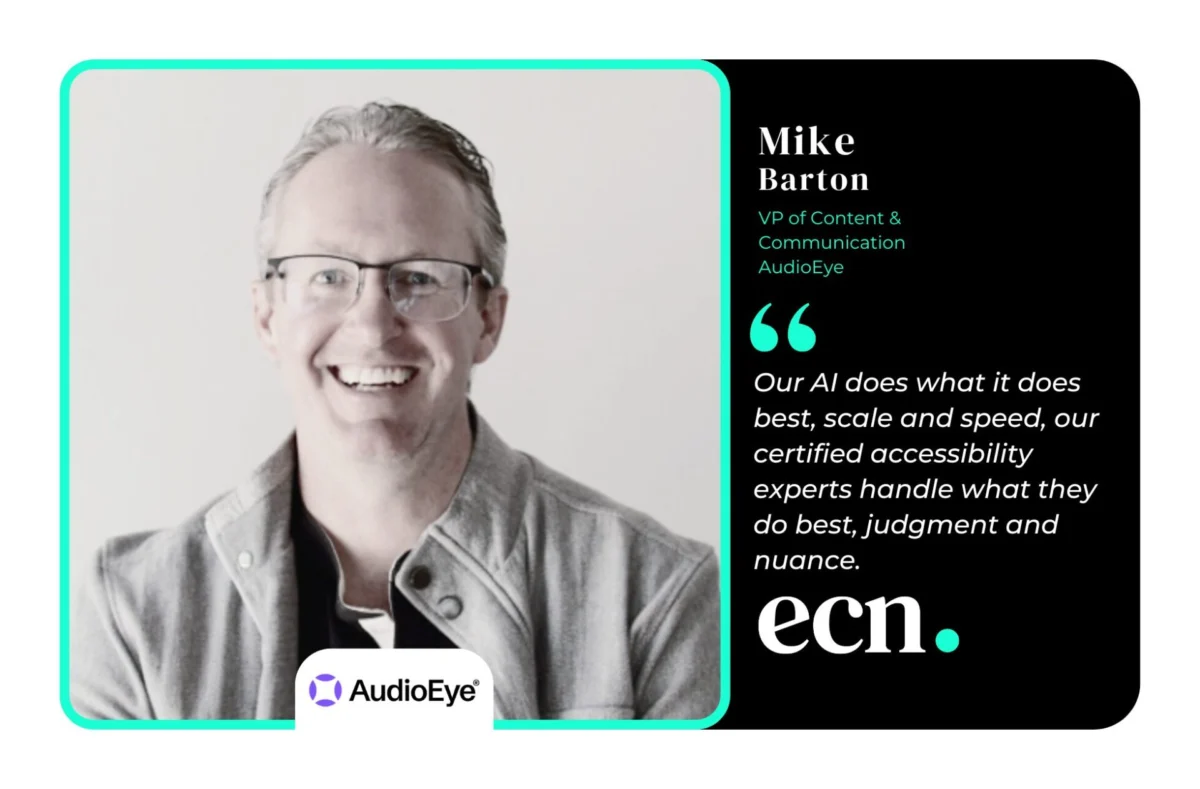
Mike Barton, Vice President of Content Marketing and Communications at AudioEye, notes that the company’s evolution reflects this broader market maturity. "We’ve doubled down on one core belief: automation is how you scale accessibility, and human expertise is how you get it right," Barton explains. "We’ve continued investing heavily in our AI to detect issues at the speed the modern web demands, but we’ve never bought into the idea that AI alone is enough. Complex issues require the nuance, judgment, and lived experience that only humans can provide."
The Economic and Legal Stakes: Why Businesses Must Adapt
Digital accessibility is no longer just about compliance; it is a significant business growth engine. According to recent data, people with disabilities represent approximately $18 trillion in global spending power. Yet, a staggering 70% to 83% of users with disabilities report abandoning websites that do not accommodate their needs, frequently migrating to competitors with more inclusive interfaces.
The Cost of Inaction
For businesses, the risks of inaction are twofold:
- Litigation Exposure: In the United States, the surge in ADA-related litigation shows no signs of slowing. E-commerce remains the primary target, accounting for 78% of all digital accessibility lawsuits.
- Market Exclusion: By ignoring accessibility, brands are effectively turning away a massive, loyal customer segment. "The companies treating accessibility as a checkbox are the ones getting caught off guard," says Barton. "The companies treating it as table stakes—or a growth engine—are winning."
The Hybrid Model: How AudioEye Bridges the Gap
The core differentiator of the AudioEye platform is its hybrid approach. While many competitors rely exclusively on "widgets" or automated scanners, AudioEye argues that technology alone cannot solve the nuanced barriers faced by users of assistive technology like screen readers.
How the Platform Functions
AudioEye’s platform functions as an integrated layer of the digital experience. Using a single line of JavaScript—similar to the implementation of a cookie consent banner—the software begins scanning the site in real-time against Web Content Accessibility Guidelines (WCAG).
- Automated Precision: The AI handles the high-volume, repetitive tasks, such as correcting missing alt text, fixing broken form labels, and optimizing heading structures across thousands of pages simultaneously.
- Expert Validation: Where the AI finds patterns, human experts find the "gray areas." Certified specialists, including individuals with disabilities, perform audits on the site’s intent and user flow. They deploy custom fixes that address the subjective experience of navigating a site, ensuring that the "accessibility tree" is truly navigable for users with visual, motor, or cognitive impairments.
This combination is statistically potent. Independent data, including a 2026 study by Adience, suggests that AudioEye detects up to 2.5 times more issues than competing tools. By resolving approximately 97% of issues automatically, the platform minimizes the burden on internal development teams, allowing engineers to focus on product innovation rather than remediation.
A New Frontier: AI Agents and the Future of Discovery
Perhaps the most compelling argument for accessibility in 2025 and beyond involves the rise of AI agents. As consumers increasingly use AI-powered search engines and digital assistants to browse the web, these agents act as the "front door" to commerce.
These agents rely heavily on a website’s accessibility tree to parse information and make recommendations. If a site is not structured correctly for a human using a screen reader, it is often equally unintelligible to the AI agents crawling the site.
"Accessibility and AI discovery are going to be the same conversation in a few years," Barton explains. "If your site isn’t accessible, you are effectively invisible to one of the fastest-growing discovery channels online."
Strategic Implications: Compliance as a Byproduct
A common misconception is that accessibility is a static goal—a "fix" achieved during an annual audit. AudioEye advocates for a dynamic approach where compliance is the byproduct of an ongoing, healthy digital ecosystem.
By offering a documented legal guarantee and proactive debunking services for potential demand letters, the company shifts the power dynamic in favor of the business. "We’re the only vendor with a documented courtroom dismissal," Barton notes, highlighting that their goal is to provide a level of protection that "fix-at-source" consulting or automation-only widgets simply cannot match.
Looking Ahead: A Global Standard
As the European Accessibility Act fully integrates into the global business environment, the demand for scalable, expert-backed accessibility will only intensify. AudioEye’s strategy for the coming years is twofold: expanding its global reach to help companies navigate new international jurisdictions and continuing to refine its AI to keep pace with an internet that is becoming increasingly complex.
The irony of the current digital age is that general-purpose AI coding tools are, in some instances, generating inaccessible code faster than ever before, as they are trained on a legacy web that was largely exclusionary. AudioEye’s mission is to counteract this by embedding accessibility into the very fabric of the internet’s infrastructure.
For the modern enterprise, the message is clear: the internet of the future will be accessible by default. Those who wait for the legal system to force their hand will find themselves playing catch-up in a market that has already moved on. Those who invest in inclusion today—leveraging the right blend of speed-focused AI and human-centered design—are positioning themselves to capture a broader audience, mitigate risk, and lead in the next generation of digital commerce.
The goal, as Barton puts it, is simple: "The internet should work for everyone who uses it. Our job is to make sure it does."