GLOBAL — In the modern digital enterprise, the hardest part of email marketing rarely happens in the composition window. While crafting a compelling subject line or choosing a dynamic template is straightforward, the hidden friction of enterprise-scale messaging lies entirely before and after the send.
As regulatory scrutiny intensifies, data architectures expand, and multi-brand operations scale across continents, the infrastructure supporting high-volume email programs faces unprecedented strain. Recent compliance failures—such as a combined £150,000 fine issued to two UK companies that bombarded consumers with 7.5 million unwanted text messages due to third-party suppliers failing to prove valid consent—underscore a harsh reality: a weak email marketing platform pushes the overwhelming burden of governance, data hygiene, and revenue attribution back onto human teams.
Conversely, a robust enterprise email platform absorbs this operational complexity, allowing marketers to launch faster, trust their underlying data, and definitively prove their bottom-line impact.

The Core Mandates: What Enterprise Email Software Must Deliver
Standard, mass-market email tools with generous contact limits often fail under the weight of enterprise demands. To separate enterprise-ready platforms from glorified auto-responders, organizations must evaluate software across six critical pillars: governance and security, CRM revenue connectivity, account-based marketing (ABM) and multi-brand support, AI-driven workflow optimization, deliverability protection, and seamless data architecture integration.
1. Enforce Governance and Security Controls
Enterprise marketing teams cannot afford to gamble with security or compliance. Comprehensive consent records must meticulously track when, where, and how each contact subscribed. These immutable logs protect the enterprise when data moves fluidly across disparate brands, geographic regions, or complex system integrations.
Global businesses must prioritize software that features granular role-based permissions, rigorous regional data hosting, end-to-end encryption, automated data retention policies, and robust support for individual data deletion requests under frameworks like GDPR and CCPA.

2. Connect Email Activity Directly to CRM Revenue Data
Email engagement metrics lose strategic value when campaign data remains siloed from the broader Customer Relationship Management (CRM) system. When campaign insights live apart from sales data, tracing marketing efforts to closed-won revenue becomes a manual chore.
CRM-native email platforms eliminate this disconnect. By keeping customer engagement, lifecycle stages, firmographic data, active deals, and revenue streams on unified records, businesses unlock crystal-clear revenue attribution. Platforms operating on unified data models allow marketing and sales teams to collaborate from a single source of truth.
3. Support ABM and Multi-Brand Operations
Account-Based Marketing (ABM) targets entire organizations, but email delivery targets individual human beings. Enterprise email software must seamlessly bridge these two layers. It must group consented contacts under specific corporate accounts, recognize individual buying roles, and dynamically adjust nurture sequences as a sales opportunity progresses.

Simultaneously, multi-brand conglomerates require specialized infrastructure. Each brand often demands independent sending domains, custom consent preferences, unique template libraries, and isolated sender reputations—all while executive leadership requires centralized customer data and consolidated reporting. Multi-account management tools at the enterprise level solve this by keeping distinct business accounts operationally separate while selectively permitting data, assets, and workflows to flow between them.
4. Apply Artificial Intelligence to High-Friction Workflows
Personalizing communications at a multi-million-contact scale requires far more than basic merge tags. Modern enterprise AI handles the heavy lifting behind the scenes: automating audience segmentation, classifying CRM data fields, mapping complex multi-step workflows, executing campaign quality assurance, and optimizing send times. By translating plain-language instructions into functional segment filters and workflows, AI removes the operational bottlenecks that traditionally slow down enterprise deployments.
5. Protect Deliverability Across Domains and IPs
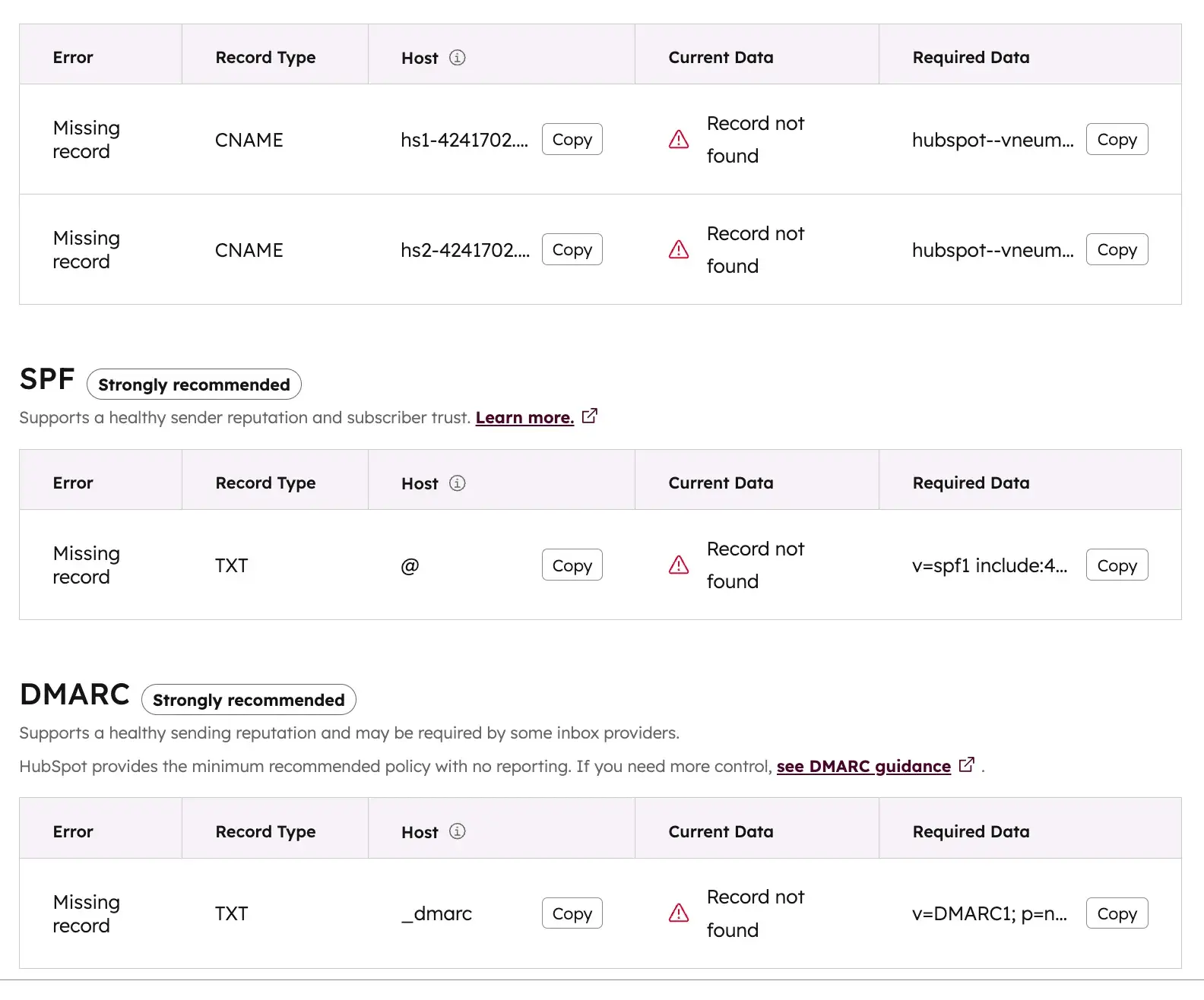
Deliverability at scale begins with rigorous technical authentication—specifically SPF, DKIM, and DMARC configurations—paired with pristine list hygiene, consistent sending volumes, and instantaneous unsubscribe processing. Major inbox providers, such as Yahoo and Google, mandate strict authentication standards for bulk senders, penalizing non-compliant domains instantly.

While a dedicated IP address grants an enterprise direct control over its sender reputation, it also assigns total accountability for maintaining it. Enterprise platforms must facilitate gradual automated warm-up phases (such as HubSpot’s 40-day automated IP warm-up protocols), maintain separate marketing and transactional sending streams, and provide brand-level infrastructure.
6. Fit the Enterprise Data Architecture
An extensive directory of third-party integrations is meaningless if those connections drop vital data fields, generate duplicate records, or fail silently without warning. Enterprises must demand native data synchronization that offers real-time visibility into syncing health, flags anomalies before data corruption occurs, and allows technical teams to configure field mappings and sync directions without writing custom code.
Market Landscape: The Top Enterprise Email Marketing Solutions
No single email platform dominates every conceivable enterprise use case. The market features distinct category leaders tailored to specialized organizational requirements.

1. HubSpot Marketing Hub Enterprise
Best For: B2B enterprises seeking to unify marketing, sales, and revenue data within a single system.
Marketing Hub Enterprise integrates email execution directly with a Smart CRM database. Every crucial data point—contact activity, company profiles, active deals, lifecycle stages, and campaign interactions—resides on unified records. Marketers can build ultra-precise audiences and trace email influence across deal creation and closed revenue without exporting data to external reporting tools.
Featuring built-in send-time optimization, strict campaign approval workflows, and robust multi-account management, HubSpot starts at approximately $3,600 per month (billed annually), including five core seats and 10,000 marketing contacts, with mandatory enterprise onboarding priced separately.

2. Salesforce Marketing Cloud Engagement
Best For: Large organizations deeply entrenched in the Salesforce ecosystem with dedicated administrative expertise.
Leveraging Data 360 architecture, Salesforce Marketing Cloud Engagement empowers enterprises to construct complex audiences, personalize outbound messaging, and trigger automated follow-ups based on real-time customer behavior. Utilizing AI assistants like Agentforce, teams can translate campaign briefs directly into multi-channel content blocks. Engagement metrics remain tied directly to Salesforce customer records, ensuring sales and customer service teams share identical context. Corporate tier pricing starts around $4,200 per month, with enterprise-level deployments requiring custom quotes.
3. Adobe Journey Optimizer
Best For: Global B2C enterprises already utilizing the Adobe Experience Platform that demand uncompromising control over massive email volumes.

Adobe Journey Optimizer orchestrates scheduled campaigns and event-driven triggers derived from Adobe Experience Platform profiles. It delivers advanced content creation tools, dynamic personalization engines, and real-time offer decisioning. Comprehensive previewing, proofing, frequency capping, and subscription management tools empower global organizations to intercept errors before launching large-scale sends. Pricing is available strictly via custom enterprise quote.
4. Braze
Best For: High-volume consumer and mobile-first brands requiring real-time reactivity to live user behavior.
Braze translates live product interactions and consumer behavior into immediate, triggered email campaigns. Featuring drag-and-drop builders, native design integrations with Figma and Canva, and support for interactive AMP emails, Braze pulls real-time product recommendations and personalized promotions at the exact moment of open. Pricing is customized based on volume, accompanied by a 14-day trial offering.

5. Klaviyo
Best For: Ecommerce and retail enterprises requiring rapid activation of transactional and behavioral data.
Klaviyo converts heavy retail and commerce activity into ready-to-deploy email segments, automated flows, and revenue analytics. It triggers personalized messaging based on browsing habits, cart abandonments, past purchases, and predictive lifetime value metrics. For enterprise senders, Klaviyo supports branded sending domains, dedicated IPs with automated warm-up protocols, and sophisticated RFM (Recency, Frequency, Monetary) analytics.
Strategic Migration and Change Management
Migrating an enterprise email program from a legacy system to a modern platform is a high-stakes operational undertaking. Organizations must avoid treating the project as a single, massive data dump, which drastically elevates the risk of data corruption and compliance failures. Instead, migrations should proceed through five controlled chronological stages:

- Audit What Must Move: Evaluate historical data ruthlessly. Import only what is operationally necessary for daily workflows; archiving legacy data prevents system clutter and avoids inflating billable contact counts.
- Build the CRM Structure First: Establish required properties, lifecycle stages, and object associations before importing any records. Test small batches using unique identifiers like email addresses or domain names to prevent duplicate creation.
- Migrate Consent and Suppressions Early: Import existing opt-out lists, map subscription types, and preserve original consent timestamps before importing active audiences. This vital step prevents the new environment from inadvertently messaging suppressed contacts.
- Prepare Sending Infrastructure: Fully authenticate sending domains via MX, DKIM, SPF, and DMARC records well in advance. Respect dedicated IP warm-up schedules rather than flooding cold infrastructure with full deployment volumes on day one.
- Rebuild, Test, and Cut Over in Waves: Begin by migrating templates, segments, and workflows supporting active campaigns. Send initial test batches to highly engaged internal audiences, verify recipient metrics, and gradually scale volume while keeping legacy systems running in read-only mode until full system stability is proven.
Implications and Future Outlook
As the enterprise software market continues to mature, the dividing line between simple messaging tools and true enterprise infrastructure will only sharpen. Organizations can no longer afford the hidden costs of disconnected data, manual governance, and opaque attribution models.
Whether an enterprise chooses the CRM-native alignment of HubSpot, the deep ecosystem integration of Salesforce, the consumer-grade real-time responsiveness of Braze or Adobe, or the commerce agility of Klaviyo, the ultimate selection must be dictated by how effectively the software absorbs operational friction.
Ultimately, enterprise email marketing is no longer judged solely by how many messages land in an inbox, but by how transparently those messages connect to sustainable, verifiable corporate growth.