











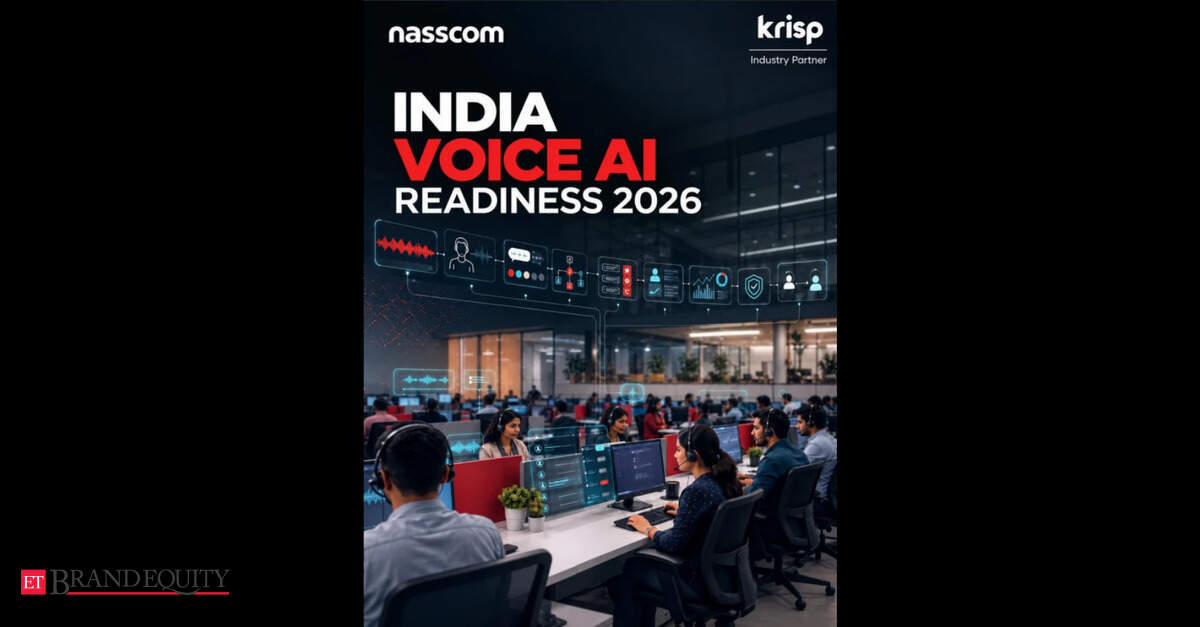
The landscape of customer experience (CX) in India is undergoing a seismic shift. According to the latest "India Voice AI Readiness 2026" report, published by industry body Nasscom in partnership with Krisp, the adoption of Voice AI has officially transitioned from the era of "curiosity and experimentation" to a phase of "production-level integration." However, this journey is not without its hurdles. While the appetite for AI-driven automation is at an all-time high, enterprise-wide deployment remains a selective achievement, with only 13% of organizations having successfully scaled Voice AI across multiple customer journeys.
For the vast majority—more than 50% of the 140 surveyed organizations, which include Business Process Management (BPM) firms and Global Capability Centers (GCCs)—the technology remains confined to exploratory phases or isolated pilot projects. As India positions itself as the global nerve center for AI-enabled services, the transition from these initial pilots to robust, enterprise-integrated solutions has become the critical mandate for 2025 and beyond.
The Chronology of Adoption: From Proof-of-Concept to Production
The adoption curve for Voice AI in India reflects a cautious, methodical approach typical of large-scale digital transformations. The industry is currently stratified into four distinct stages of maturity:
- The Exploratory Phase (23%): Organizations are currently assessing the technology stack, evaluating vendors, and mapping out potential high-impact use cases within their specific industry verticals.
- The Proof-of-Concept (PoC) Stage (32%): Enterprises are running controlled trials to validate the efficacy of Voice AI against specific operational KPIs, such as call deflection or average handling time (AHT).
- Limited Production (31%): A significant segment of the market has moved beyond the lab, deploying Voice AI for specific, low-risk customer touchpoints.
- Scaled Deployment (13%): This elite group has integrated Voice AI into the core architecture of their customer service operations, moving away from siloed implementations to an enterprise-wide model.
Despite these figures, there is a clear "adoption gap." While many companies are "using" Voice AI, only 9% are utilizing the technology to handle more than 50% of their eligible customer interactions. This suggests that while the entry barrier has been lowered, the climb to full-scale, autonomous operations remains steep.
Supporting Data: The Efficiency Engine
The primary catalyst for this adoption is the tangible promise of operational efficiency. For organizations struggling with high-volume, repetitive customer queries, Voice AI is not just a luxury—it is a fiscal necessity.
The Nasscom-Krisp report provides compelling data on the financial upside:
- Cost Reduction: 61% of respondents reported a reduction in "cost per eligible interaction" of more than 20%.
- Time Savings: Nearly two-thirds of organizations observed a 10–30% reduction in Average Handling Time (AHT).
- The ROI Timeline: Financial viability is proving to be a short-term goal for most, with 68% of organizations realizing a Return on Investment (ROI) within six to 24 months. Only 18% reported that they had yet to see a clear financial return, highlighting the generally favorable economic profile of Voice AI investments.
However, a recurring theme in the report is the "measurement mismatch." Many firms continue to evaluate AI success through the narrow lens of legacy operational metrics (like call volume). Only 14% of organizations are tracking comprehensive business outcomes, such as customer lifetime value or long-term loyalty. The report argues that true value is found in "task completion"—the ability of the AI to resolve an issue entirely without human intervention—rather than merely automating the duration of a conversation.
Navigating the Linguistic and Technical Frontier
India’s inherent complexity—a mosaic of regional languages, varied dialects, and diverse accents—serves as both the biggest hurdle and the greatest potential differentiator for the nation’s AI industry.
The Challenge of Real-World Conditions
The "laboratory" performance of AI rarely matches the reality of a busy contact center. The report identifies three primary technical barriers:
- Background Noise (32%): The leading impediment, particularly in dense office environments.
- Language Switching (24%): The challenge of managing "Hinglish" or other mixed-language conversations, where users naturally switch codes mid-sentence.
- Accent Inconsistencies (18%): The variability in regional Indian accents remains a struggle for models trained primarily on standard international English.
The Global Opportunity
Paradoxically, by solving these uniquely Indian challenges, firms are creating a "gold standard" for AI performance that is highly exportable. Among organizations that have mastered three to five languages, 29% are already identifying growth opportunities in North and Latin America, while 27% are expanding their reach into Europe and the UK. By mastering the art of the "complex, noisy, multilingual interaction," India is positioning itself as a global hub for AI-enabled customer experience, potentially outperforming regions that have only focused on standard, mono-lingual deployments.
Sectoral Leaders: BFSI, Telecom, and Retail
The adoption of Voice AI is not uniform across all industries. It is currently concentrated in sectors that possess high-frequency interaction data and predictable workflows:
- BFSI (Banking, Financial Services, and Insurance): The frontrunner, utilizing Voice AI for high-volume tasks such as account verification, loan inquiries, collections, and fraud alerts.
- Retail and E-commerce: Focusing on the "post-purchase" journey, specifically order tracking, return processing, and basic support.
- Telecom: Leveraging AI for billing inquiries, technical troubleshooting, and automated upselling.
Despite this sector-specific success, the integration is still fragmented. Only 6% of organizations have managed to implement Voice AI across the entire end-to-end customer lifecycle. The report highlights that the next wave of investment will be defined by "workflow integration"—ensuring that the AI is not a standalone chatbot, but is deeply linked to CRM systems, transaction platforms, and enterprise knowledge bases.
Official Responses and Strategic Outlook
Industry leaders view this phase as a transformative moment for the Indian BPM and GCC sectors.
Rajesh Nambiar, President of Nasscom, emphasizes that the industry is shedding its image as a mere cost-arbitrage destination. "Voice AI is creating a significant opportunity for India’s BPM sector to move beyond traditional voice operations toward AI-enabled, multilingual customer operations," Nambiar noted. He underscored that the path forward lies in "greater ownership of outcomes," where Indian firms move from being service providers to being strategic partners in their clients’ digital transformation journeys.

Davit Baghdasaryan, Co-founder and CEO of Krisp, highlights the technical reality of the market: "The future of Voice AI will be defined not by how many languages a system supports, but by how reliably it performs in real-world conversations." He identifies the Indian contact center as the ultimate "proving ground." According to Baghdasaryan, because 63% of organizations prioritize language accuracy as a top spending priority, the market is finally acknowledging that the foundation of AI is human understanding. "Organisations that get Voice AI right in India will be well-positioned to serve customers anywhere," he added.
Future Implications: The Road to 2026
Looking ahead to 2026, the trajectory for investment is bullish. A staggering 80% of respondents expect to increase their Voice AI budgets in the next two years, with 35% planning an increase of over 25%.
The focus is shifting from "full automation" to "AI-augmented operations." Enterprises have realized that the immediate value lies in empowering human agents with real-time analytics, sentiment tracking, and suggested resolutions, rather than replacing them entirely. Over the next 24 months, 38% of organizations expect to reach the stage of "AI-augmented contact centers," while only 15% are aiming for full, autonomous, proactive operations.
The Human Element
Workforce readiness remains a critical variable. While 40% of organizations feel their workforce is "highly prepared," 35% admit to only moderate readiness. As routine queries are handled by machines, the human role will inevitably shift. Employees will need to evolve into "AI supervisors" and "complex problem solvers," handling the exceptions that the AI cannot resolve.
Ultimately, the Nasscom report concludes that India’s success in the global AI race will not be determined by the raw availability of the technology—which is becoming a commodity—but by the ability of enterprises to integrate these tools into their operational DNA. Success will require a tripartite focus: improving multilingual accuracy, strengthening data governance, and upskilling the workforce to manage the new, AI-driven reality. As India moves from the pilot phase to the era of enterprise-scale production, the message is clear: the technology is ready, but the transformation has only just begun.



