










As the excitement builds for the 2026 FIFA World Cup, the influence of the tournament is expanding far beyond stadiums, fan zones, and television ratings. For security teams and IT administrators, the event represents a looming threat to digital infrastructure. New research suggests that global sporting spectacles have a direct, measurable, and dangerous impact on the strength of corporate passwords, turning the names of celebrated players and iconic clubs into the keys that could unlock sensitive enterprise data.
The Intersection of Fandom and Cybersecurity
The human element remains the most significant variable in the cybersecurity equation. In an era of digital transformation, where users are tasked with managing dozens of unique credentials across cloud-based SaaS applications, VPNs, and internal corporate systems, "password fatigue" is an unavoidable reality. When faced with the pressure to generate "complex" passwords that meet strict corporate requirements, users frequently default to the path of least resistance: personal familiarity.
Football, being the world’s most popular sport, provides an endless reservoir of memorable terms. Whether it is the name of a childhood hero, a local club, or a historic tournament final, these cultural touchstones are easy to recall. However, what is convenient for the user is often a goldmine for the threat actor. As recent data from Specops Software reveals, attackers are well aware of this tendency and have integrated these predictable patterns into their automated reconnaissance and credential-cracking toolsets.
Chronology of a Vulnerability: From Passion to Breach
The lifecycle of a football-themed password breach typically follows a predictable trajectory. It begins not with a sophisticated exploit, but with a simple act of user convenience during a password change cycle.

- The Trigger Event: A major sporting event—like the upcoming 2026 World Cup—captures the public imagination. Users are prompted by their IT department to rotate their passwords due to age or compliance requirements.
- The Association: Seeking a password that is both "complex" and memorable, the user incorporates a football-themed keyword. They apply common modifications—capitalizing the first letter, swapping an ‘o’ for a zero, or appending the current year—to satisfy the organization’s complexity rules.
- The Exposure: The user utilizes this same credential on a less-secure personal site, such as a forum or a fan-merchandise store.
- The Infostealer: A malware infection or a database breach on the third-party site leads to the exposure of the user’s credentials in an "infostealer" dataset—a collection of stolen data sold on the dark web.
- The Credential Stuffing Attack: Threat actors ingest these leaked datasets, cross-reference them with corporate email addresses, and use automated "stuffing" bots to attempt entry into enterprise environments.
Data-Driven Insights: The Scale of the Problem
The findings from Specops Software, derived from an analysis of more than 6.4 billion compromised passwords, provide a sobering look at how deeply entrenched these habits are.
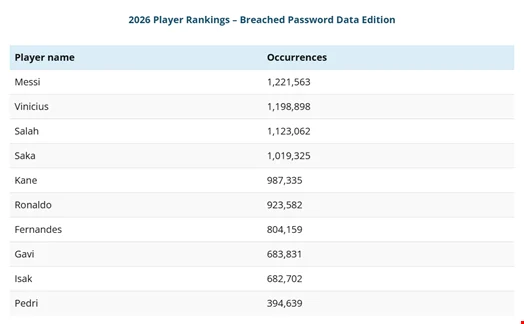
Player Rankings
The data highlights that legendary status correlates with high-frequency password usage. Lionel Messi tops the player rankings with over 1.2 million occurrences in leaked data. Cristiano Ronaldo follows closely with approximately 923,000, representing a significant percentage of total breaches. Other high-ranking names include Vinicius Jr., Mohamed Salah, Bukayo Saka, Harry Kane, and Pedri.
Club and Cultural References
Club-themed passwords are equally prevalent. Interestingly, the club name "Roma" appears over 5.3 million times. Experts suggest that while this reflects the popularity of the AS Roma football club, it also captures a significant volume of users referencing the city of Rome, proving that cultural and geographical markers share the same security flaws as sports-themed ones.
Why Native Active Directory Policies Fail
For many organizations, the primary line of defense remains the native password policy features within Microsoft Active Directory (AD). While these controls are fundamental, they are increasingly insufficient against modern, context-aware threats.

Standard AD policies focus on structural complexity: minimum length, the inclusion of special characters, and numeric requirements. From the perspective of a native AD policy, a password like Messi2026! is considered "strong" because it meets all the standard character-class criteria. It has an uppercase letter, lowercase letters, numbers, and a symbol.
However, the system is fundamentally "meaning-blind." It cannot distinguish between a high-entropy string of random characters and a context-heavy, predictable term like Messi2026!. Because native tools lack the ability to check against real-time, global breached-password databases or block custom wordlists, they inadvertently provide a false sense of security.
The Attacker’s Playbook: Predictability as a Weapon
Threat actors do not rely on brute force alone; they rely on intelligence. Attackers maintain custom wordlists that are regularly updated with current events, celebrity names, and trending topics. When an attacker targets a specific organization, they often tailor their "spraying" attacks to include industry-specific or culturally relevant terms.
By utilizing "leetspeak" modifications—such as changing ‘a’ to ‘@’ or ‘e’ to ‘3’—attackers can bypass basic filtering while still guessing a high percentage of user passwords. In a password spraying scenario, the attacker attempts a single, common password (e.g., Saka2026!) across hundreds of accounts. This strategy allows them to gain access to at least one account while remaining below the threshold that would trigger a mass account lockout.
Implications for Corporate Security Strategy
The shift toward more intelligent password management is no longer a "nice-to-have" but a strategic necessity. The implications of continuing with legacy, structure-only password policies are significant:
- Increased Risk of Ransomware: Credential theft is the primary vector for initial access in the vast majority of ransomware attacks. A single compromised, football-themed password can provide the foothold needed for lateral movement.
- Compliance Gaps: Regulatory frameworks increasingly demand that organizations implement "effective" password policies. Relying on standards that permit known, breached, or easily guessable terms may result in compliance failures during audits.
- Operational Burden: Incident response teams spend countless hours remediating accounts that were compromised via simple, preventable password reuse.
Closing the Gap: Advanced Protection Strategies
To effectively mitigate these risks, security leaders must move beyond the limitations of native Active Directory controls. The most effective strategy involves integrating active, real-time protection directly into the password-change workflow.
Custom Dictionaries
Organizations should implement custom dictionaries that block specific, context-sensitive terms. This includes not just football players and club names during tournament cycles, but also company-specific terms, product names, or project codenames that are likely to be guessed by external parties.
Breached Password Protection
The most robust defense is the integration of a continuously updated, massive database of known-breached credentials. By checking every password change against a repository of billions of leaked credentials—including those from infostealers—organizations can prevent users from ever selecting a password that is already in the hands of an attacker.
The Role of Managed Solutions
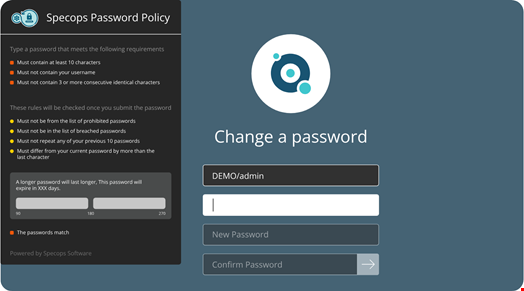
Solutions like the Specops Password Policy suite are designed specifically to extend the capabilities of Active Directory. By running directly on domain controllers, these tools allow administrators to apply granular, group-based policies. This allows for a tiered approach: enforcing stricter rules for high-privileged accounts while ensuring that the general workforce is shielded from the hazards of predictable, event-driven password choices.
Conclusion: A Proactive Stance
As the 2026 FIFA World Cup approaches, the digital footprint of the event will inevitably be reflected in the passwords of millions of employees. The data is clear: passwords built on passion are rarely secure.
For IT and security leaders, the lesson is straightforward: security policies must evolve at the same speed as the threats they aim to mitigate. By moving away from "complexity for complexity’s sake" and adopting tools that recognize the context and history of a password, organizations can ensure that their digital borders are not breached by the very culture their employees enjoy. Now is the time to review password policies and ensure that the only thing your users are cheering for this summer is the match—not the ease with which their credentials can be compromised.