









By mid-2026, the landscape of artificial intelligence has undergone a seismic shift. The "brute-force" era of 2024 and 2025—characterized by massive, monolithic models struggling to juggle complex chains of thought—has been relegated to the history books. Today, the industry has embraced a modular, protocol-driven architecture that favors specialization over scale.
As we look at the current state of agentic AI, the defining trend is the transition from "prompt-heavy" orchestration to "infrastructure-heavy" swarm design. This evolution has transformed the role of the AI engineer from a prompt crafter into a systems architect.
The Evolution of Agentic AI: A Chronology
To understand the current state, we must map the rapid evolution of the last 24 months:
- 2024 (The Era of Brute Force): Engineers relied on heavy external scaffolding like LangChain or LlamaIndex to force models into reasoning loops. Techniques like ReAct (Reasoning and Acting) were manually implemented to simulate "thinking."
- 2025 (The Cognitive Shift): The introduction of native "System 2" reasoning models—models that perform internal, hidden reasoning before outputting tokens—rendered manual reflection loops largely obsolete.
- 2026 (The Swarm Revolution): The industry coalesced around the Model Context Protocol (MCP) and multi-agent swarm architectures. The focus shifted from making one model "smarter" to making ten specialized agents "work together."
The End of Orchestrated Reasoning Loops
In the early days, if you wanted an agent to plan, you had to build a complex state machine that manually prompted the model to "think step-by-step." This added significant latency and, quite often, increased the likelihood of failure as the agent wandered off-path.
Today, foundation models handle test-time compute natively. By generating hidden reasoning tokens, these models explore multiple solution branches and self-correct internally before the user ever sees a character on their screen.
For the modern practitioner, this means the orchestration layer has been freed. You no longer need to write code that critiques the agent’s logic; you need to build the sandbox it lives in. The orchestration layer has been redefined to focus strictly on three areas: routing, state management, and environment execution. By offloading cognition to the model, engineering teams are finally able to focus on system-level performance.
The Rise of Agentic Swarms
If the previous era was about the "Giant Model," the current era is defined by the "Specialized Agent." Production teams have realized that attaching 50 different tools to a single LLM creates a bottleneck that limits performance and increases error rates.
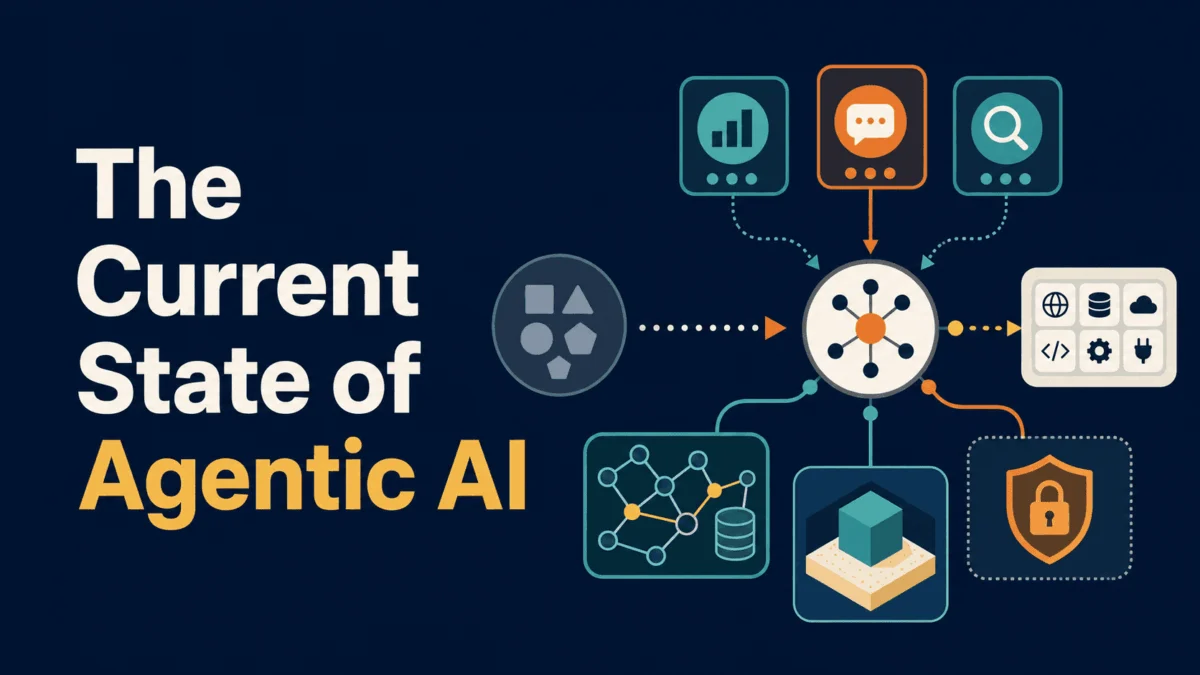
Instead, we now see the rise of Agent Swarms: a collection of small, highly specialized agents that communicate via a standardized handoff protocol. In a modern enterprise swarm, you might find:
- The Triage Agent: A high-level router that interprets user intent.
- The SQL Agent: A narrow-scope agent with access only to read-only database tools.
- The Analysis Agent: A sandbox-heavy agent that processes data using Python or specialized statistical libraries.
This modularity isn’t just aesthetic; it’s an architectural necessity. By keeping agents stateless and scoped, teams can swap out individual nodes for newer, faster, or cheaper models without needing to re-engineer the entire system.
Implementation Pattern: The Handoff Logic
While frameworks are still maturing, the pattern for a successful swarm involves "Transfer Commands." In this model, an agent performs its task and then, upon completion, explicitly passes the context to the next agent in the sequence.
# Conceptual Swarm Architecture
triage_agent = Agent(name="Triage", system_prompt="Route requests to specialists.")
sql_agent = Agent(name="Data Fetcher", system_prompt="Execute read-only SQL.")
analysis_agent = Agent(name="Data Analyst", system_prompt="Analyze data via Python.")

# Handoff allows context-rich transitions
def transfer_to_analyst(context):
    return TransferCommand(target_agent=analysis_agent, context=context)
This design allows for "stateless-per-agent" execution while maintaining "stateful-across-the-system" memory, keeping context windows lean and costs predictable.
Standardization: The Model Context Protocol (MCP)
Perhaps the most significant development in 2026 is the widespread adoption of the Model Context Protocol (MCP). Before MCP, integrating an AI agent into a corporate environment was an integration nightmare. Developers had to write custom JSON schemas, manage brittle API wrappers, and debug inconsistent tool-calling formats for every single data source.
MCP acts as a universal adapter. By standardizing how models talk to data—whether it’s a PostgreSQL database, a Slack channel, or a local GitHub repository—MCP has drastically reduced the "integration surface."
| Feature | Pre-2025 Paradigm | 2026 State (MCP) |
|---|---|---|
| API Integration | Hardcoded, bespoke wrappers | Isolated, standard MCP servers |
| Tool Schemas | Manual JSON definition | Automatic exposure via protocol |
| Execution | Inline API calls | Execution in secure, remote sandboxes |
Memory Graphs: The "Long-Term" Brain
One of the most persistent criticisms of earlier agents was their "goldfish memory." They were excellent at solving an immediate query but failed to learn from experience.
The industry has moved toward Memory Graphs. By utilizing a graph database (like Neo4j) to store the relationships and facts extracted during agent execution, developers can create a "long-term memory" that persists outside the ephemeral context window of the model.
When a swarm operates, a background "Memory Agent" continuously reviews the conversation trajectory. It identifies key facts—such as user preferences or recurring data errors—and maps them into the graph. The next time the user interacts with the swarm, the system queries this graph to prime the context, allowing the agent to "remember" previous interactions without needing to re-process thousands of lines of history.
Security and the "AIjacking" Threat
With increased connectivity comes increased risk. The swarm architecture, while powerful, introduces a wider attack surface. Because agents can now pass context and control to one another, an indirect prompt injection—where a malicious instruction is hidden in an external data source like an email—can pivot through the entire swarm.
If an "Email Agent" is compromised, it could theoretically hand off that malicious context to a "Database Agent" with elevated permissions. To combat this, three primary defenses are currently being implemented by leading firms:
- Strict Handoff Validation: Agents must verify the source of a transfer command against a hardcoded "allow-list."
- Human-in-the-Loop (HITL) Gateways: Any transfer to a high-privilege agent (e.g., one with
writeaccess to a database) requires a mandatory human authorization token. - Instruction Sandboxing: System prompts are strictly separated from user-generated content, preventing "jailbreak" attempts from ever reaching the agent’s core logic layer.
Implications for the Future
The move toward agentic swarms signifies that AI has finally graduated from a research curiosity to a robust engineering discipline. The "wild west" of prompting is over; the era of systems architecture has begun.
For organizations looking to deploy AI, the lesson of 2026 is clear: do not chase the "smarter" monolithic model. Instead, focus on building resilient, specialized swarms. By investing in the infrastructure—the protocols, the memory graphs, and the security boundaries—teams can build agents that are not just capable of solving today’s problems, but are architected to compound their intelligence and utility over time.
As we move toward the second half of the decade, the winners will not be those with the largest models, but those with the most elegant and secure systems of coordination.