










In the ever-evolving landscape of digital publishing, the greatest challenge for any WordPress site owner remains the same: how to bridge the gap between what you create and what your audience actually needs. Traditionally, site owners have relied on static analytics tools that track where users have been, but rarely reveal why they arrived or what they failed to find.
A new experimental project, dubbed "Site Brain," is looking to change that. By leveraging the power of always-on AI agents through the OpenClaw platform, Site Brain transforms a standard chatbot from a mere customer service tool into a sophisticated, dual-purpose engine that both assists visitors in real-time and provides site owners with a data-driven editorial roadmap.
The Genesis of Site Brain: A New Paradigm for WordPress
The concept behind Site Brain is simple yet revolutionary: what if a visitor’s unanswered question could become the foundation for a new, high-value piece of content?
For years, website owners have been forced to play a guessing game, relying on intuition or lagging keyword research tools to determine their next editorial move. When a visitor leaves a site because they cannot find an answer, that data point—the most valuable insight a publisher can have—is typically lost.

As highlighted in the recent OpenClaw agent hosting announcement, WPMU DEV’s development team has been exploring how persistent AI agents can integrate with WordPress to perform tasks that were previously impossible for automated systems. Site Brain is the first major proof-of-concept to emerge from these experiments, blending conversational AI with internal site intelligence to create a seamless loop of discovery and content optimization.
How It Works: The Architecture of Intelligence
At its core, Site Brain functions as a sophisticated, user-friendly interface that lives in the corner of a WordPress site. While it looks like a standard chatbot, its internal mechanics are significantly more complex. The system relies on three primary pillars working in concert:
- AI Embeddings: Using OpenAI’s embedding technology, the system converts the site’s existing content into a searchable, semantic index. This allows the AI to understand the meaning behind a user’s query, rather than relying on simple keyword matching.
- Vector Storage (Qdrant): This service acts as the memory for the site, enabling the AI to perform lightning-fast, highly accurate retrieval of information from thousands of pages.
- The OpenClaw Agent: This is the "brain" that monitors the dialogue, identifies gaps in the knowledge base, and suggests actionable editorial strategies to the site owner.
By synthesizing these technologies, Site Brain creates a dynamic environment where a static website becomes an interactive, evolving resource.
Supporting Data: From Recipe Helper to Editorial Assistant
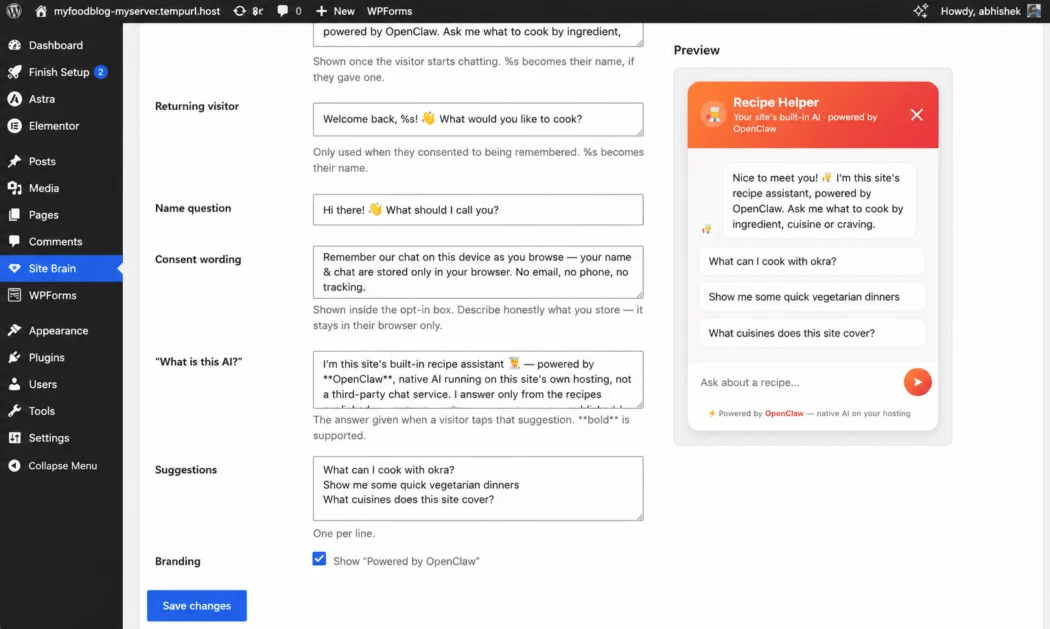
To test the efficacy of this technology, the development team deployed a prototype on a food blog. The result was a "Recipe Helper" that allowed users to ask complex, natural-language questions such as, "Do you have any quick, vegetarian dinner ideas that feature potatoes?" or "What is the best way to bake a dairy-free tiramisu?"

The Visitor Experience
Instead of returning a standard 404 or a list of irrelevant search results, the AI parses the existing database of recipes and returns curated, highly relevant links. This maximizes the utility of the site’s back catalog, ensuring that users find exactly what they need while discovering hidden gems they might have otherwise missed.
The Editorial Advantage
The true innovation, however, happens behind the scenes. The AI tracks every query that fails to yield a satisfactory result. If multiple users ask about "Indian-inspired potato dishes" and the site lacks a specific recipe, the AI flags this as a "content gap."
Rather than merely reporting these failures, the agent categorizes them and generates a list of five potential blog post ideas. These are not generic suggestions; they are informed by direct visitor intent, effectively creating an editorial calendar that is guaranteed to be relevant to the audience.
Implications for SEO and Internal Linking
One of the most persistent issues for large WordPress sites is the "orphan post"—content that is valuable but lacks internal links, rendering it invisible to both human readers and search engine crawlers.

Site Brain tackles this technical debt with precision. The agent scans the site’s architecture, identifies pages with zero inbound links, and proposes a "rescue plan." It doesn’t just flag the orphan; it suggests specific anchor text and identifies the exact sentences in other, high-traffic posts where a link would feel natural and contextually appropriate.
Site owners are kept firmly in the driver’s seat. The AI provides a preview of these proposed changes, allowing the human editor to review, edit, or reject each suggestion. It is a collaborative process, not an automated takeover.
Expert Perspectives: Why This Changes the Game
The implications for digital strategy are profound. By moving from reactive analytics (what happened yesterday) to proactive AI-driven insights (what my readers want tomorrow), publishers can significantly increase user engagement and retention.
"The goal isn’t to replace the writer," notes a lead developer on the project. "It is to remove the guesswork. By the time a creator sits down to write, they already have a list of topics that their audience is actively searching for, alongside a map of how those new posts should link back to their existing library."

This model is not limited to food blogs. The framework is highly scalable and applicable to:
- Technical Documentation: Allowing users to query complex API manuals and identifying where tutorials are lacking.
- Educational Platforms: Spotting gaps in course material based on student questions.
- Travel and Lifestyle Portals: Connecting readers to destination guides based on their specific, niche requirements.
The Path Forward: Experimenting with OpenClaw
For developers and site owners interested in implementing similar systems, the barrier to entry is lowering. WPMU DEV has published a comprehensive build guide that breaks down the technical configuration required to connect OpenClaw, WordPress, and the necessary AI services.
While Site Brain is currently classified as an experiment, it represents a significant leap forward in how we think about the "intelligence" of a website. It suggests that the future of content management isn’t just about managing media—it’s about managing relationships and information flow.
As AI continues to integrate into the core of the web, the sites that thrive will be those that use these tools to listen more closely to their audience. By turning every unanswered question into a roadmap for growth, Site Brain provides a template for a more responsive, user-centric internet.

Conclusion: A New Standard for Engagement
The "Site Brain" experiment demonstrates that the most powerful application of AI in the WordPress ecosystem isn’t necessarily the automated generation of content, but the automated optimization of strategy. By closing the loop between visitor intent and content creation, site owners can ensure that their digital properties remain living, breathing assets that grow more valuable with every interaction.
As we look toward the future, the question for site owners is no longer "What should I write about?" but rather, "How can I better leverage the data I already have?" With tools like OpenClaw and experiments like Site Brain, the answer is finally within reach.



