










The landscape of professional software development is undergoing a seismic shift. For decades, the barrier to entry for creating complex, enterprise-grade software was insurmountable for anyone outside of multi-billion-dollar corporations. Building a competitor to Adobe Creative Cloud or Microsoft Office required thousands of engineers, decades of iterative development, and massive capital reserves.
Today, that barrier is eroding. A new wave of "vibe coding"—the practice of using autonomous AI agents to build, iterate, and refine software—is empowering individual developers to recreate sophisticated commercial suites with unprecedented speed. Projects like Reverse Engineer Anything (REA) and the ArtCraft ecosystem are not just novel experiments; they are the harbingers of a movement that threatens to dismantle the subscription-based hegemony of legacy software giants.
The Chronology of a Disruption: From GIMP to Generative Engineering
The history of software alternatives is littered with noble failures. For years, open-source projects like GIMP, Inkscape, and LibreOffice have attempted to challenge industry standards like Photoshop, Illustrator, and Microsoft Office. While these tools are functionally robust, they have historically failed to achieve mass adoption due to a single, stubborn hurdle: switching costs.
Professional workflows are built on muscle memory. A creative director who has spent two decades mastering the specific keybindings, menu structures, and rendering behaviors of Adobe Photoshop cannot easily pivot to GIMP. The cognitive load required to relearn a tool—even if it is technically "free"—often outweighs the cost of a monthly subscription.
However, the current AI-driven movement has identified this bottleneck. Instead of forcing users to adapt to new interfaces, developers are using AI agents to "clone" the user experience of dominant market leaders.
- The Inception: Earlier this year, the rise of AI-coding agents—such as Claude Code, Cursor, and various LLM-driven IDE extensions—provided developers with the ability to prototype features at a rate previously thought impossible.
- The Catalyst: The release of REA (Reverse Engineer Anything) provided the technical toolkit for this disruption. By automating the tedious process of deconstructing binary files, REA allowed developers to look "under the hood" of proprietary software.
- The Acceleration: Within just four days of gaining significant traction, REA accumulated over 134,000 GitHub stars, signaling a massive developer appetite for democratizing proprietary software architectures. Simultaneously, developers like Brandon Thomas began shipping the ArtCraft suite, demonstrating that individual contributors could realistically aim for functional parity with Adobe’s flagship products.
Reverse Engineer Anything (REA): The Technical Lever
The core innovation behind the current viral wave is REA, a toolkit that bridges the gap between binary code and human-readable architecture. Historically, reverse engineering was the domain of security researchers and specialists. It required deep expertise in assembly language, processor architecture, and specialized tools like IDA Pro or Ghidra.
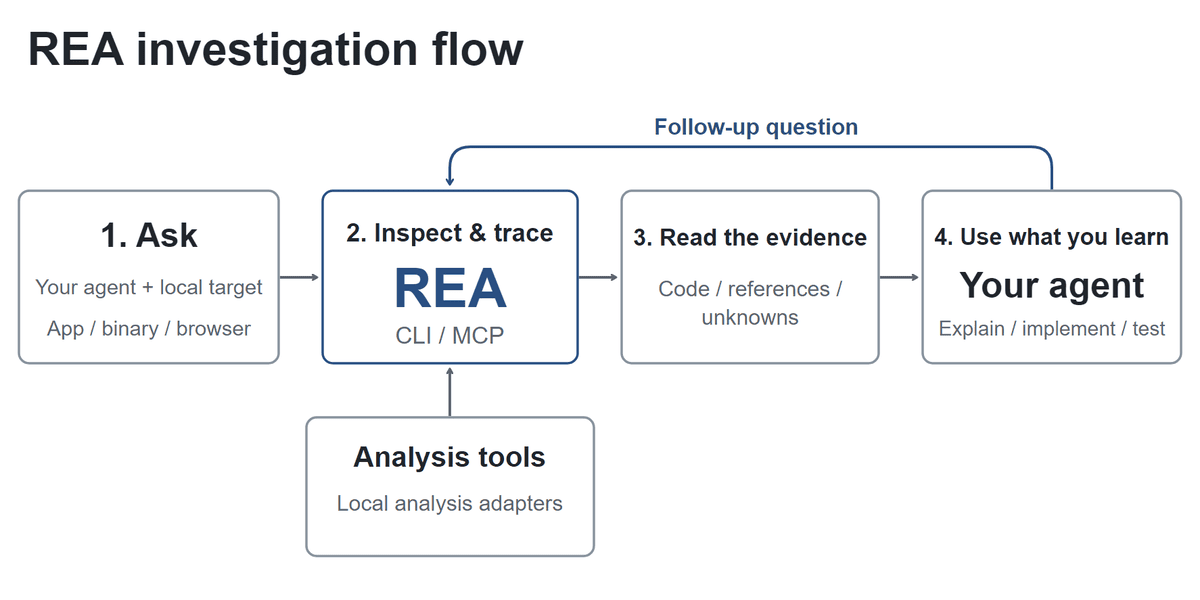
REA changes the math. By serving as an orchestrator that connects AI agents to these low-level analysis tools, it allows an AI to ingest the binary of a commercial application and begin mapping its internal logic.
How It Works:
- Ingestion: The agent analyzes the binary of an existing, proprietary application.
- Mapping: The AI identifies dependencies, functional routines, and internal data structures.
- Synthesis: The AI generates modern, clean code that mimics the original’s behavior.
This process has already been validated in small-scale proofs of concept. Developers have used REA to reconstruct the complex clipboard logic within Notion and extract proprietary math routines from legacy PC-98 software. When applied to modern creative suites, this capability allows a developer to bypass the "blank canvas" phase of software development and jump straight into functional emulation.
The ArtCraft Ecosystem: Testing the Limits of "Vibe Coding"
If REA is the pickaxe, ArtCraft is the structure being built. Brandon Thomas’s project is perhaps the most audacious attempt to date to recreate the Adobe suite using Rust and AI-assisted workflows.
The suite currently includes:
- PhotoCraft: An image editor designed to replace Photoshop.
- VectorCraft: A tool for vector graphics, challenging Adobe Illustrator.
- FilmCraft: A video editing environment aiming to mimic Adobe Premiere.
The ambitious goal—achieving feature parity within a month—has met with both awe and skepticism. Critics point out that "cloning" a UI is vastly different from building a robust, crash-proof engine that handles high-bit-depth color processing or multi-track 4K video rendering. However, the significance lies not in the current stability of the software, but in the methodology. If an individual can build the foundation of an industry-standard editor in weeks, what happens when a team of ten, twenty, or fifty developers uses the same tools?
The Implications: Why Subscription Models Are Under Fire
The implications for the software industry are profound. The current economic model of "Software as a Service" (SaaS) relies on the fact that users are locked into an ecosystem. Once a business relies on a specific file format or a complex internal workflow, the provider can raise prices with relative impunity.
1. The Death of Proprietary Lock-in
If AI-built alternatives can open existing project files (e.g., .psd or .docx) and maintain a familiar interface, the primary reason for staying with an expensive, subscription-locked provider evaporates. We are looking at a potential "unbundling" of the creative and office software stacks.
2. The Rise of "Personalized" Software
Instead of a bloated, one-size-fits-all suite, we may see the rise of modular, AI-generated applications. A user could theoretically "request" a version of an image editor that contains only the five features they actually use, stripped of the bloat that currently characterizes legacy enterprise software.
3. The Legal and Intellectual Property Quagmire
The elephant in the room is copyright. While it is legal to build software that performs the same function as another, copying proprietary source code is a violation of intellectual property laws. Developers and legal experts are currently debating the "black box" nature of AI—if an AI learns from proprietary code to build an alternative, where does the line between "inspiration" and "theft" fall? As these projects scale, we can expect significant pushback from the legal departments of major tech corporations.
Industry Response and Market Sentiment
While Adobe, Microsoft, and other giants have yet to issue official statements regarding specific "clone" projects, the market sentiment is clear: investors and users are paying attention. The skepticism from traditional software engineers regarding the "reliability" of AI-coded apps is being met with a counter-argument from the open-source community: reliability is a function of time and community contribution.
As more developers join these projects, the "vibe-coded" prototypes will inevitably harden into production-ready software. We are currently in the "wild west" phase, where experimental builds are prone to crashes and missing edge-case features. However, the velocity of progress is accelerating.
The Future: Toward Sovereign Computing
The movement represents a shift toward what some call "sovereign computing." In this vision, the user is no longer a tenant in a cloud-based software environment but an owner of the tools they use. By leveraging AI to reduce the cost of development, the industry is effectively lowering the barrier for entry to zero.
We are witnessing the end of the era where "software quality" was defined by the size of the company that built it. Instead, we are entering an era where software quality is defined by the agility of the agent-assisted developer and the accessibility of the underlying technology.
The threat to Adobe, Microsoft, and their peers is not that these clones are perfect today. It is that they are good enough to be usable, and they are being built with the specific intent of removing the friction of migration. As these tools mature, the question for the average user will shift from "Can I afford this subscription?" to "Why should I pay for a subscription when an open-source, AI-built equivalent feels exactly the same?"
For now, the development community is just getting started. The next twelve months will likely determine whether these clones can cross the "chasm" from niche hobbyist projects to genuine market disruptors. One thing is certain: the era of the impenetrable software moat is coming to an end.



