










The digital landscape is often described as a gold rush, and nowhere is this more evident than in the shadow economy of online piracy. When a cinematic titan like Christopher Nolan releases a highly anticipated project—in this case, the sprawling epic The Odyssey—the demand for unauthorized access reaches a fever pitch almost instantly. However, for thousands of users attempting to circumvent legitimate distribution channels, the hunt for a "free" copy has turned into a perilous trap.
According to new research from the cybersecurity firm Malwarebytes, scammers mobilized with terrifying efficiency, launching coordinated campaigns targeting moviegoers within mere hours of the film’s theatrical debut. These threats, which utilize psychological manipulation rather than technical exploits, underscore the shifting nature of modern cybercrime: when technology is hard to break, the human element becomes the primary target.
Chronology of a Digital Ambush
The timeline of the attacks against The Odyssey serves as a case study in predatory opportunistic behavior. As the film’s $250 million production budget and massive marketing campaign drove global search interest to its peak, a network of "cloned" piracy sites—pages designed to mimic the aesthetics and functionality of established torrent trackers—was already live.
Within hours of the first screenings, these sites were populated with listings for the film. Unlike legitimate torrent sites, which rely on community vetting and historical reputation, these cloned domains functioned as automated malicious distribution hubs. The speed at which these sites appeared suggests a highly automated infrastructure, likely controlled by organized syndicates capable of scraping legitimate metadata, artwork, and cast lists from movie databases to create a veneer of authenticity.
By the time the early reviews hit the web, the traps were already set. Users navigating these sites were greeted by two distinct, parallel attack vectors: a browser-based social engineering campaign and a classic file-disguise executable attack.
The Anatomy of the Deception: Browser-Based Malvertising
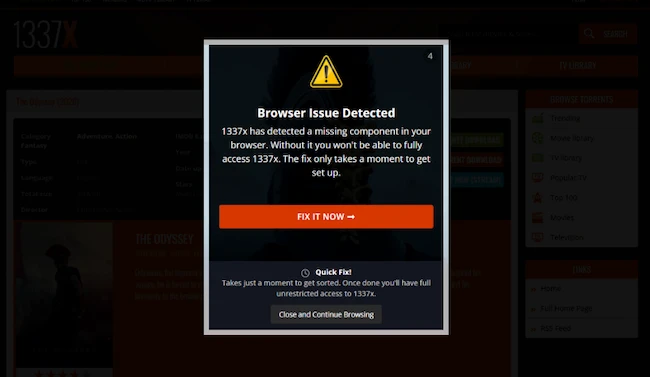
The first, and perhaps most pervasive, scam identified by researchers involved a deceptive "Browser Issue Detected" pop-up. This was not a system-level notification, but rather a sophisticated piece of HTML/CSS rendering designed to masquerade as an integral part of the user’s web experience.
The pop-up appeared to be a legitimate warning, informing the user that a "missing component" was obstructing their ability to view the movie content. To resolve this manufactured crisis, the site provided a prominent, high-contrast "Fix It Now" button.
The Malvertising Pipeline
When users clicked the button, they were not "fixing" their browser; they were being funneled into a sprawling malvertising network. The researchers at Malwarebytes noted that the destination of these redirects was fluid, changing based on the specific ad campaign currently active in the rotation. Victims could be redirected to:
- Fake Browser Extensions: Malicious plugins designed to inject ads, track browsing history, or steal sensitive session cookies.
- Scareware Campaigns: Phony "tech support" portals that utilize loud audio cues and flashing warnings to coerce users into calling a premium-rate number, where scammers pose as customer service representatives to extract payment or remote access permissions.
- Malware Redirects: Further links leading to drive-by downloads or exploit kits that search for unpatched vulnerabilities in the user’s software.
The sheer uniformity of these pop-ups across multiple cloned sites confirms that this was not a localized infection of a legitimate site, but a centralized, coordinated campaign. The scammers had invested time in creating a modular system, allowing them to swap color schemes and branding to match the specific "piracy portal" the victim happened to be visiting.
The Trojan Horse: Executable Disguises
For those who navigated past the browser pop-ups, a more direct threat awaited. The researchers identified a specific torrent listing titled "The Odyssey 2026 1080p WEBRip-LAMA," which boasted an artificially inflated count of 597 seeders and 520 leechers to create a sense of false legitimacy.
However, the file extension told a different story. Instead of a standard container format like .mkv, .mp4, or .avi, the file was an .exe—a Windows executable.
The Psychology of the Icon
To minimize suspicion, the attackers employed a classic social engineering tactic: icon spoofing. The file utilized the iconic orange traffic cone associated with the VLC Media Player. Because VLC is a globally recognized, open-source tool for playing virtually any media file, the average user reflexively associates that icon with a harmless video.
When analyzed, the file’s internal metadata revealed a glaring inconsistency. The description field listed the software as "wireless bus Business Controller." This was a "ghost in the machine," likely a remnant of the software the attackers used to wrap their malware within an installer. Once executed, the program would typically deploy a variety of payloads, ranging from information-stealing Trojans designed to harvest login credentials and cryptocurrency wallet keys, to sophisticated ransomware capable of encrypting the user’s entire document library.
Supporting Data and Technical Implications
What makes the The Odyssey scams particularly dangerous is their reliance on social engineering over traditional software vulnerabilities. Cybersecurity professionals often emphasize the importance of "patching," but these attacks render that advice secondary.
Antivirus (AV) software, while effective at catching known malware signatures, struggles with "polymorphic" files—malware that changes its code structure slightly every time it is downloaded to evade detection. Furthermore, browser-rendered warnings are difficult for security software to categorize because, to the browser, the pop-up is simply a part of the website’s content.
The use of "leechers" and "seeders" to create a sense of popularity is a form of social proof, a psychological trigger that lowers the victim’s critical thinking. By the time the user realizes the file is not a video, the damage is often already done. The Malwarebytes report confirms that there was no "exploit" involved; the user was, in effect, invited to bypass their own security protocols by granting the file permission to run.
Implications for the Digital Ecosystem
The rapid emergence of these threats highlights several critical issues in the modern digital ecosystem:
1. The Erosion of Trust in Piracy Ecosystems
For decades, the "underground" web operated on a loose code of conduct. However, as the barriers to entry for cybercrime have lowered, the quality of piracy sites has plummeted. The "reputation" of a torrent site is now easily faked, meaning that even users who believe they are "safe" because they use "reputable" trackers are at high risk of encountering automated, malicious clones.
2. The Persistence of Social Engineering
Security vendors have made massive strides in hardware-level security, such as TPM chips and secure boot processes. As these walls have thickened, attackers have increasingly focused on the weakest link: the human user. By mimicking professional browser warnings and using familiar icons, scammers are bypassing the need to "hack" a computer in the traditional sense.
3. The Economic Impact on Content Creators
While the conversation often centers on the financial loss to studios like those behind The Odyssey, the reality is more complex. The proliferation of these scams creates a "poisoned well" scenario. Users who have their identity stolen or their files ransomed while trying to download a film are less likely to engage with legitimate digital marketplaces in the future, fearing similar outcomes.
A Call for Vigilance
The investigation into the The Odyssey scams serves as a stark reminder of the risks inherent in the digital age. Security experts provide a simple, albeit firm, heuristic for users: if a movie download requires the installation of software, the adjustment of browser settings, or the execution of an application, it is not a movie. It is a delivery vehicle for malicious software.
As high-profile releases continue to draw massive global audiences, the syndicates behind these attacks are becoming more refined and more aggressive. The The Odyssey case is not an anomaly; it is the new status quo. The primary defense against such threats remains constant: critical skepticism and a firm commitment to sourcing entertainment through legitimate, secure, and verifiable channels. In the battle between convenience and security, the "free" download is becoming a price most users can no longer afford to pay.