By Industry News Desk
Published: October 2026
Executive Summary & Main Facts
The traditional search engine results page (SERP) defined by a wall of blue links is rapidly becoming a relic of the past. Today, when a prospective buyer poses a complex question to ChatGPT, Perplexity, or Google’s AI-powered search modes, they are rarely presented with a directory of choices. Instead, they receive a single, synthesized narrative answer grounded by a handful of authoritative citations.
This transformation marks the definitive rise of AI Search Optimization (commonly referred to as Answer Engine Optimization, or AEO). In the modern discovery ecosystem, brands face a binary reality: if your organization is among the selected citations, you capture immediate attention, high-intent traffic, and foundational brand trust. If you are excluded, your brand remains effectively invisible—even if it commands a top-ranking position on traditional page one.
Recent industry data underscores the urgency of this transition for revenue teams and enterprise marketers:
- Surging Referral Traffic: Referral traffic originating from conversational AI platforms like ChatGPT and Google Gemini has tripled over the past twelve months.
- Direct Purchasing Behavior: Approximately 44% of marketers report having made a commercial business purchase based on a brand they first encountered inside an AI-generated answer.
- Repeated Conversions: Nearly one-third of surveyed professionals have completed multiple purchases through AI discovery paths, confirming that modern consumer journeys have permanently migrated into the synthesized answer block.
Chronology of the Shift: From Keywords to Conversational Context
To understand how digital marketing arrived at this juncture, it is helpful to trace the evolution of search algorithms over the past several decades.
1. The Era of Classic SEO (Late 1990s – Early 2020s)
For over twenty years, search optimization was governed by keyword matching, backlink volume, and domain authority scores. Users typed short, fragmented phrases—averaging three to four words—into search bars. Algorithms scanned indexes for exact-match keywords, ranking pages based on popularity metrics and syntactic relevance.
2. The Rise of Large Language Models (2023 – 2024)
The commercial deployment of generative pre-trained transformers changed user behavior. Consumers shifted from typing fragmented search strings to conversational, multi-clause prompts. The average length of a discovery prompt expanded dramatically, often running twenty words or more. Traditional search engines struggled to deliver single-source value, paving the way for conversational AI interfaces.

3. The Integration of RAG and Live Retrieval (2025 – 2026)
Early large language models suffered from static training cutoff dates and frequent hallucinations. To solve this, developers integrated Retrieval-Augmented Generation (RAG) and Query Fan-Out technologies. Systems became capable of querying live web indices in real-time, extracting specific passages, grounding their outputs in factual web sources, and appending clickable citations. Search was no longer about ranking whole web pages; it became about winning extractable blocks of text.
Supporting Data & Market Metrics
The economic impact of this architectural shift is captured in recent benchmark studies across the digital marketing landscape:
- Conversion Superiority: According to data from Similarweb, AI-referred ecommerce traffic converted at an impressive 11.4%, compared to just 5.3% for traditional organic search.
- Enterprise ROI: Early adopters of AEO strategies are witnessing unprecedented returns. For instance, enterprise tech leader HubSpot reported a 1,600% surge in qualified inbound leads originating from AI touchpoints within two years of strategy implementation, alongside a 411% improvement in brand citation frequency.
- The Reddit Factor: Through major data-licensing partnerships established with platforms like Reddit and authoritative publishers, AI models heavily weight authentic, community-driven discussions when synthesizing consumer reviews and product recommendations.
Under the Hood: How AI Search Systems Retrieve and Cite Content
To optimize content for generative engines, digital strategists must master the mechanical processes that occur between a user’s prompt and an AI’s final output. According to industry experts, two primary mechanisms drive this ecosystem: Retrieval-Augmented Generation (RAG) and Query Fan-Out.
Retrieval-Augmented Generation (RAG)
LLMs generate text based on probabilistic patterns learned during initial training. Because this internal knowledge base can become dated, RAG introduces an external search loop.
When a user submits a prompt, the answer engine executes a live background search across indexed web pages, retrieves relevant documents, analyzes the text, and constructs a response grounded strictly in the retrieved data. This grounding process is why users see clickable inline citations. For a brand to be featured, its web pages must first be fully crawlable, indexable, and snippet-eligible.
Query Fan-Out
While RAG determines where source material comes from, query fan-out addresses the why behind user intent. When a user asks a complex question, the AI engine breaks the core prompt down into dozens of related sub-queries—exploring equivalent phrasings, chronological constraints, pricing criteria, and logical follow-ups.
Because prompts are conversational, pages structured to answer comprehensive intent clusters capture significantly more retrieval opportunities than single-keyword landing pages.

Official Responses & Expert Perspectives
Leading practitioners across the search optimization industry have emphasized that AI search optimization does not obliterate traditional SEO; rather, it introduces a vital new structural layer.
"An LLM does not operate the same way that a traditional search engine like Google or Bing does," explains Pat Reinhart, Vice President of Professional Services at Conductor. "Traditional engines reach into an index to semantically link a query to a piece of content. An LLM works off its own internal model. If it doesn’t know the answer, or feels it isn’t complete, it goes out and searches the live web in real time. It’s not about ranking for a keyword; it’s about how often you are mentioned and cited for the topics people are discussing."
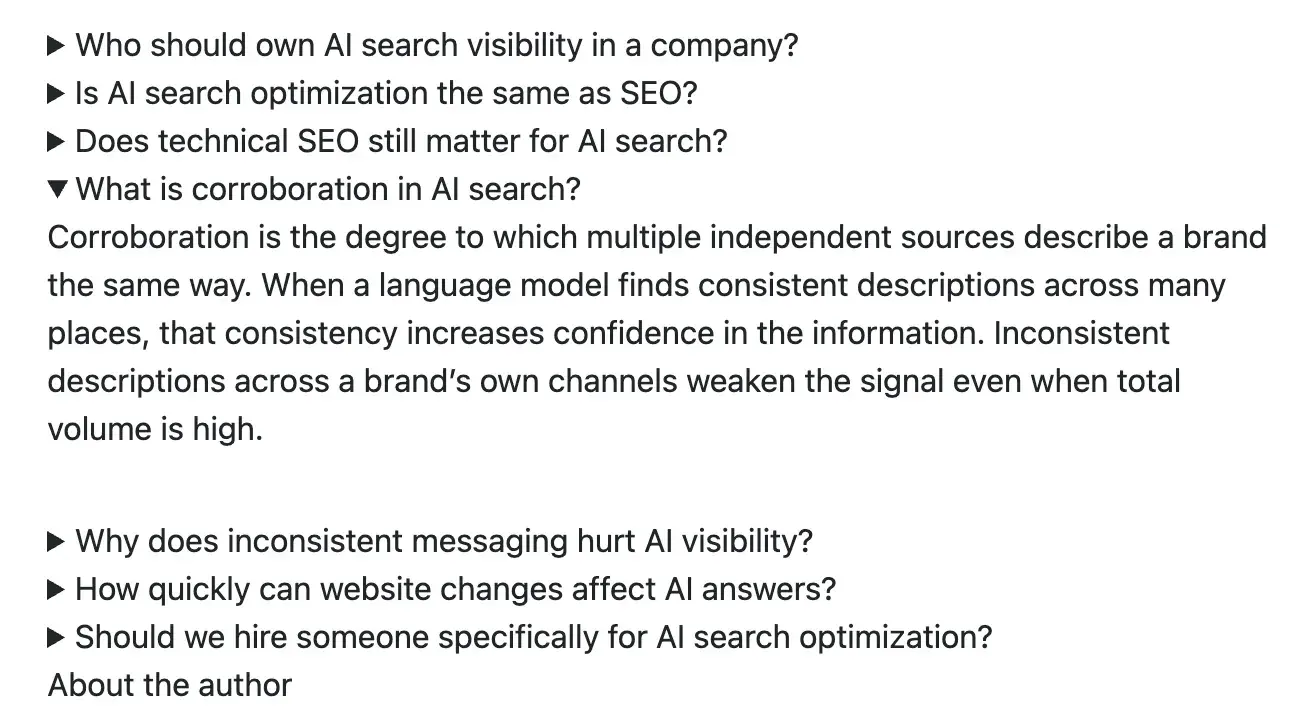
Experts also emphasize the structural discipline required for successful extraction. Romana Kuts, founder of SaaStorm, notes that answer engines prefer concise, direct information. "Most traffic coming from generative engines stems from short, sweet, well-structured FAQ blocks," Kuts explains.
Furthermore, brand consistency plays an unprecedented role in establishing algorithmic trust. David Kirkdorffer, a fractional marketer, cautions against linguistic drift: "We can say the same thing with different words and retain meaning. But if we alter our brand descriptors too much across different surfaces, we break the entity link in the model’s memory."
Implications for Marketers and Revenue Teams
The transition to AI search optimization carries profound operational implications for corporate marketing departments, content creators, and technical web developers.
1. Shift from Page-Level to Block-Level Optimization
Answer engines do not regurgitate entire web pages; they lift specific passages. Content teams must adopt a claim-then-evidence writing pattern: leading a section with a direct, self-contained claim, immediately followed by supporting data or named examples.
2. Standardization of Brand Entities
In AI search, brand authority is tied to recognized entities (people, products, and organizations). Organizations must audit and standardize their brand bios, author credentials, and company descriptions across all digital surfaces—from corporate websites to third-party review directories and social channels.

3. Technical Crawlability and JavaScript Rendering
AI crawlers demand speed and efficiency. If critical product descriptions, pricing comparisons, or FAQ answers are hidden behind heavy client-side JavaScript rendering, automated scrapers may fail to capture the text, rendering the brand invisible to the RAG pipeline.
Debunking Common AI Search Myths
As the field of AEO expands, misinformation abounds. Industry leaders advise marketers to disregard several widespread myths:
- Myth: You must maintain an
llms.txtfile for Google Search.
Fact: Major search engines like Google have explicitly clarified that they ignorellms.txtfiles for core web search indexing. Focus resources on clean HTML structure, crawlability, and substantive content instead. - Myth: You must shred content into tiny, disconnected sentences.
Fact: Generative engines value contextual coherence. Clean headings, logical grouping, and well-developed paragraphs perform better than fragmented walls of text. - Myth: Schema markup alone guarantees citations.
Fact: Schema is a labeling tool, not a substitute for substance. It clarifies good content for machines, but it cannot rescue thin or inaccurate writing.
Conclusion and Strategic Action Plan
The emergence of AI search optimization represents a permanent evolution in digital discovery. By shifting focus from keyword volume to extractable clarity, entity consistency, and robust technical crawlability, brands can secure their position inside the synthesized answers that define modern buyer journeys.
To begin winning in AI search today, marketing teams should execute three immediate steps:
- Incorporate Short Q&A Blocks: Add concise, direct FAQ sections to core commercial landing pages.
- Standardize Entity Profiles: Ensure brand and author descriptions are identical across all internal and external touchpoints.
- Audit Technical Rendering: Verify that primary text content is rendered server-side and fully accessible to automated web crawlers.
Optimize for the answer, and you secure visibility for the future of search.