










In the rapidly evolving landscape of artificial intelligence, the industry has spent the last two years obsessing over "System Two" capabilities—the deep, reflective, and reasoning-heavy processes that define Large Language Models (LLMs) like GPT-4, Claude 3.5, and Gemini. However, as developers attempt to build complex, autonomous agents, they are hitting a wall. High-latency, expensive, and unpredictable models are being tasked with mundane, repetitive "micro-judgments" that they were never architected to handle.
Last week, TypeSafe AI, a startup founded by former OpenAI researcher Diogo Almeida, shifted the narrative by launching Jev, the company’s first "System One" model. Unlike generative giants, Jev isn’t designed to compose poetry, debug complex code, or summarize long documents. Instead, it is purpose-built to act as the "nervous system" for autonomous agents, providing instantaneous, typed, and calibrated decisions at a fraction of the cost of general-purpose LLMs.
The Architecture of Immediate Thought: What is a System One Model?
To understand the significance of Jev, one must borrow from the psychological framework popularized by Daniel Kahneman. "System One" thinking refers to the fast, automatic, and intuitive processes of the mind, whereas "System Two" involves slow, deliberative, and effortful reasoning.
Current AI agents rely heavily on System Two models to function, requiring them to "stop and think" for every minor action. If an agent is browsing the web, it might use a massive LLM to decide whether a specific link is relevant, whether a button is clickable, or whether a process has completed. This is akin to a human using a PhD-level physicist to calculate the tip on a coffee bill—it is overkill, expensive, and incredibly slow.
Jev changes this paradigm. It takes unstructured state data—whether text or JSON—and outputs highly specific, typed decisions accompanied by calibrated probability scores. By offloading these "micro-judgments" to a model optimized for throughput and reliability, developers can streamline the agent loop, creating systems that are more responsive and less prone to the "hallucination creep" often seen in multi-step LLM chains.
Chronology: From OpenAI Research to TypeSafe AI
The genesis of Jev lies in the research conducted by Diogo Almeida during his tenure at OpenAI, where he focused on instruction-following and the underlying mechanics of how models interpret human intent. Recognizing that the bottleneck for agentic growth wasn’t a lack of raw intelligence, but rather a lack of specialized, low-latency decision-making, Almeida transitioned to founding TypeSafe AI.
The development of Jev was not an overnight success but a result of rigorous "workflow evals." Throughout the product’s development, TypeSafe focused on the friction points that developers face when building production-grade agents. By iterating on Reinforcement Learning for Calibrated Decisions (RLCD), the team ensured that Jev’s confidence scores are not just arbitrary numbers, but accurate predictors of success.
The launch of Jev 1.13 marks the first public step in a broader roadmap for TypeSafe, aimed at replacing the "prompt-engineering-as-a-fix" culture with a more robust, schema-bound engineering approach to AI.
Supporting Data: Efficiency at Scale
The primary value proposition of Jev is its staggering efficiency. According to internal workflow evaluations conducted by TypeSafe, Jev is up to 193.6x faster and 444.6x cheaper than traditional generative LLMs when performing standard classification and routing tasks.
These figures, while based on the upper end of performance gains, highlight a critical shift in the economics of AI agents. In a head-to-head comparison against industry-leading models like Claude Opus 5, Jev demonstrated:
- Latency: A median latency of 175ms (via OpenRouter), compared to 2,266ms for generative alternatives.
- Cost: At approximately $0.11 per 1,000 requests, Jev provides a significant reduction in operational expenditure compared to the $2.42 per 1,000 requests often associated with high-end generative API calls.
- Accuracy: On the rigorous "Banking77" intent-classification benchmark, Jev achieved 81% accuracy, trailing Claude Opus 5 by only 3.3 percentage points, despite being orders of magnitude faster and cheaper.
For enterprise-level agents processing millions of decisions per month, these differentials are not merely optimizations—they are the difference between a project being commercially viable and being a research experiment.
Official Stance and Technical Primitives
TypeSafe AI’s documentation outlines three core primitives that define how Jev interacts with the world. By forcing developers to define their questions as typed inputs, the model guarantees that the output adheres strictly to a predefined schema. This eliminates the "type errors" and unpredictable formatting that plague standard chat-based LLMs.
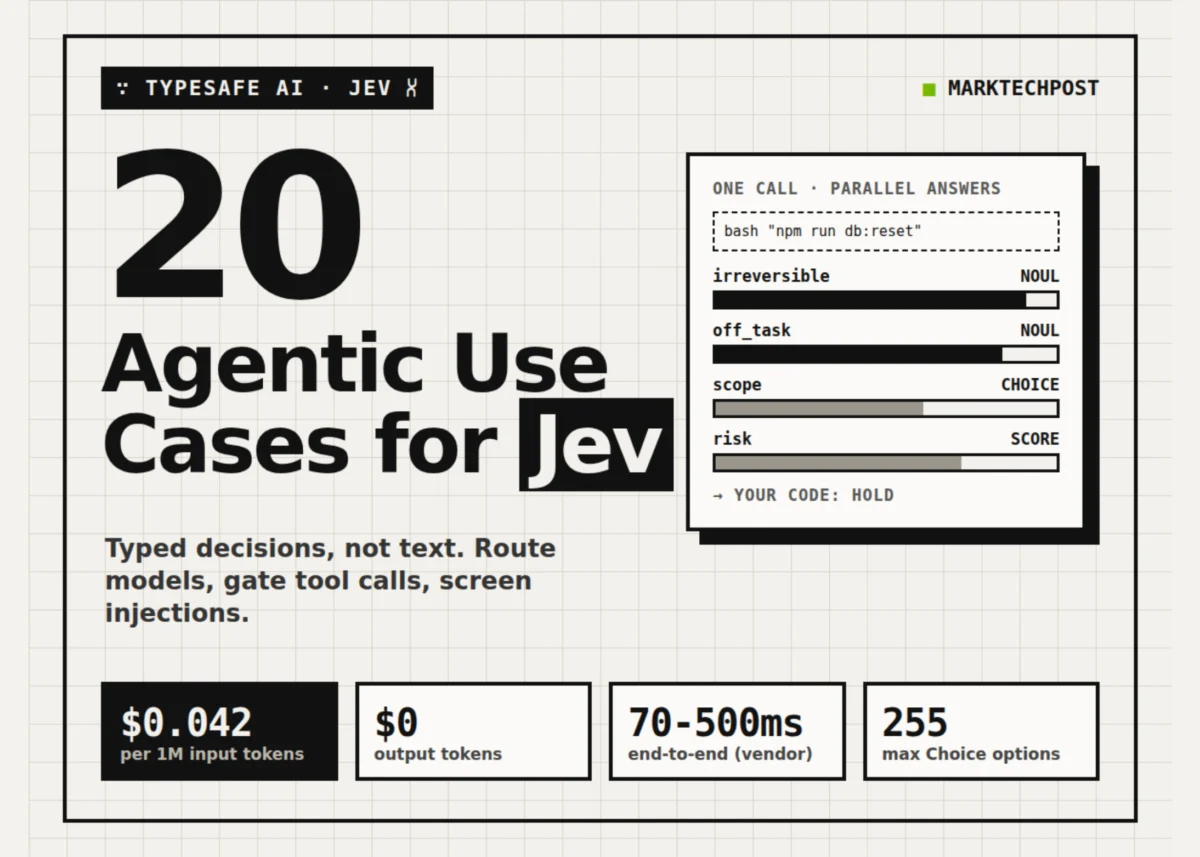
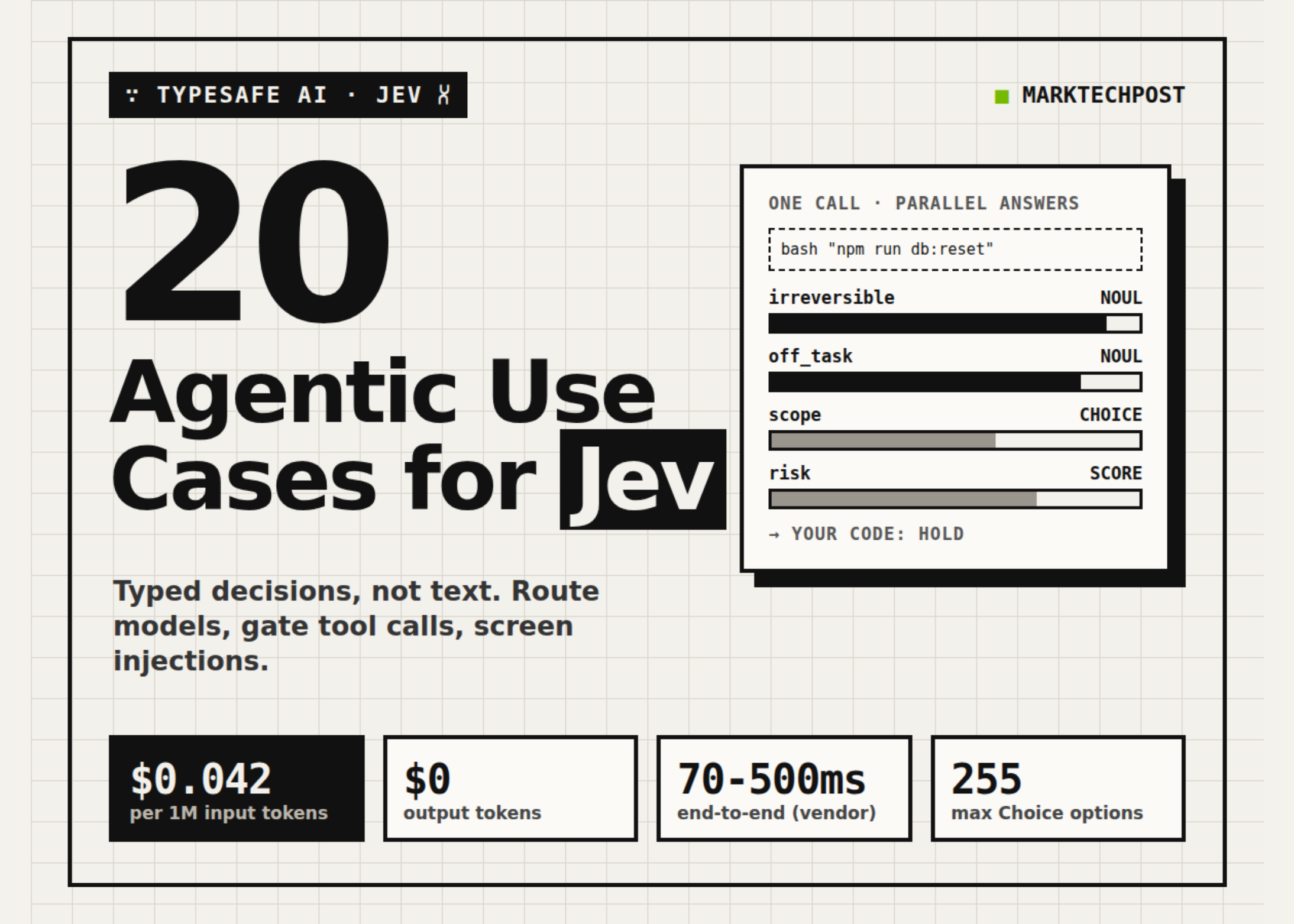
Jev allows for up to 255 unique choice options in a single call, and because all questions are evaluated in parallel, the model maintains a flat latency profile even as the complexity of the agent’s decision-tree increases.
In response to the launch, the developer community has noted the importance of the model’s "calibration." Because Jev is trained with RLCD, it provides a confidence score for every decision. If the confidence is low, the agent can be programmed to "escalate" the task to a more powerful System Two model—a technique known as "Model Cascading." This hybrid approach—using Jev for 90% of decisions and a generative model for the 10% that require deep reasoning—is currently viewed by experts as the "gold standard" for building resilient, production-ready agents.
Implications for the Future of AI Agents
The introduction of Jev signals a maturation of the AI agent market. We are moving away from the era of "everything-as-a-chatbot" and toward a modular, component-based architecture for software development.
1. The Death of the "Prompt" for Simple Tasks
For years, developers have used natural language prompts to coerce LLMs into making simple classifications. This is inherently brittle; a model might return a slightly different string, breaking the downstream code. Jev’s commitment to "schema-bound" output means that the AI becomes a predictable component in a larger software stack, rather than a black box that requires constant monitoring.
2. Guardrails and Safety
Safety is no longer an afterthought. By utilizing a dedicated System One model for guardrails, developers can implement real-time safety checks that are fast enough to run before an agent executes a command. This is critical for agents that have the ability to interact with browsers, file systems, or financial APIs.
3. The Democratization of Agentic Workflows
As costs drop, the barrier to entry for building autonomous systems lowers. Jev enables small startups to build agents that perform with the same efficiency as those built by tech giants. By offloading the "heavy lifting" of logic to a high-speed, low-cost layer, developers can focus their resources on the creative and high-value aspects of their applications.
Conclusion: A Shift in Paradigms
As TypeSafe AI continues to refine Jev, the broader implications for the AI ecosystem are clear. The industry is entering a phase where the "intelligence" of a model is less important than its "utility." Jev does not aim to be the smartest model in the room; it aims to be the most reliable, the fastest, and the most cost-effective.
For the developer community, Jev represents a necessary pivot toward engineering rigor. As we push the boundaries of what autonomous agents can achieve, the reliance on massive, general-purpose models will continue to decrease, replaced by a sophisticated layer of specialized, high-performance decision-makers. In this new world, the agents that succeed will be the ones that know when to think deeply, and when to act instantly. With Jev, TypeSafe AI has provided the tools to make that distinction not just possible, but the default.



