










In a market increasingly obsessed with packing cameras, sensors, and "super-sensing" capabilities into every wearable, Halliday is making a calculated bet on minimalism and privacy. The company has officially announced the Halliday G2, a pair of AI-powered smart glasses that fundamentally pivots away from the "all-seeing" trend of its competitors. By opting for a camera-less design, Halliday is positioning the G2 as the ultimate professional tool—a device designed for the boardroom, not the street.
The Core Proposition: Innovation Through Omission
The Halliday G2 is not just an iteration of its predecessor; it is a conceptual reset. While the original Halliday AI glasses served as a proof-of-concept for micro-display integration, the G2 is a refined instrument built for productivity. The most significant hardware change is the transition from a single-eye display to a binocular waveguide optical system.
By utilizing dual micro-LED projectors capable of reaching 1,600 nits of peak brightness, the G2 ensures that visual overlays remain crisp even in challenging lighting conditions. The resolution of 600 x 300 per eye is specifically calibrated for "glanceability"—the ability to process information without breaking eye contact or losing focus on the physical environment.
Perhaps most crucially, by stripping away the camera, Halliday has circumvented the primary hurdle preventing smart glasses from entering corporate spaces: the "privacy tax." Many modern enterprises have strict bans on recording devices in secure areas. By removing the lens, the G2 effectively grants itself a "clearance" that Meta’s experimental frames and the rumored Samsung Galaxy Glasses may struggle to achieve.
Chronology: From Concept to Corporate Essential
To understand the significance of the Halliday G2, one must look at the rapid evolution of the brand over the past eighteen months.
- Early 2025: Halliday introduces its first-generation glasses. The reception is lukewarm regarding aesthetics, but the "Pip-Boy-esque" utility sparks interest in the concept of heads-up meeting data.
- Late 2025: As competitors like Meta and Apple (via Vision Pro) dominate the news cycle with camera-centric mixed reality, enterprise feedback reveals a growing anxiety among managers and IT security departments regarding data privacy.
- Q1 2026: Halliday pivots its engineering focus toward "Meeting Flow," a software-first approach that prioritizes audio processing and text-based visual feedback.
- July 2026: The official announcement of the Halliday G2. The company opens a pre-sale window, signaling a readiness to scale production for the enterprise market.
- September 2026 (Projected): Full retail shipment begins, accompanied by the rollout of integrated prescription lens support.
Supporting Data and Technical Specifications
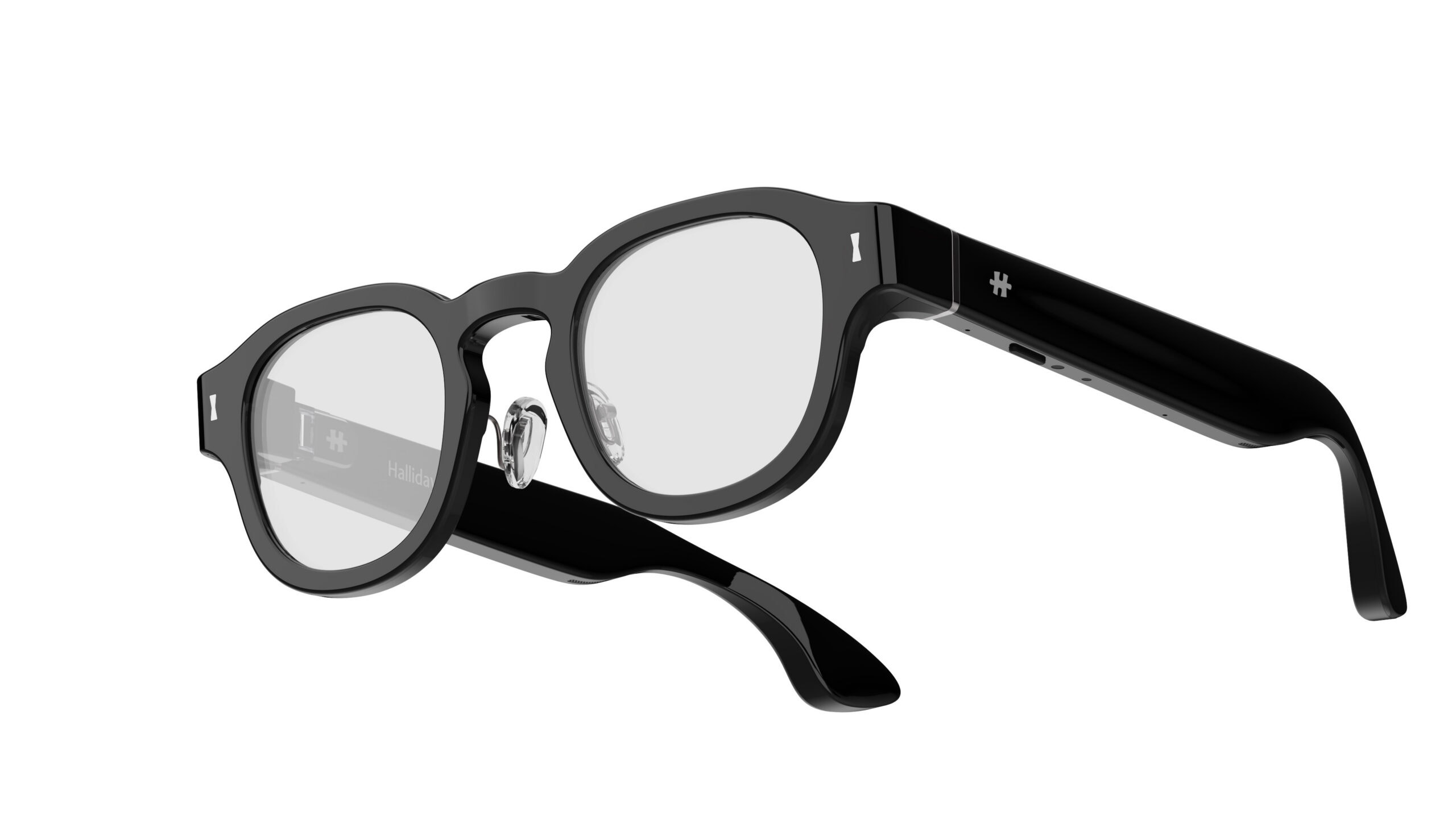
The G2 is a masterclass in weight management and power efficiency. Halliday has targeted a sub-50g frame weight—an impressive feat for a device containing a binocular waveguide, a four-microphone array, and the necessary compute hardware to handle on-device AI.

Hardware Breakdown:
- Display: Binocular waveguide, dual micro-LED projectors.
- Brightness: 1,600 nits (peak), with dynamic auto-dimming.
- Audio: Four-microphone beamforming array (up to 2-meter effective voice recognition).
- Battery Life: 12+ hours of typical usage, designed to last a full workday on a single charge.
- Weight: Under 50 grams (similar to standard high-end eyewear).
The choice of a four-microphone array is strategic. By focusing on voice recognition rather than visual input, the G2 can effectively "listen" to a room, identify speakers, and provide real-time transcriptions without needing to record video. This is the cornerstone of the device’s "Meeting Flow" software suite.
The Software Ecosystem: "Meeting Flow"
Hardware is merely the vessel for the G2’s real value: the "Meeting Flow" ecosystem. The software is designed to turn a standard conference room into a high-information environment.
Key Features of Meeting Flow:
- Live Translation: Real-time, in-eye captioning for over 45 languages. This feature is a game-changer for international business, allowing participants to follow a conversation in their native language regardless of the speaker’s fluency.
- Thread Tracker: A visual aid that keeps track of complex, multi-topic discussions, surfacing unresolved issues as they occur.
- Commitment Check: An AI-driven tool that flags potential action items and deliverables, asking the user to confirm them before the meeting concludes.
- Teleprompter (Cheatsheet): Outside of meetings, this mode allows users to project notes or bullet points, making it an invaluable tool for public speaking or presentations.
Post-meeting, the companion app synthesizes these data points into a structured summary, effectively automating the "minutes" of the meeting. This integration between the wearable and the digital workspace is where Halliday aims to justify the $599 price tag.
Official Responses and Strategic Positioning
In official statements, Halliday leadership has emphasized that they are not competing for the "social media" or "lifestyle" market. They are explicitly targeting the "knowledge worker."
"The goal was never to build a camera that happens to be glasses," a spokesperson noted during the launch. "The goal was to build a brain that happens to be glasses. By removing the camera, we aren’t just protecting privacy; we are reducing distraction. We want our users to be more present in their meetings, not more tethered to a digital recording device."
This stance is a direct rebuttal to the current trend of "Super Sensing" glasses. While companies like Meta are experimenting with AI that can see and describe the world around the user, Halliday is betting that the most valuable data is the information already contained in the conversation, not the video of the coffee mug on the table.
Implications for the Industry
The launch of the Halliday G2 sends a clear signal to the rest of the wearable technology sector: there is a viable path forward that doesn’t involve pervasive surveillance.
1. The Enterprise Privacy Standard
If the G2 succeeds, it will likely set a new standard for corporate hardware. IT departments are notoriously conservative regarding new tech. By effectively removing the "threat vector" of a camera, Halliday makes it much easier for a CTO to approve these devices for office use. If employees can attend meetings with a discreet device that provides AI-assisted summaries, the demand for such tech will skyrocket.
2. The Return of Practical AR
We have spent years waiting for "killer apps" in Augmented Reality. Most have failed because they were either too bulky, too expensive, or too intrusive. The G2, by focusing on text-based overlays and audio-driven AI, delivers utility that is immediately understandable. You don’t need to "learn" how to use a teleprompter or a live translator; the value is self-evident.
3. The Future of Competition
This launch puts pressure on companies like Samsung and Meta. If Halliday can prove that professionals prefer a privacy-first, lightweight device over a camera-heavy one, we may see a bifurcation in the market. We will likely see "Consumer AR" (cameras, heavy sensors, social media focus) and "Professional AR" (no cameras, privacy-centric, productivity focus).
Pricing and Final Thoughts
The Halliday G2 is currently in its "initial pre-sale" phase. Prospective buyers can place a $10 refundable deposit on the company’s official website, which nets them a $100 discount on the final $599 retail price. While $599 is a premium price point, it is significantly more affordable than high-end mixed-reality headsets, positioning it as a professional investment rather than a luxury gadget.
As we move toward September 2026, all eyes will be on how the market reacts to a device that promises to help us work smarter, not by recording everything we see, but by understanding everything we say. Halliday has recognized that the future of AI isn’t just about what a device can see—it’s about how much more we can do when the technology stays out of the way.