On September 29, 2026, OpenAI fundamentally altered the landscape of human-computer interaction at its DevDay conference. The company unveiled Dots, a suite of "always-on" AI agents designed to function not as mere chatbots, but as autonomous collaborators capable of operating independently across cloud infrastructure and external software ecosystems.
For the global data science and machine learning community, Dots represents more than a product launch; it is the realization of a long-promised, yet frequently elusive, vision: the transition from reactive prompt-based AI to proactive, persistent agentic workflows. As professionals begin to integrate these tools into their daily routines, the industry faces a critical juncture where the promise of immense productivity gains meets the reality of unresolved security, privacy, and operational governance challenges.
The Chronology of Autonomy: How We Got Here
The path to Dots was paved by years of iterative refinement in the Large Language Model (LLM) space. Following the explosive growth of ChatGPT, the industry moved through distinct phases of AI adoption:
- 2022–2023: The Chatbot Era. Users learned to prompt, iterate, and treat AI as an expert consultant. Interaction was strictly synchronous; the AI existed only within the bounds of a chat window.
- 2024: The Tool-Use Era. OpenAI and its competitors introduced function calling and "plugins," allowing models to access search engines and external databases. However, these interactions remained brittle, often failing after a few steps or requiring constant human intervention.
- 2025: The Rise of Frameworks. Developers experimented with frameworks like LangChain and AutoGPT, attempting to string together sequences of AI actions. These were powerful but technically demanding, often suffering from "context drift" and hallucinations.
- 2026: The Agentic Leap (Dots). OpenAI introduced the first enterprise-grade, persistent agent architecture. By moving the compute to the cloud and ensuring the agent operates beyond the session, OpenAI has shifted the paradigm from "AI as a tool" to "AI as a team member."
What Dots Actually Is: Architecture and Capabilities
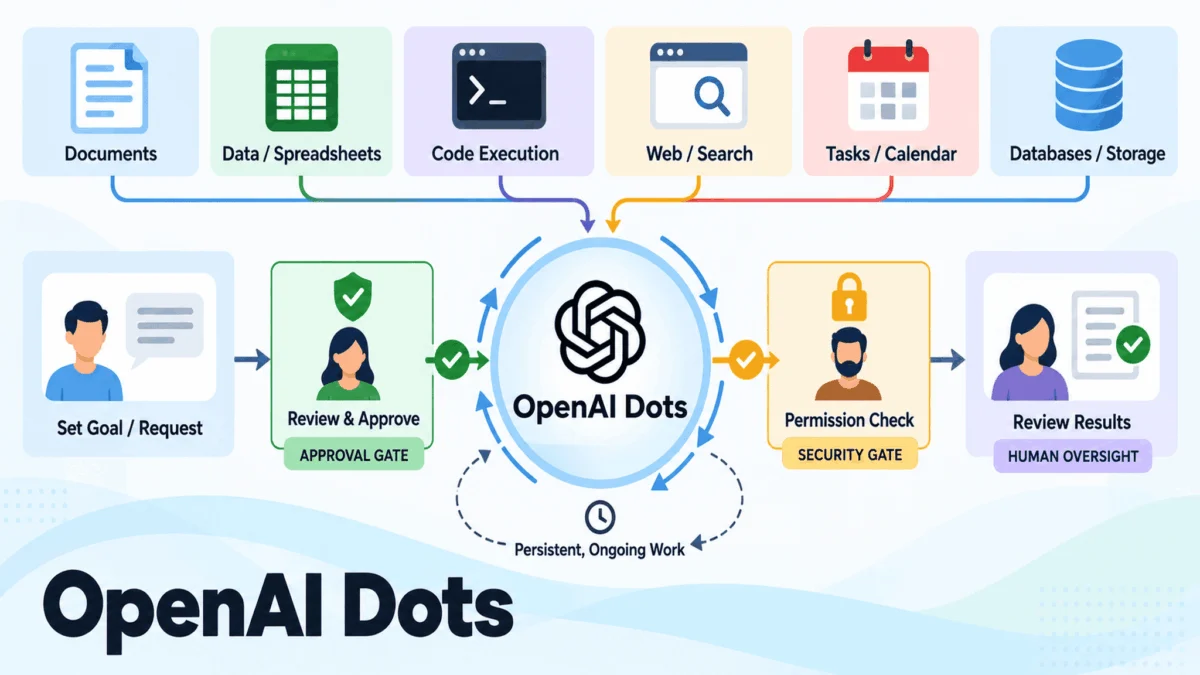
At the core of the Dots experience is the integration of the GPT-6 Astra model, which has been optimized specifically for multi-step, sustained reasoning. Unlike previous iterations, a "Dot" maintains a persistent state. It does not "forget" upon closing the laptop. It runs on dedicated cloud infrastructure, meaning it can continue to process background tasks—such as scraping data, summarizing threads, or drafting documentation—even when the user is offline.
Key Functional Pillars:
- Proactive Execution: A Dot is goal-oriented. Rather than waiting for a prompt, it can be assigned a standing objective—such as "monitor for new customer feedback and draft technical fixes."
- Cross-App Connectivity: With hooks into over 4,000 applications, Dots functions as a digital orchestrator. It bridges the gap between siloed platforms like Slack, Microsoft Teams, and proprietary data lakes.
- Contextual Evolution: The agent learns from its mistakes. If a user provides feedback on a specific output, the Dot internalizes that preference, reducing the need for repetitive instruction in future sessions.
Supporting Data: Why Reliability Has Changed
For many practitioners, the skepticism surrounding Dots stems from past failures with agentic systems. Why is this time different? The shift lies in the architecture of GPT-6 Astra.
In earlier models, reliability degraded linearly with the number of steps in a task. If a process required five logical steps, the probability of failure by step four was statistically high due to context window limitations and erratic reasoning. Astra’s architecture prioritizes "branching logic," allowing the agent to evaluate its progress against a goal and backtrack or adjust its strategy without human intervention.
According to preliminary internal benchmarks shared by OpenAI, Astra demonstrated a 40% improvement in "task completion rate" on long-horizon, multi-tool workflows compared to its predecessor, GPT-4o. This reduction in the "human-in-the-loop" requirement is the primary factor that differentiates Dots from the brittle bots of 2024.
Official Responses and Strategic Positioning
During the DevDay 2026 keynote, OpenAI CEO Sam Altman positioned Dots as a "delegation model." He emphasized that the goal is not to automate away the human, but to liberate the human from "low-agency" cognitive labor.
"You don’t hire a senior engineer to hold their hand through every keystroke," Altman noted. "You hire them to own an outcome. Dots is designed to be the digital equivalent of that high-agency colleague."
However, the response from the broader tech community has been a mixture of cautious optimism and sharp scrutiny. While enterprise leaders are eager to reduce operational overhead, cybersecurity experts have raised red flags regarding the "black box" nature of Dot’s memory. Currently, users have limited visibility into exactly what an agent "remembers," leading to concerns about how proprietary data is handled across long-term autonomous operations.
Implications for Data Science and Engineering
The arrival of Dots forces a fundamental rethink of the data scientist’s workflow. The job title "Data Scientist" may soon be forced to incorporate "Agent Architect."
Efficiency Gains
The most immediate impact will be felt in the "administrative debt" of data science:
- Documentation: Automatically updating READMEs and model cards as code evolves.
- Status Reporting: Synthesizing complex pipeline outputs into executive summaries.
- Pipeline Monitoring: Proactively identifying drift or failure in data streams and drafting root-cause analyses.
The Governance Risk
Conversely, the "always-on" nature of these agents introduces new risks. If an agent is granted permission to write code or access production databases, the surface area for errors increases significantly. If a Dot misinterprets a requirement, it could execute a sequence of actions that results in corrupted data or broken pipelines before a human notices.
Practitioners must now master the art of Permission Design. Just as developers manage permissions in a cloud environment (IAM roles), data scientists will need to establish strict boundaries for what their agents can "read," "write," and "execute."
Practical Constraints and Privacy Realities
While the potential is vast, the current rollout of Dots comes with significant caveats that professional teams must consider:
- Exclusion Zones: As of the current release, Pro users in the European Economic Area, Switzerland, and the UK are excluded. This creates a compliance nightmare for multinational firms attempting to standardize their toolsets.
- Memory Opacity: Users currently lack the granular ability to audit, modify, or purge individual memories within an agent. For a data scientist working with PII (Personally Identifiable Information) or sensitive client intellectual property, this represents a significant security hurdle.
- Pricing and Scaling: While a "Pro" subscription starts at $100/month, the cost for enterprise-scale deployment remains unclear. Organizations need to calculate the ROI of an agent versus the subscription fees and the latent cost of potential errors.
The Path Forward: Clarity as the New Currency
The most profound takeaway from the release of Dots is that the bottleneck for AI adoption is no longer technical capability—it is human clarity.
To use Dots effectively, a practitioner must be able to define their work with a level of precision that many have never had to articulate. An agent cannot fulfill a "vague" request; it requires explicit goal definitions, clear success criteria, and well-defined "stopping conditions."
As we look toward the next year of AI development, the most successful data scientists will not be those who simply prompt the most, but those who are the most skilled at designing delegation. They will build workflows that treat the AI agent as a junior associate: someone capable of high-speed execution, provided they are given the right boundaries, the right tools, and the right oversight.
The agent is only as good as the brief you provide. In the era of Dots, the brief is the most critical piece of software you will ever write.
About the Contributor
Vinod Chugani is an AI and data science educator focused on the intersection of agentic workflows and practical enterprise application. With a background in quantitative finance, Vinod bridges the gap between complex model architecture and the pragmatic needs of working professionals. His ongoing work focuses on helping teams transition from reactive prompting to proactive, agent-based operational models.