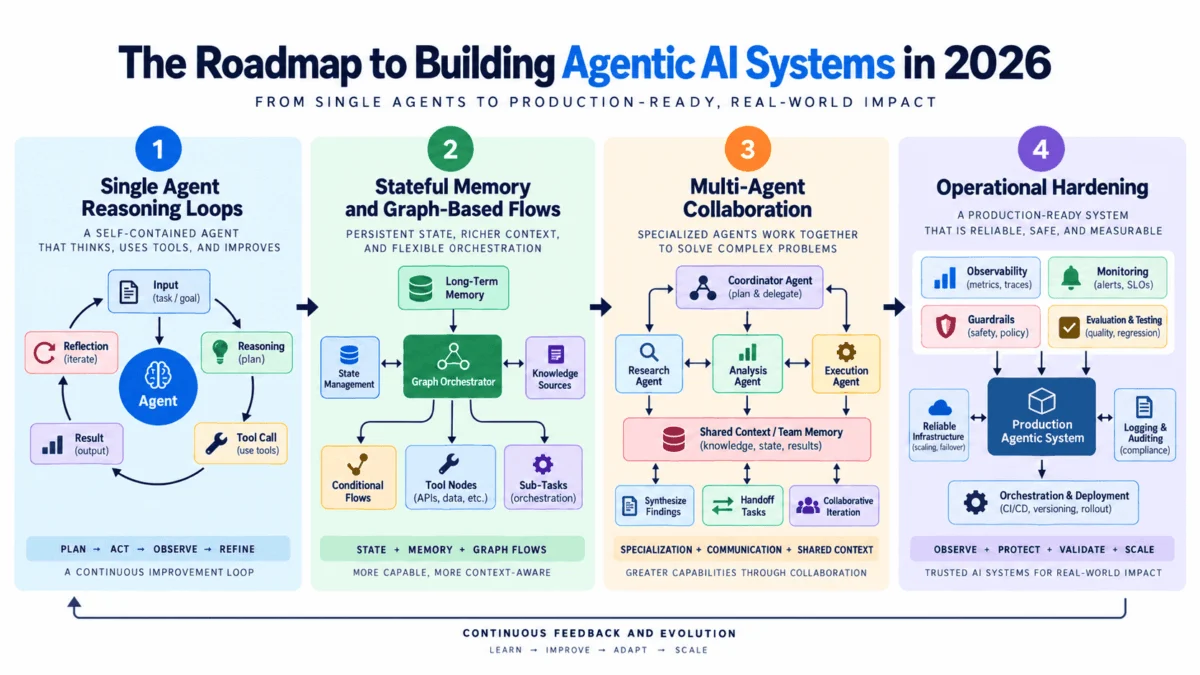
The landscape of artificial intelligence is undergoing a profound metamorphosis. We are moving beyond the era of passive chatbots and single-turn prompt engineering into the age of "Agentic AI"—systems capable of autonomous planning, tool utilization, and iterative problem-solving. As these agents transition from experimental research papers to the backbone of enterprise infrastructure, they are being deployed in mission-critical environments: from automated code review pipelines and sophisticated research assistants to complex customer operations and internal organizational workflows.
However, the chasm between a convincing demo and a production-ready autonomous system is vast. While a chatbot requires only an LLM call, an agentic system demands a new class of engineering rigour, focusing on state management, failure recovery, sandboxed execution, and trajectory evaluation. This article outlines a comprehensive four-level roadmap for mastering the development of robust, agentic AI systems.
I. The Anatomy of an Agent: Foundations and Cognitive Architectures
At its core, an "agent" is a system that perceives its environment, selects actions, executes those actions through external tools, and leverages the results to inform subsequent decisions. This feedback loop is the defining characteristic that separates true agency from standard language model inference.
The Reasoning Paradigm
The primary hurdle for beginners is structuring this loop. Reasoning paradigms—such as the seminal "ReAct" framework—allow models to interleave verbal reasoning with actionable steps. By explicitly stating its thought process before executing a tool, the agent provides a transparent audit trail, which is critical for debugging complex decision paths.
Structured Tool Interaction
Modern agents interact with the world via function calling. To prevent cascading failures, developers must move beyond raw text output and implement strict validation schemas. Utilizing tools like Pydantic allows for the enforcement of strict type-checking, ensuring that tool calls—whether they are web searches, database queries, or code execution—adhere to predefined schemas.
-
Example Implementation:
from pydantic import BaseModel
from typing import Literal

class CodeToolCall(BaseModel):
    tool: Literal["run_python"]
    code: str
    timeout_seconds: int = 30

# Strict validation prevents malformed execution
Dynamic Context Assembly
As agents perform multi-step tasks, the "context window" becomes a precious resource. Developers must implement dynamic context management, deciding what information is essential for the current step, what should be summarized, and what should be offloaded to long-term memory. This is not merely a performance optimization; it is a fundamental systems challenge that dictates the coherence and cost-efficiency of the agent.
II. Stateful Memory and Graph-Based Control Flows
A common point of failure in early-stage agent development is the "stateless trap." If an agent loses context between tool calls, it becomes brittle and prone to logical drift.
The Three Forms of Memory
- Short-term memory: The immediate conversational history within a single session.
- Episodic memory: The ability to store and retrieve past experiences or specific outcomes of previous tasks.
- Semantic memory: A persistent knowledge base that the agent can query to inform its reasoning.
Replacing Chains with Graphs
Linear execution chains (A $rightarrow$ B $rightarrow$ C) are insufficient for real-world complexity. Modern production systems are increasingly using graph-based architectures. Tools like LangGraph allow developers to model execution as a Directed Acyclic Graph (DAG) or a cyclical state machine. This allows agents to handle branching logic—for example, attempting a research path, evaluating the results, and deciding whether to pivot or proceed based on the data returned.
State Persistence as an Engineering Pillar
In production, checkpointing is mandatory. By saving the state of an agent at every step, developers gain the ability to roll back failed executions, resume long-running tasks after a crash, and introduce "human-in-the-loop" approval gates. This is the difference between a prototype and a resilient piece of enterprise software.
III. Multi-Agent Collaboration and Protocol Design
When a single agent reaches its cognitive capacity, the solution is to orchestrate a team. Multi-agent systems involve specialized entities working in tandem, mirroring the structure of human organizations.
Team Topology
Developers must decide between hierarchical models (where a "manager" agent delegates to subordinates) or collaborative models (where agents communicate in a peer-to-peer fashion).
Communication Protocols
One of the most under-researched areas in AI development is the inter-agent protocol. If agents communicate via unstructured natural language, errors compound exponentially. Establishing structured message schemas—standardized formats for task assignment, status reporting, and result delivery—is essential for mitigating "coordination rot." The Model Context Protocol (MCP) is currently emerging as a standard to facilitate this, providing a unified interface for connecting agents to diverse data sources and tools.
Conflict Resolution
Specialized agents will inevitably disagree. A "Coder" agent might produce a solution that a "Critic" agent deems insecure. A robust multi-agent system must have built-in mechanisms for resolution: voting, re-querying with provided context, or human escalation.
IV. Operational Hardening, Sandboxing, and Observability
The final frontier of agentic development is operational maturity. An agent that works in a local environment but fails in the wild is a liability.
Safety and Runaway Loops
Agents can easily enter self-reinforcing reasoning loops, consuming massive amounts of tokens and potentially performing dangerous actions. Implementing "circuit breakers"—hard limits on the number of steps or token usage—is a mandatory safety feature. Furthermore, any agent with code-writing capabilities must operate within an isolated sandbox (such as Docker or WebAssembly runtimes) to prevent unauthorized system access.
The New Standard: Trajectory Evaluation
Traditional "unit testing" is insufficient for agents. We must shift toward trajectory-level evaluation. This involves scoring the efficiency, correctness, and safety of the entire execution path, rather than merely inspecting the final answer.
Platforms like LangSmith and Arize Phoenix provide the necessary observability to record every step in the agent’s reasoning process. By using decorators (like @traceable), developers can build a comprehensive map of how an agent arrived at a conclusion, making it possible to identify the exact point where a chain of thought diverged into error.
Implications for the Future of Work
The shift toward Agentic AI represents a fundamental change in software development. We are moving from building tools that wait for human input to building systems that proactively pursue goals over extended time horizons.
The compounding effect of these four levels is significant:
- Structured validation prevents runtime crashes.
- State management ensures coherence over long-running tasks.
- Protocol discipline reduces coordination errors in multi-agent teams.
- Observability infrastructure makes complex systems debuggable.
For organizations, the implication is clear: the focus must shift from "getting the AI to answer" to "building the infrastructure that keeps the AI on track." As Vinod Chugani, an expert in the field, notes, the roadmap is ordered by complexity, but also by the order in which systems fail. By building these layers deliberately, developers can create AI systems that are not only powerful but reliable, auditable, and truly enterprise-grade.
The year 2026 will not be defined by the intelligence of individual models, but by the sophistication of the agentic architectures that contain and guide them. The transition to autonomous systems is no longer a research goal; it is an engineering mandate.