







In the sophisticated landscape of Python development, the ability to manage how object attributes are accessed, modified, and computed is a hallmark of senior-level engineering. While many developers rely on @property decorators to encapsulate logic, there exists a more powerful, reusable, and elegant mechanism under the hood: Python Descriptors.
Descriptors represent the structural "glue" that holds together much of Python’s internal behavior, including methods, static methods, and class methods. By mastering this protocol, developers can move beyond simple getters and setters, creating robust, declarative frameworks that handle validation, computation, and resource management with surgical precision.
1. The Anatomy of the Descriptor Protocol
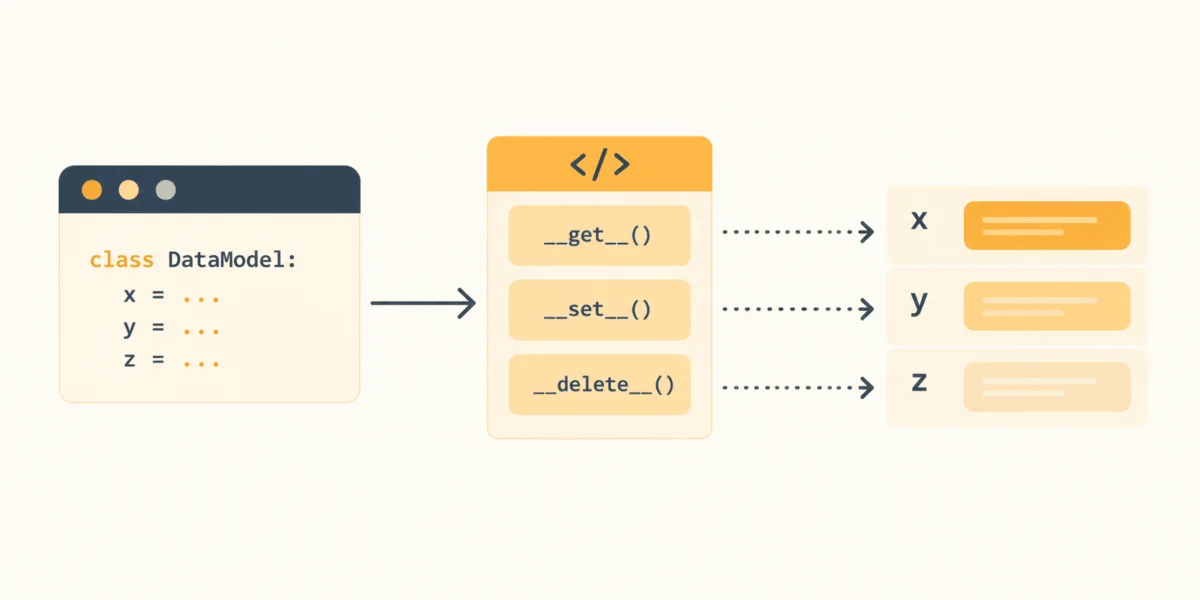
At its core, a descriptor is simply a class that implements one or more of the "descriptor protocol" methods: __get__, __set__, or __delete__. When an object is defined as a class attribute of another class, Python treats it as a descriptor.
This protocol grants the developer total control over the attribute lifecycle. The introduction of __set_name__ in Python 3.6 further elevated this utility, allowing descriptors to "know" their assigned name, which eliminates the need for redundant boilerplate code and prevents naming collisions.
By leveraging this, we can implement "Controlled Attributes"—properties that don’t just hold data, but enforce business rules, compute values on the fly, or optimize performance through lazy evaluation.
2. Validated Attributes: Ensuring Data Integrity
In enterprise applications, data integrity is paramount. Whether you are building a financial engine or a tourism management platform, allowing invalid data to persist in an object is a recipe for system failure.
Implementing ValidatedRating
Consider a Japan tourism application where we must track user ratings for various destinations. A rating must be a numeric value between 1.0 and 5.0. Instead of littering every class with if statements or repetitive property blocks, we can encapsulate this logic into a single, reusable descriptor:
class ValidatedRating:
    def __init__(self, min_val=1.0, max_val=5.0):
        self.min_val = min_val
        self.max_val = max_val

    def __set_name__(self, owner, name):
        self.public_name = name
        self.private_name = f"_name"

    def __get__(self, obj, objtype=None):
        if obj is None: return self
        return getattr(obj, self.private_name)

    def __set__(self, obj, value):
        if not isinstance(value, (int, float)):
            raise TypeError(f"self.public_name must be a number.")
        if not (self.min_val <= value <= self.max_val):
            raise ValueError(f"self.public_name must be between self.min_val and self.max_val.")
        setattr(obj, self.private_name, float(value))
This implementation ensures that the ValidatedRating class acts as a guardian. Whenever a value is assigned, the __set__ method triggers an immediate validation check, throwing an error long before the invalid data can propagate through the system.
3. Computed Attributes: Dynamic Data Transformation
Modern applications often require attributes that are derived from other data points. A classic example is currency conversion. Storing prices in a base currency (e.g., Japanese Yen) while providing real-time access in a secondary currency (e.g., US Dollars) is a common requirement.
The ComputedUSDPrice Descriptor
Rather than manually updating a usd_price field whenever jpy_price changes, we can use a descriptor to calculate the value on demand.
class ComputedUSDPrice:
    def __init__(self, exchange_rate=0.0067):
        self.exchange_rate = exchange_rate

    def __set_name__(self, owner, name):
        self.name = name

    def __get__(self, obj, objtype=None):
        if obj is None: return self
        jpy_price = getattr(obj, 'price_jpy', 0)
        return round(jpy_price * self.exchange_rate, 2)

    def __set__(self, obj, value):
        raise AttributeError(f"self.name is a read-only computed attribute.")
By explicitly raising an AttributeError in the __set__ method, we create a "read-only" property that remains perfectly synchronized with the underlying state, ensuring that the UI or API layer always receives the most accurate, up-to-date conversion.
4. Lazily Loaded Attributes: Optimizing Performance
Performance bottlenecks often arise from heavy I/O operations—such as querying a database, fetching an API response, or loading a large JSON file. If these operations are performed during object instantiation, the system becomes sluggish and memory-intensive.
The LazyItinerary Strategy
A lazy descriptor defers execution until the attribute is actually accessed. Once the data is fetched, the descriptor caches it directly into the object’s __dict__. Future access skips the descriptor logic entirely, resulting in near-instant retrieval.
import time

class LazyItinerary:
    def __set_name__(self, owner, name):
        self.name = name

    def __get__(self, obj, objtype=None):
        if obj is None: return self
        print(f"[System] Simulating expensive database query for obj.destination...")
        time.sleep(1) # Simulated latency
        itinerary = f"Itinerary for obj.destination: Arrival, Sightseeing, Departure."
        obj.__dict__[self.name] = itinerary
        return itinerary
This pattern is essential for high-performance applications where objects may be instantiated frequently, but their "heavy" attributes are only accessed sporadically.
5. Implications for System Architecture
The use of descriptors transforms how we design classes. By offloading logic from the main class body into specialized descriptor objects, we achieve several key architectural benefits:
- Separation of Concerns: The
JapanTourclass no longer needs to know how to validate a rating or how to fetch an itinerary. It only knows that it has these attributes. - DRY (Don’t Repeat Yourself): Descriptors are reusable components. You can attach the same
ValidatedRatingdescriptor to aHotelclass, aFlightclass, and aTourclass simultaneously. - Readability: The declarative nature of descriptors makes class definitions cleaner and more readable. One look at the class attributes reveals the business rules governing the object’s state.
6. Official Perspectives and Best Practices
While descriptors are a powerful feature, Python’s documentation and core contributors often emphasize that they should be used judiciously. They are "power tools"—highly effective when used correctly, but potentially confusing to developers unfamiliar with the underlying protocol.
Best Practices:
- Keep it Simple: If a standard
@propertydecorator is sufficient for your needs, use it. Reserve descriptors for scenarios where you need to reuse logic across multiple classes or where the logic is complex enough to warrant its own class. - Documentation: Because descriptor logic happens "in the background," ensure your code is well-documented. Other developers may be confused if they see an attribute being assigned but don’t see an explicit
__set__method in the parent class. - Test Extensively: Since descriptors manipulate attribute access, they can have side effects. Rigorous unit testing is required to ensure that
__get__and__set__behave predictably under all conditions.
7. Conclusion
Python descriptors are a testament to the language’s design philosophy: providing high-level abstractions that remain deeply connected to the underlying mechanics of the interpreter. By moving from procedural getters and setters to a declarative descriptor-based approach, developers can build systems that are not only more resilient and efficient but also significantly easier to maintain.
Whether you are enforcing strict data validation, providing seamless real-time calculations, or optimizing performance through lazy loading, descriptors provide the architectural foundation required for modern, scalable software development. By integrating these patterns into your workflow, you move beyond writing scripts and start architecting robust, professional-grade systems.