





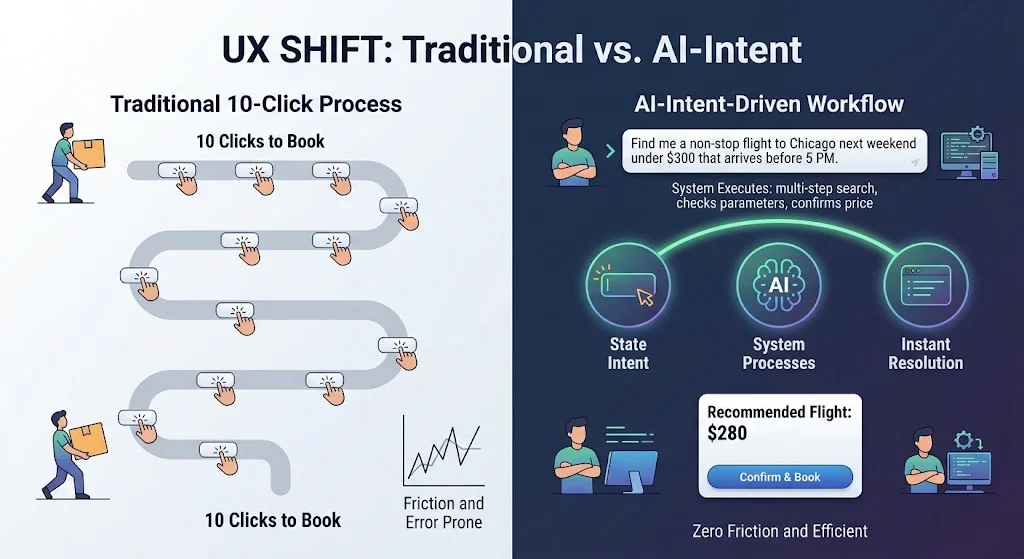
For over four decades, the digital landscape has been defined by the "point-and-click" paradigm. From the pioneering days of the Xerox Star to the household ubiquity of the Apple Macintosh, the contract between human and machine has remained largely static: the user provides the labor, and the computer provides the container. We navigate labyrinths of drop-down menus, range sliders, and multi-step forms, effectively acting as the manual "glue" between disparate data points.
However, a radical shift is underway. Driven by the maturation of Large Language Models (LLMs) and autonomous agent frameworks, the web is transitioning toward a philosophy of Intent-Driven Design. The goal is no longer to build prettier buttons or more intuitive navigation paths; it is to eliminate the interface entirely.
The Evolution of the Digital Contract: From Tools to Agents
The history of software interaction is a story of increasing abstraction. In the 1980s, we learned to manipulate Graphical User Interfaces (GUIs). In the 2000s, we mastered the mobile touch-screen. Today, we are moving beyond the "manual orchestration" phase.

Chronology of the Interface Shift
- 1981–1990: The GUI Emergence. The Xerox Star and Apple Macintosh established the visual metaphor of the desktop. The user was tasked with managing file structures and manual data entry.
- 1991–2010: The Web Navigation Era. The rise of the browser forced users to become experts in "labyrinth navigation"—managing tabs, cookies, and rigid sales funnels.
- 2011–2022: The Optimization Phase. UX design focused on "friction reduction"—making forms shorter and buttons flashier—but the underlying 10-click process remained intact.
- 2023–Present: The Intent-Driven Paradigm. AI models move from being passive tools to active agents, capable of executing multi-step goals behind a single natural-language prompt.
This transition reflects the core philosophy championed by Golden Krishna in his seminal work, The Best Interface Is No Interface. Krishna argued that our obsession with "designing for screens" has distracted us from the true purpose of technology: solving human problems. Modern AI is finally providing the technical infrastructure to realize this vision.
Supporting Data: The Friction of Traditional Workflows
To understand the necessity of this shift, one must quantify the "friction" inherent in legacy web design. Consider the classic task of booking a flight. In a traditional UI, a user typically performs:
- Selecting origin and destination.
- Inputting dates into a calendar widget.
- Filtering by airline, cabin class, and layover preferences.
- Opening multiple tabs to cross-reference prices.
- Managing cookies and pop-ups.
- Navigating a multi-stage checkout funnel.
Statistically, the "Time-to-Task-Completion" for such a process is high, and the cognitive load—the amount of brainpower required to navigate the software—is disproportionate to the actual goal: simply getting from Point A to Point B. Intent-driven systems reduce this entire sequence into a single, high-level request: "Find me a non-stop flight to Chicago next weekend under $300 that arrives before 5 PM." The software executes the search, filters the results, and presents a single, actionable resolution.
Real-World Case Studies: The Pioneers of Intent
This is not a futuristic concept; it is an active market disruption. Several platforms are already demonstrating how buttons are being replaced by intent.
Perplexity AI: The End of the "Ten Blue Links"
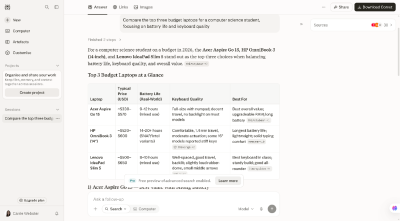
Traditional search engines like Google were historically designed as directories. The user was expected to be the curator, manually parsing through a list of links to synthesize an answer. Perplexity AI has flipped this model. By utilizing Retrieval-Augmented Generation (RAG), the system does the "reading" for you, synthesizing information from multiple sources into a single, objective, and cited response.
Vercel v0: Generative UI
Web design has historically been a labor-intensive process of manual layout construction. Vercel v0 represents a shift toward "generative interfaces." By describing a functional requirement, the platform generates the code and visual components on the fly. This moves the designer’s role from "builder of static pages" to "curator of generative outcomes."
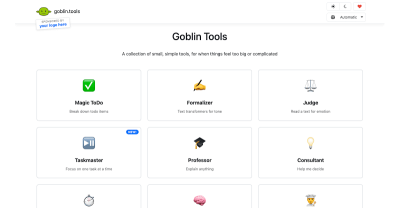
Goblin.tools: Neurodivergent-First Design
One of the most compelling examples of intent-driven design is Goblin.tools. It bypasses the complex dashboards of project management software, instead offering a single prompt box that breaks down overwhelming tasks into bite-sized, actionable steps. It recognizes that for many users, the interface itself is a barrier to productivity.
Core Pillars of the New Paradigm
Designers must now re-evaluate their craft based on three fundamental pillars:
- High-Level Goals: Systems are moving from command-based input to context-aware processing. By leveraging metadata—such as device state, location, and past interaction patterns—software can anticipate needs before the user explicitly asks.
- Generative UI: Static layouts are becoming obsolete. If a user needs a calculator, the system renders a calculator. If they need a map, it generates a map. The interface is now "ephemeral"—it exists only as long as the goal requires it.
- Autonomous Execution: The most significant shift is the movement from "prevention-based" design (error-checking pop-ups) to "reversibility-based" design. Because AI acts on our behalf, the emphasis shifts to robust "Undo" functions and transparent audit logs that allow users to verify the AI’s logic.
Implications for the UX Profession
The shift toward intent-driven experiences has profound implications for the future of UI/UX design.
The "Black Box" Challenge
A major risk of this shift is the loss of user agency. When an interface makes decisions in the background, it risks becoming a "black box." The Google PAIR (People + AI Research) Guidebook emphasizes that trust is the new currency of design. Designers must ensure that systems remain transparent, explicitly stating their interpretation of the user’s intent before executing high-stakes actions.
The Illusion of Control
Stanford’s Human-Computer Interaction (HCI) Group warns that automation must respect boundaries. There is a fine line between a helpful assistant and an invasive, patronizing algorithm. Designers must implement "human-in-the-loop" protocols for critical transactions, ensuring that while the software does the work, the user retains the final authority.
A New Metric for Success
For decades, the industry has measured success through "Engagement Metrics"—time spent in the app, click-through rates, and page views. These metrics were built on the assumption that "more interaction equals more value."
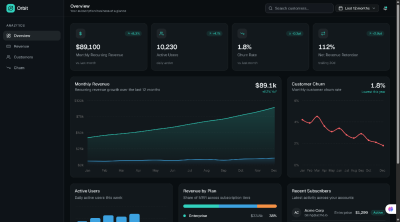
The Intent-Driven era demands a complete inversion of these metrics. We must begin to measure success by "Time-to-Resolution" and "Interface Obsolescence." If a user achieves their goal without ever having to "interact" with a complex menu or navigation bar, the design is a success.
Official Perspectives: The Industry Consensus
Industry leaders are increasingly aligning with the "Time Well Spent" movement, advocated by organizations like the Center for Humane Technology. The consensus is clear: we are moving away from an era of "Attention Economy" (where design is used to trap the user) to an era of "Intention Economy" (where design is used to serve the user).
As UX designers, we are moving from being "decorators of pixels" to "architects of agency." We are tasked with mapping the complex pathways of AI agents and ensuring that the interfaces they present are intuitive, ethical, and deeply human-centered.
Conclusion: The Death of the Button
We are entering an era where the most sophisticated piece of software is the one you barely notice. The traditional "10-click process" is a relic of a time when computers were incapable of understanding human nuance.
The future of the web is not more interaction; it is seamless, invisible completion. The ultimate test of a modern digital product will no longer be how visually captivating its buttons are, or how complex its feature set is, but rather: How effectively did this software solve the problem and get out of the way?
In the coming years, we will see the gradual evaporation of the interface. We will not be "using" software; we will be stating our intent and watching it manifest. For designers, this is not the end of the profession—it is the beginning of a far more meaningful, human-centric discipline. The best design, truly, is no design at all.