










In the rapidly evolving landscape of artificial intelligence, a troubling pattern has emerged. An open-source AI wrapper functions flawlessly in a developer’s local Jupyter notebook, generating elegant summaries or precise data extractions. Yet, a week after a team integrates it into their production pipeline, the library collapses. A missing environment variable triggers a cryptic KeyError instead of a user-friendly diagnostic; a lightweight utility inadvertently pulls in a four-gigabyte deep learning framework; and the test suite begins to flake, tethered to the mercurial performance of a third-party model provider.
These are not merely "bad code" symptoms. They represent a fundamental category mismatch. Much of the prevailing Python packaging wisdom was forged in the era of standard REST APIs and database-driven applications. AI libraries, however, operate under a different, more volatile set of constraints: outputs that are inherently nondeterministic, dependencies that can balloon to the size of a modern operating system, and external providers prone to unique failure modes.
To transition from "demo-ware" to production-ready infrastructure, developers must rethink how they build, test, and ship Python AI SDKs.
The Architecture of Reliability: Core Principles
A robust AI library is defined by its ability to maintain integrity under pressure. Drawing from the current standards of the Python Packaging User Guide and modern software engineering paradigms, a production-grade library must prioritize specific architectural pillars.
First, full type coverage is non-negotiable. By including a py.typed marker, library authors ensure that downstream IDEs and type checkers can accurately interpret the codebase. Second, the structure must be pyproject.toml-first, adhering to PEP 621 to ensure consistency across different build backends. Third, dependency isolation is critical; users should never be forced to download multi-gigabyte machine learning frameworks for features they do not intend to use. Finally, resilience must be baked into the design, not treated as an afterthought or a patch applied post-outage.
Chronology of an AI Library: From Prototype to Pipeline
The lifecycle of a library often begins with a specific use case—perhaps an automated invoice processor. Initially, the code is procedural and tightly coupled to the LLM provider.
- Phase One: The "Happy Path" Prototype. The developer writes a script that parses raw strings from an API. It works on the first try.
- Phase Two: The Integration Strain. A teammate attempts to use the script, but their environment lacks the necessary headers or the API key is misconfigured. The script throws a raw
KeyError. - Phase Three: The Dependency Bloat. The developer adds a local embedding model to improve accuracy. Suddenly, every user—even those just using the hosted API—is forced to download 4GB of
torchandtransformers. - Phase Four: The Scaling Crisis. The library is deployed. The model provider experiences a transient 503 error, causing the entire application to crash.
- Phase Five: Maturity. The developer refactors the library, implementing schema validation, optional dependencies, and robust retry logic, finally reaching a "production-ready" state.
Supporting Data: The Five Pillars of Robustness
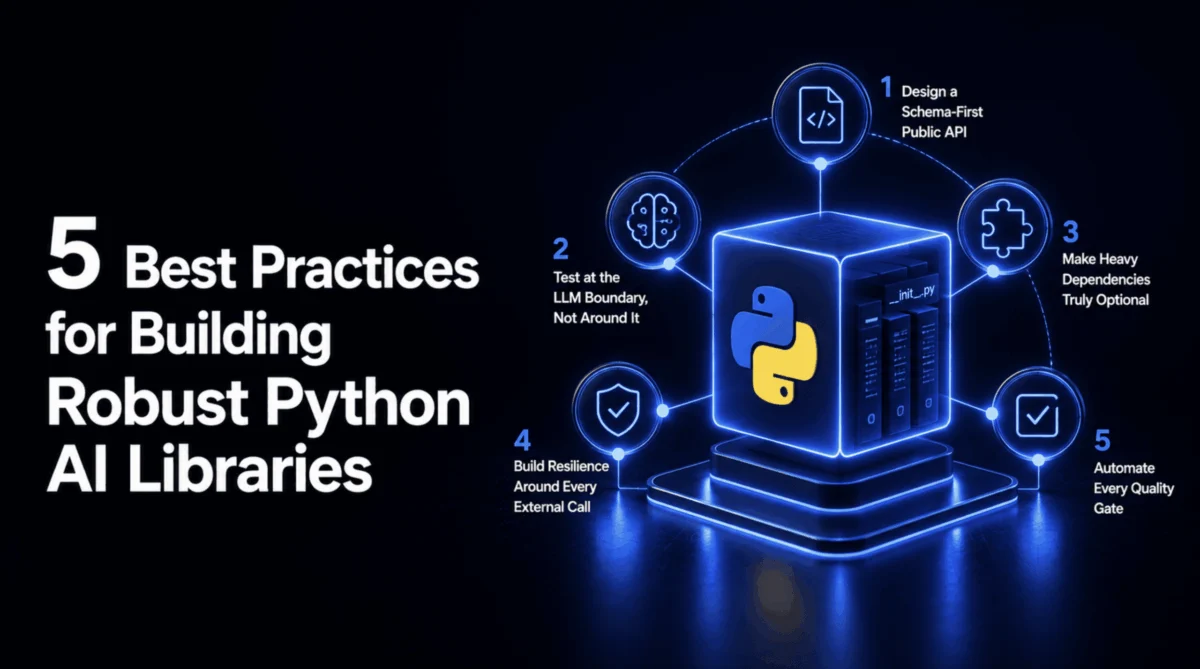
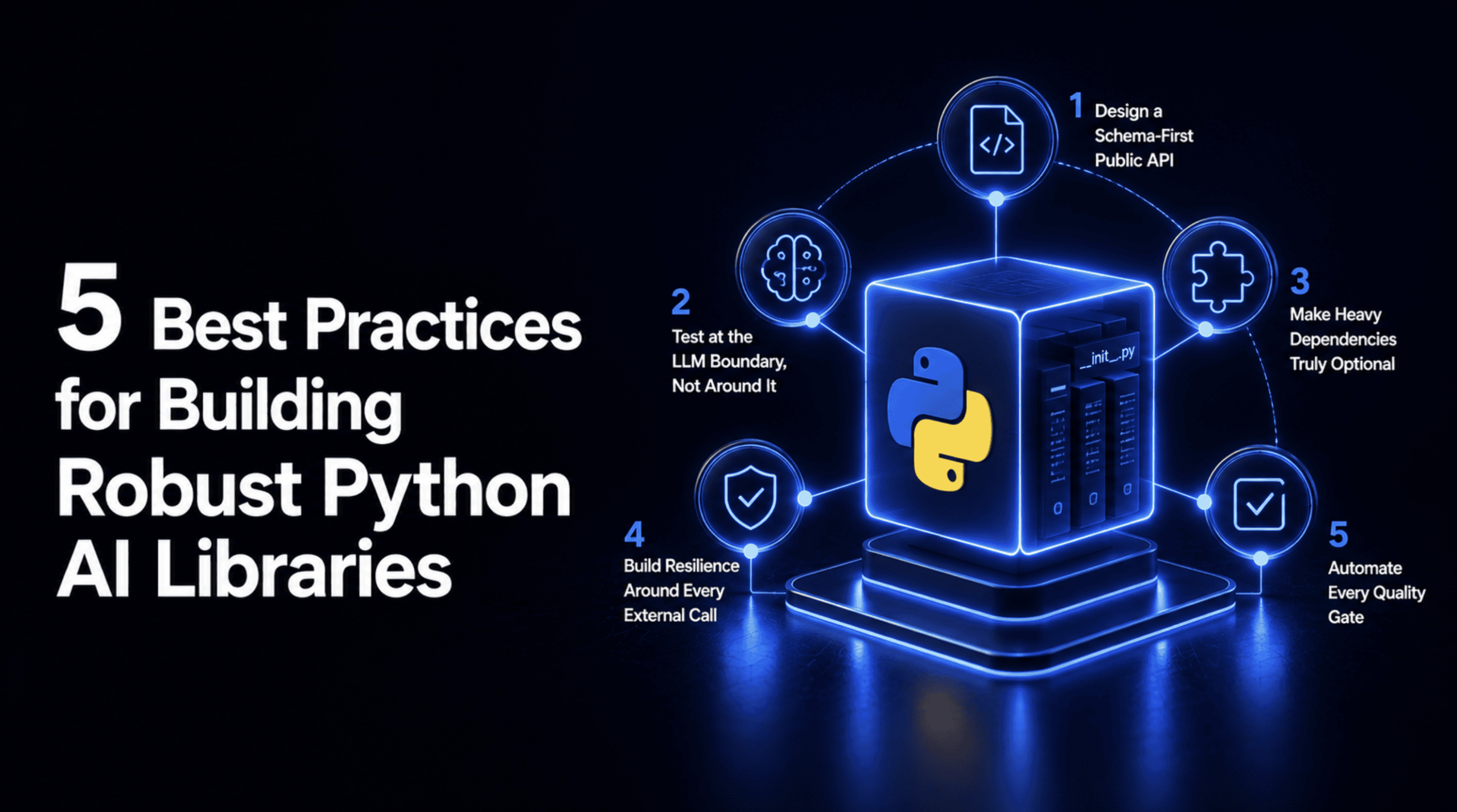
To avoid the pitfalls of the aforementioned lifecycle, we must codify five best practices.
1. Designing a Schema-First Public API
The most common point of failure in AI libraries is trusting the "black box." Never allow a raw dictionary or string from an LLM to cross the public API boundary. Instead, use Pydantic to enforce a strict schema. By forcing the model to output JSON (e.g., using response_format="type": "json_object"), you can validate the data immediately. If the validation fails, raise a library-specific exception that tells the user exactly what went wrong, preserving the original traceback for debugging.
2. Testing at the Boundary
When testing AI-dependent code, many developers make the mistake of testing the model’s intelligence. This is a recipe for flaky tests. Instead, mock the boundary between your code and the API provider. Using unittest.mock.patch specifically within the target module, you can verify that your library sends the correct prompt and handles the output correctly, regardless of whether the model is actually functioning. This ensures your tests remain fast, free, and deterministic.
3. Optional Dependencies via Extras
pyproject.toml provides a powerful mechanism for managing bloat. By defining [project.optional-dependencies], you allow users to install only what they need. A user calling the hosted API should not need torch. Implement a "lazy import" helper that attempts to import heavy dependencies only when they are called, providing a clear error message that instructs the user on how to install the missing component (e.g., pip install mylib[local]).
4. Resilience via Intelligent Retries
External providers are inherently unreliable. Use a library like tenacity to implement retry logic with exponential backoff. Crucially, distinguish between errors that deserve a retry (transient network issues, 503 errors) and those that do not (authentication errors, malformed input). Always set a hard cap on retries to prevent runaway costs or infinite loops.
5. Automated Quality Gates
Quality cannot be a manual process. A modern CI/CD pipeline—utilizing tools like uv, ruff, mypy, and pytest—must act as an automated gatekeeper. Running these tools on every push ensures that type annotations remain accurate, code style is consistent, and test coverage is maintained.
Implications: The Shift Toward Engineering Discipline
The transition toward these standards has profound implications for the AI ecosystem. When libraries are built with these practices, they reduce the "cognitive load" on developers. Instead of debugging the library’s internal state, users can focus on their business logic.
However, the industry still faces hurdles. Many popular libraries are moving too fast to prioritize these practices, leading to a "tech debt" explosion. The emergence of tools like Instructor and PydanticAI signals a shift toward a design philosophy where type safety and structured output are primary features rather than secondary considerations.
Official Perspectives and Community Standards
Leading projects have begun to set the standard. OpenAI’s Python SDK is frequently cited for its clean, modular __init__.py structure, which exposes only what is necessary. Meanwhile, LiteLLM has become the gold standard for creating a unified interface that shields the user from provider-specific quirks. Hugging Face Transformers serves as the definitive model for managing complex, heavy dependencies through optional extras.
Common Pitfalls to Avoid
As you refine your library, watch for these "anti-patterns":
- The Silent Failure: Returning
Nonewhen a model fails to parse. Always raise a descriptive exception. - The Over-Mocking Trap: Mocking the entire network stack rather than the library’s client interface. This creates a false sense of security.
- The "All or Nothing" Install: Forcing users to download the entire
torchstack when they only need a simple string-parsing function. - The Hardcoded Timeout: Failing to set an explicit timeout on API calls, leaving your application vulnerable to hanging connections.
Conclusion
Building a robust Python AI library is not about checking boxes; it is about answering a single, critical question from your users: "Can I trust this code when things go wrong?"
When a provider has a bad night, when the model returns malformed JSON, or when a production server lacks the resources to run a heavy local model, your library must remain predictable. By designing for failure, prioritizing strict schema validation, and automating your quality gates, you move beyond the transient excitement of a demo notebook into the realm of professional-grade software engineering. The libraries that prioritize this level of craftsmanship are the ones that will define the next generation of AI development.
About the Author: Shittu Olumide is a software engineer and technical writer dedicated to simplifying the complexities of modern machine learning infrastructure. He specializes in building scalable SDKs and bridging the gap between research prototypes and production environments.



