








Main Facts
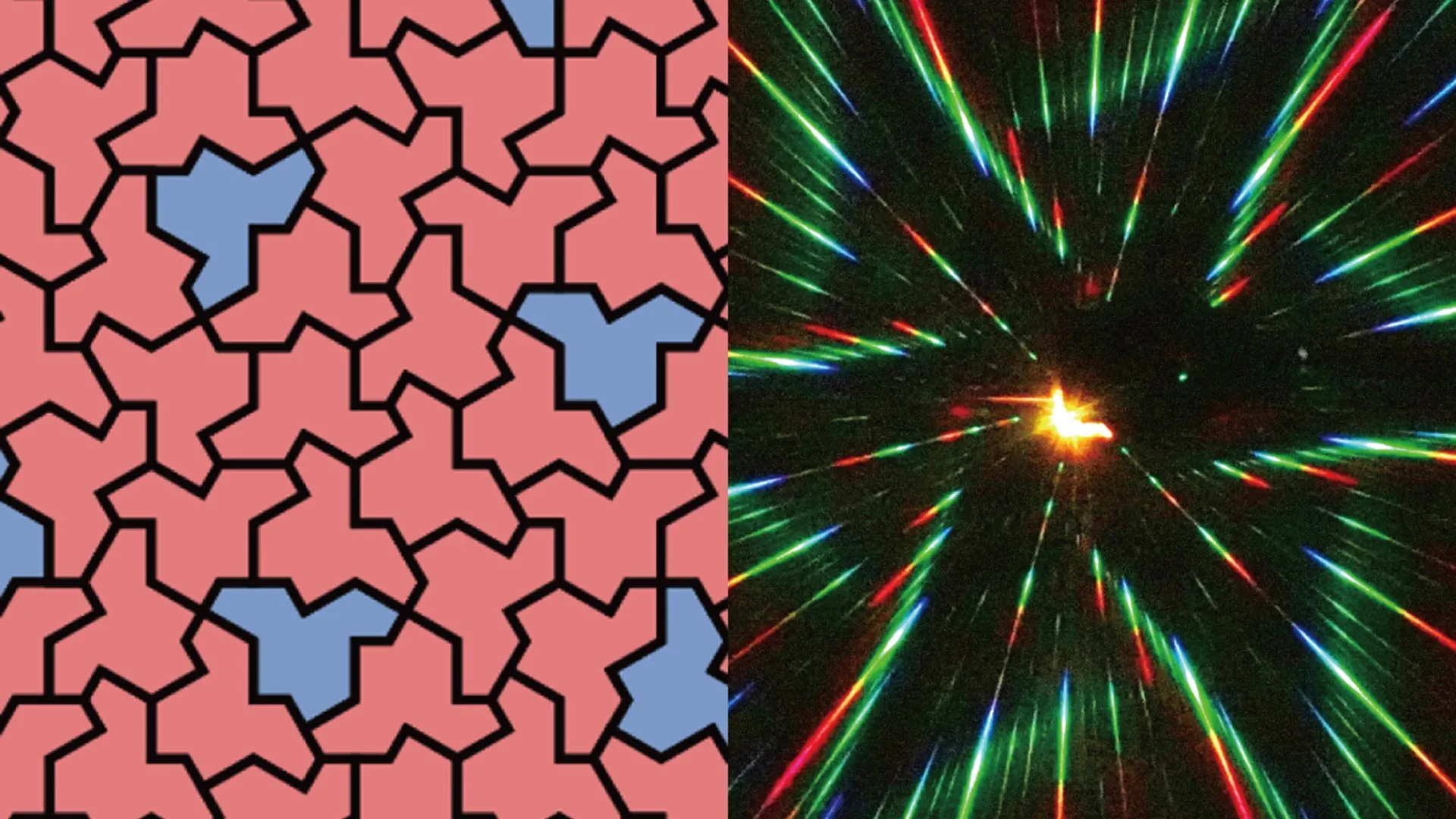
In a startling convergence of abstract mathematics and applied physics, researchers have discovered that the "Smith hat"—a mathematical shape famously celebrated for solving a decades-old tiling puzzle—harbors profound implications for optics. According to a recent study published in Nature Communications, a collaborative team led by scientists from the Institute of Industrial Science at The University of Tokyo has demonstrated that nanoscale structures based on this monotile can force light to form unusual, highly distinctive chiral patterns.
This breakthrough bridges the gap between aperiodic geometry and wave optics, offering physicists an entirely new playground for manipulating light. When illuminated with laser light, optical structures patterned after the Smith hat produce diffraction effects that defy the standard behaviors observed in conventional quasicrystals. Specifically, the diffracted light forms pinwheel-like geometries that expose a fundamental lack of mirror symmetry within the underlying structure.
The core takeaways of this research include:
- The Einstein Problem Solution in Optics: The Smith hat, which solved the mathematical "Einstein problem" of finding a single aperiodic monotile, has now been physically realized at the nanoscale using silicon nitride films.
- Symmetry-Controlled Chirality: The lack of mirror symmetry in the monotile pattern imparts a distinct "handedness" to the diffracted light, meaning the optical response changes entirely depending on whether the physical structure—or the incoming light’s polarization—is inverted.
- Tunable Light Manipulation: The diffraction patterns shift dynamically based on the direction and polarization of the incident laser light, pointing toward novel applications in advanced optical devices, polarization control, and light-routing technologies.
Chronology: From the 1960s Puzzle to Nanoscale Optics
To understand the magnitude of the recent physics findings, one must trace a timeline spanning more than half a century of mathematical inquiry and recent breakthroughs in nanotechnology.
The Quest for the Aperiodic Monotile
For decades, mathematicians wrestled with the "Einstein problem" (derived from the German ein Stein, meaning "one stone"). The puzzle asked a deceptively simple question: Is it possible to find a single geometric shape (a monotile) that can tile an infinite two-dimensional plane completely, without gaps or overlaps, but only in a non-repeating (aperiodic) pattern?
While researchers like Roger Penrose found sets of multiple tiles that could achieve aperiodicity in the 1970s, finding a single standalone shape remained an elusive Holy Grail of tessellation theory for nearly 50 years.
The Breakthrough of 2023: The Smith Hat
That drought ended in 2023 when a group of amateur and professional mathematicians—including David Smith, Joseph Samuel Myers, Craig S. Kaplan, and Chaim Goodman-Strauss—discovered the "hat" tile. This polygon successfully solved the Einstein problem. The mathematical community celebrated the discovery as a monumental structural achievement, noting that while the resulting tessellation appears chaotic and irregular to the human eye, it is deeply rooted in an underlying honeycomb lattice structure.
Translating Math to Silicon (2023–2024)
Recognizing the unique symmetry properties of the Smith hat, a team of physicists led by researchers at The University of Tokyo wondered if this abstract geometry could dictate physical phenomena. Moving swiftly from mathematical theory to physical experimentation, the team utilized advanced electron beam lithography to etch nanoscale versions of the Smith hat pattern onto silicon nitride films.
The 2024 Discovery in Nature Communications
In their published study, the research team illuminated these nanoscale silicon nitride structures with laser light. Rather than yielding standard crystalline diffraction rings or conventional quasicrystalline speckle patterns, the light formed striking, pinwheel-like geometries. This confirmed that the abstract mathematical properties of the Smith hat could directly command the behavior of physical waves, launching a new frontier in optical physics.
Supporting Data and Experimental Methodology
The multidisciplinary nature of this research required sophisticated fabrication techniques and precise optical instrumentation to bridge the gap between microscopic geometry and macroscopic light behavior.
Nanofabrication via Electron Beam Lithography
To test how light interacts with the Smith hat geometry, the research team could not rely on macro-scale models. Light waves in the visible and near-infrared spectrum interact with features scaled to their wavelength. Consequently, the team employed high-resolution electron beam lithography to pattern silicon nitride ($textSi_3textN_4$) films. Silicon nitride was chosen due to its high refractive index, excellent transparency in the optical spectrum, and compatibility with standard semiconductor nanofabrication workflows.
Laser Diffraction Analysis
Once the nanoscale aperiodic patterns were successfully etched, the researchers directed coherent laser light through the structures. In a periodic crystal, diffraction produces sharp, predictable dots (Bragg peaks). In a traditional quasicrystal, diffraction yields dense, symmetrical patterns with forbidden rotational symmetries (such as five-fold symmetry).
However, the diffraction patterns generated by the Smith hat structures introduced an entirely new category of optical signatures:
- Pinwheel Chirality: The diffracted light fields exhibited clear rotational asymmetry, curving outward like microscopic pinwheels.
- Polarization Sensitivity: Altering the polarization state of the incoming laser beam drastically changed the intensity distribution of the diffraction orders.
- Angle-Dependent Response: Tilting the angle of incidence revealed how tightly coupled the optical response is to the exact spatial orientation of the aperiodic monotile array.
When the physical samples were virtually or physically inverted (mirrored), the resulting optical chirality inverted in tandem, proving definitively that the light’s behavior was an exact optical translation of the structure’s asymmetrical geometry.
Official Responses and Expert Insights
The intersection of topology, number theory, and wave optics has generated considerable excitement within the academic community. The study’s lead and senior authors elaborate on the significance of these findings.
Lead author Yuto Moritake of The University of Tokyo emphasized the surprising lineage of the pattern:
"What is especially fascinating about the hat tile is that, although the resulting pattern appears irregular at first glance, it is actually constructed from the honeycomb lattice. We wanted to see whether this unique shape could also produce any unexpected physical phenomena."
Moritake further highlighted the conceptual shift represented by the research:
"These results open a new direction of research on the fusion of quasiperiodic order and chirality. Monotile patterns provide a platform for exploring optical phenomena that emerge from the interplay of symmetry, chirality, and aperiodicity."
Senior author Masaya Notomi pointed out the fundamental physical mechanism driving the phenomenon:
"We found that the diffraction patterns themselves become chiral because the structure lacks mirror symmetry. This kind of optical response is fundamentally different from that observed in conventional quasicrystalline materials."
Independent optics experts not directly involved in the study have noted that the research successfully marries two fields—aperiodic tiling theory and nanophotonics—that rarely intersect in such a clean, deterministic manner. By demonstrating that a single monotile can orchestrate complex wave interference without the need for multi-component composite designs, the Tokyo team has provided a streamlined blueprint for designing custom optical materials from the ground up.
Implications for Future Technology and Physics
While the discovery began as a purely theoretical exploration of a mathematical curiosity, the practical and theoretical implications span multiple scientific disciplines.
1. Advanced Optical and Photonic Devices
Engineering materials that can manipulate light at the nanoscale is a central goal of modern photonics. Traditional photonic crystals rely on strict periodicity, while metamaterials often require complex, multi-layered fabrication processes. The Smith hat monotile offers a third way: an aperiodic, single-shape tiling system that natively exhibits complex directional and polarization-dependent responses.
Engineers could leverage these properties to design:
- Compact Polarization Controllers: Devices that filter, rotate, or split light based on its polarization state with high spatial efficiency.
- Chiral Optical Sensors: Highly sensitive detectors capable of identifying chiral molecules (vital in pharmaceuticals and biochemistry) by exploiting how the structured light interacts with targeted matter.
- Advanced Metasurfaces: Flat optics that bend, focus, or scatter light in unconventional ways, reducing the bulk of traditional lenses and optical systems.
2. A New Paradigm in Condensed Matter Physics
Beyond immediate technological applications, the research provides fundamental insights into how spatial symmetry—or the deliberate lack thereof—governs physical laws. Physicists are increasingly interested in "quasiperiodic physics," which explores systems that are ordered yet non-repeating (such as quasicrystals, which won Dan Shechtman the 2011 Nobel Prize in Chemistry).
The integration of the Smith hat monotile into this domain adds a crucial missing puzzle piece: the interplay between aperiodicity and macroscopic chirality. Researchers can now use these aperiodic platforms to study topological physics, wave localization, and photonic bandgaps in environments that completely lack conventional translational symmetry.
3. The Unpredictable Utility of Pure Mathematics
Ultimately, the Smith hat optics study serves as a powerful reminder of Eugene Wigner’s famous observation regarding "the unreasonable effectiveness of mathematics in the natural sciences." A shape devised by mathematicians to solve an abstract geometric puzzle about covering infinite planes has found a second life orchestrating the behavior of light waves at the nanometer scale.
As research groups around the world begin to fabricate and test other variations of aperiodic monotiles—such as the recently discovered "spectre" tile—the boundary between pure geometry and applied optics will continue to blur, unlocking generations of technological innovations born from pure intellectual curiosity.