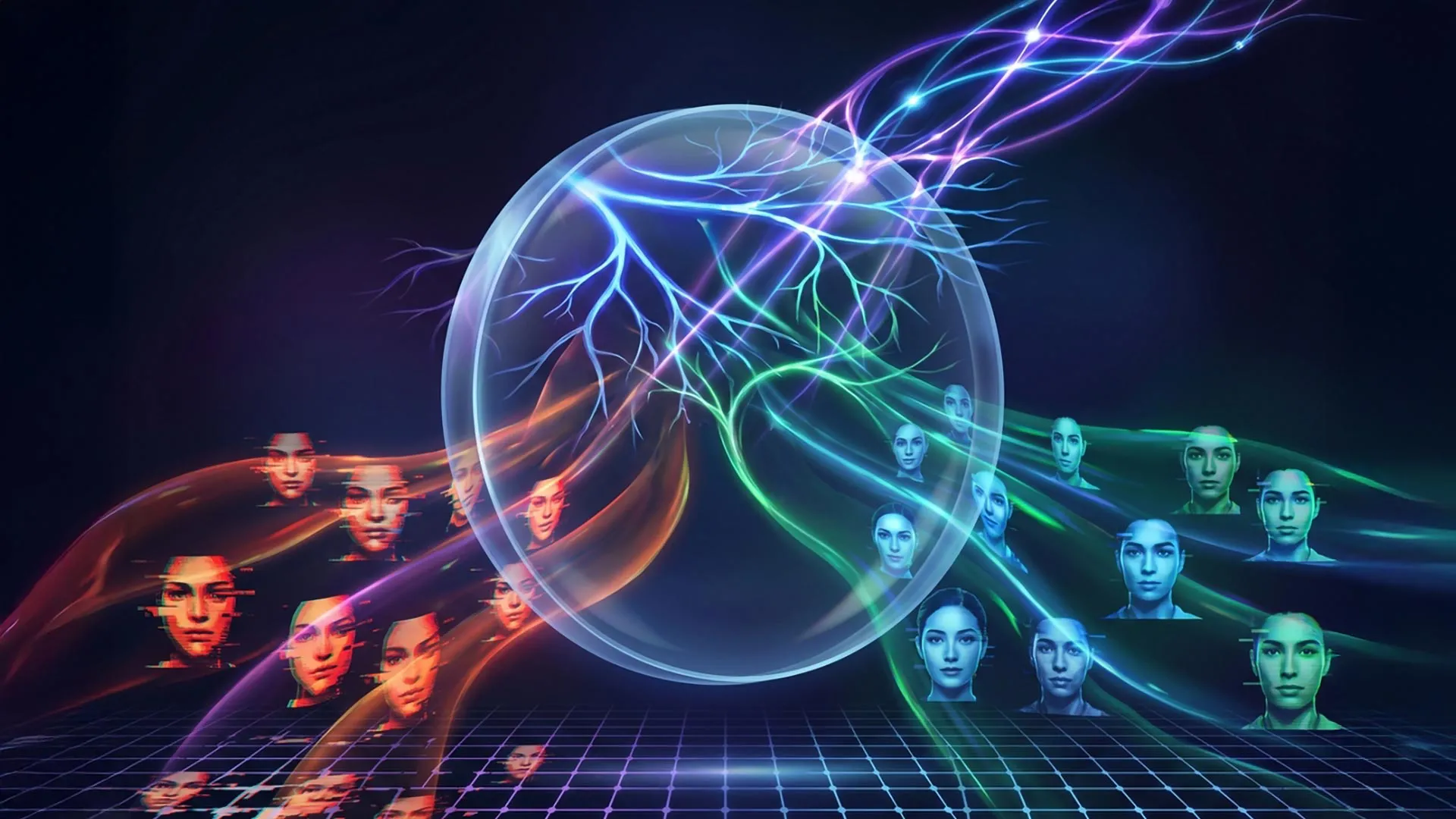
LOS ANGELES — As generative artificial intelligence continues to blur the boundary between reality and fabrication, researchers at the University of California, Los Angeles (UCLA) have unveiled a breakthrough technology that could fundamentally alter the landscape of digital media authentication.
In a study published in the peer-reviewed journal eLight, a team of UCLA scientists detailed the creation of a novel optical-neural processor. This hybrid system leverages the physical propagation of light to analyze multiple video streams simultaneously. Unlike traditional digital hardware that evaluates deepfakes sequentially—a process that is both computationally heavy and time-consuming—the UCLA optical processor can screen 15 or more video feeds in a single optical pass.
Achieving nearly 98% accuracy in early trials, the technology is designed to act as a high-throughput, energy-efficient first line of defense against the mounting wave of synthetic media threatening global information ecosystems.
Main Facts
The core innovation of the UCLA research lies in its marriage of digital preprocessing and analog, light-based computation. Led by Professor Aydogan Ozcan, alongside co-lead researchers Parnian Ghapandar Kashani and Dr. Shiqi Chen, the team developed an architecture officially detailed in the study titled "Scalable, Energy-Efficient Optical-Neural Architecture for Multiplexed Deepfake Video Detection."
The system functions through a meticulously engineered hybrid pipeline:
- Digital Encoding: A lightweight digital encoder first extracts compact spatial, spectral, and temporal features from incoming videos.
- Optical Transformation: This information is converted into a phase pattern and displayed on a programmable spatial light modulator.
- Light Propagation: The resulting optical wavefront travels through a free-space-based, passive optical decoder.
- Instantaneous Scoring: Paired optical detectors at the terminal end directly output an authenticity score for each video stream.
By shifting a significant portion of the heavy lifting from power-hungry digital neural networks to the physical diffraction of light, the system achieves unprecedented parallelism. In experimental testing using visible light, the processor successfully evaluated 15 Celeb-DF videos simultaneously per optical pass, yielding an average detection accuracy of 97.79%, an astonishing 99.86% sensitivity, and a 95.72% specificity.
Even when pushed to process 18 concurrent video streams, the system maintained a robust average accuracy of 96.13%. Furthermore, when challenged with cutting-edge synthetic media from Google’s VEO-3 model—footage engineered to lack traditional deepfake artifacts—the optical processor achieved 94.80% accuracy and 97.61% sensitivity with only minimal fine-tuning.
Chronology of the Crisis and Technological Evolution
To understand the significance of the UCLA breakthrough, one must examine the rapid and compounding trajectory of generative artificial intelligence over the past half-decade.
The Early Era of Crude Manipulation
In the nascent stages of deepfake technology, synthetic video relied heavily on rudimentary face-swapping algorithms applied to source footage. These early iterations were often betrayed by glaring visual anomalies: unnatural blinking rates, inconsistent lighting across facial features, unnatural skin textures, and visible warping around the jawline. Detection systems of this era could rely on straightforward digital classifiers to flag these artifacts with reasonable success.
The Scaling and Computational Bottleneck
As generative models evolved into sophisticated deep-learning architectures—such as advanced Generative Adversarial Networks (GANs) and modern diffusion models—the visual quality of synthetic media skyrocketed. Consequently, detection requirements shifted. Protecting digital ecosystems from pervasive disinformation meant scaling up detection infrastructure.
However, conventional digital detectors hit a severe scaling wall. Evaluating high-resolution video streams required hundreds of billions of floating-point operations per analysis. Because traditional hardware processes videos sequentially, ramping up capacity to match the exponential growth of internet video created skyrocketing energy consumption and processing latency. Content moderators and platforms faced a grim mathematical reality: as deepfakes multiplied, the cost and time required to find them grew proportionally.
The Hybrid Breakthrough at UCLA
Recognizing that purely digital infrastructure could not sustainably outpace the generation of synthetic media, Professor Ozcan’s team at the UCLA Electrical and Computer Engineering Department, Bioengineering Department, and the California NanoSystems Institute took a different path. Rather than fighting digital scale with more digital power, they looked to optics.
By conceptualizing a system where the physical properties of light perform parallel calculations, the team successfully bridged optics and artificial intelligence. This milestone shifted the paradigm from sequential digital execution to instantaneous optical multiplexing, setting the stage for a new class of intelligent hardware.
Supporting Data and Experimental Metrics
The empirical data gathered during the UCLA research underscores the efficacy, reliability, and resilience of the optical-neural processor across multiple demanding testing environments.
Accuracy, Sensitivity, and Specificity
In standard experimental trials using visible light to screen 15 Celeb-DF videos concurrently, the system delivered exceptional statistical performance:
- Overall Accuracy: 97.79%
- Sensitivity: 99.86%
- Specificity: 95.72%
In the context of automated content screening, sensitivity is perhaps the most vital metric. It measures the system’s success rate in correctly identifying manipulated media, thereby minimizing the number of dangerous fakes that slip past defenses. The UCLA processor’s 99.86% sensitivity translates to a remarkably low false-negative rate of approximately 0.14%. Only a minuscule fraction of malicious videos managed to pass as authentic during testing.
Enhancing Performance via Physical Depth
Rather than consuming more electricity to achieve higher performance—the traditional trade-off in digital computing—the UCLA researchers discovered that scaling the physical depth of the passive optical decoder yielded exponential gains.
When the team integrated two optimized, passive diffractive layers into the system to handle more complex deepfake datasets, detection accuracy surged by approximately 6.8%. Because these phase-only diffractive layers operate as static, physical optical surfaces, they perform advanced calculations through light diffraction alone. They draw zero additional electrical power during inference, offering a stark contrast to digital neural networks, which require massive surges in power to scale up their parameter counts.
Resilience Against Advanced Generative Models
Older deepfake detectors often struggle when confronted with state-of-the-art generative video models that do not exhibit legacy artifacts. To test their system’s adaptability, the UCLA team deployed the processor against synthetic footage generated by Google’s VEO-3 model.
Even without extensive retraining, the optical processor demonstrated strong adaptability, registering 94.80% accuracy and 97.61% sensitivity on these entirely novel, highly sophisticated synthetic feeds.
Robustness Against Adversarial Attacks
Bad actors frequently attempt to bypass content moderators by deploying "adversarial attacks"—subtly altering digital video files with noise, compression artifacts, or pixel shifts designed to confuse or blind a classifier.
The UCLA optical system demonstrated profound resistance to both black-box and white-box adversarial tampering. Because a core portion of the inference pipeline occurs physically through light diffraction, the critical parameters of the optical model are inherently embedded within the physical hardware itself.
Attackers find it exceptionally difficult to measure, reproduce, or reverse-engineer these physical parameters. Consequently, crafting targeted adversarial mutations to evade the detector becomes practically infeasible. Furthermore, the processor maintained operational stability when subjected to standard real-world degradation factors, including image noise, blur, JPEG compression, and experimental misalignments.
Official Responses and Expert Insights
The unveiling of the UCLA optical-neural processor has drawn significant attention from the broader scientific and technology communities, who view the work as a pioneering step toward hardware-level security solutions.
While traditional cybersecurity approaches have treated deepfake detection strictly as a software problem—relying on software patches, algorithmic updates, and massive server farms—the UCLA research team emphasizes that physical computing paradigms are necessary to meet the sheer volume of modern data.
"By harnessing the natural, parallel propagation of light, we can bypass the fundamental bottlenecks that constrain conventional digital hardware," noted the research team in their published study. "Our objective was not necessarily to discard digital computing, but to establish a secure, lightning-fast physical gateway that can screen vast volumes of media before heavier digital analysis is even triggered."
Independent AI safety analysts have echoed these sentiments, pointing out that the integration of passive optical layers addresses two of the tech industry’s most intractable modern dilemmas: escalating power grids demands for AI infrastructure, and the constant cat-and-mouse game of adversarial machine learning. By baking mathematical weights directly into physical optics, the UCLA design effectively locks out digital hackers who rely on open-source codebases or accessible model weights to craft evasion strategies.
Implications for the Future of Media Integrity and Security
The practical applications of UCLA’s optical-neural architecture extend far beyond academic novelty. As generative video tools become democratized, accessible to anyone with an internet connection, society faces a looming crisis of trust. From corporate fraud and financial market manipulation to political disinformation and non-consensual synthetic media, the inability to verify the authenticity of video in real-time threatens democratic institutions and personal security alike.
A Layered Defense Architecture
Crucially, the UCLA team does not envision their optical processor as a standalone replacement for all digital detectors. Instead, the technology is purposefully engineered to function as an elite, high-throughput first line of defense.
In a real-world deployment scenario, massive global volumes of video uploads—whether on social media platforms, enterprise cloud storage, or live-streaming networks—would first flow through the parallel optical processor. Because the system can handle numerous streams simultaneously with minimal latency and negligible energy overhead, it can instantly clear authentic content while flagging suspicious files.
Only those flagged streams would then be routed to computationally heavy, resource-intensive digital neural networks for deep forensic investigation. This hierarchical approach marries the staggering speed, energy efficiency, and security of optics with the analytical depth of advanced software.
Broad Industrial Applications
The realization of a scalable, energy-efficient optical detection layer opens doors across multiple sensitive sectors:
- Large-Scale Content Moderation: Social media giants struggling to process petabytes of daily video uploads could deploy optical screening gateways to drastically cut server costs and response times.
- Media Authentication and Journalism: Newsrooms and verification agencies could rapidly vet user-generated footage during breaking news events to prevent the spread of fabricated crisis videos.
- Security and Surveillance: Government and private security sectors could integrate optical processors into closed-circuit television (CCTV) and live-feed monitoring systems to defend against real-time video spoofing attacks.
Conclusion
As artificial intelligence marches toward hyper-realistic video generation, the traditional methods of digital defense are buckling under the weight of scale and energy demands. By looking backward into the fundamental physics of light, UCLA researchers have charted a path forward.
The successful demonstration of a nearly 98% accurate, power-efficient, attack-resilient optical-neural processor proves that the future of digital safety may not rest entirely in silicon chips and software code, but in the blinding speed and physical security of light itself.