For nearly a decade, the Unified Payments Interface (UPI) has been hailed as the crown jewel of India’s digital transformation. By stripping away transaction fees, it democratized digital payments, turning street-side tea vendors and high-end luxury retailers alike into participants of the formal economy. However, as of October 15, the economic foundation of this massive payment rail is undergoing a structural shift. The introduction of a new Merchant Discount Rate (MDR) framework marks a pivotal transition, moving UPI from a state-subsidized utility toward a sustainable, market-driven financial ecosystem.
The Core Mechanics: What Changes on October 15?
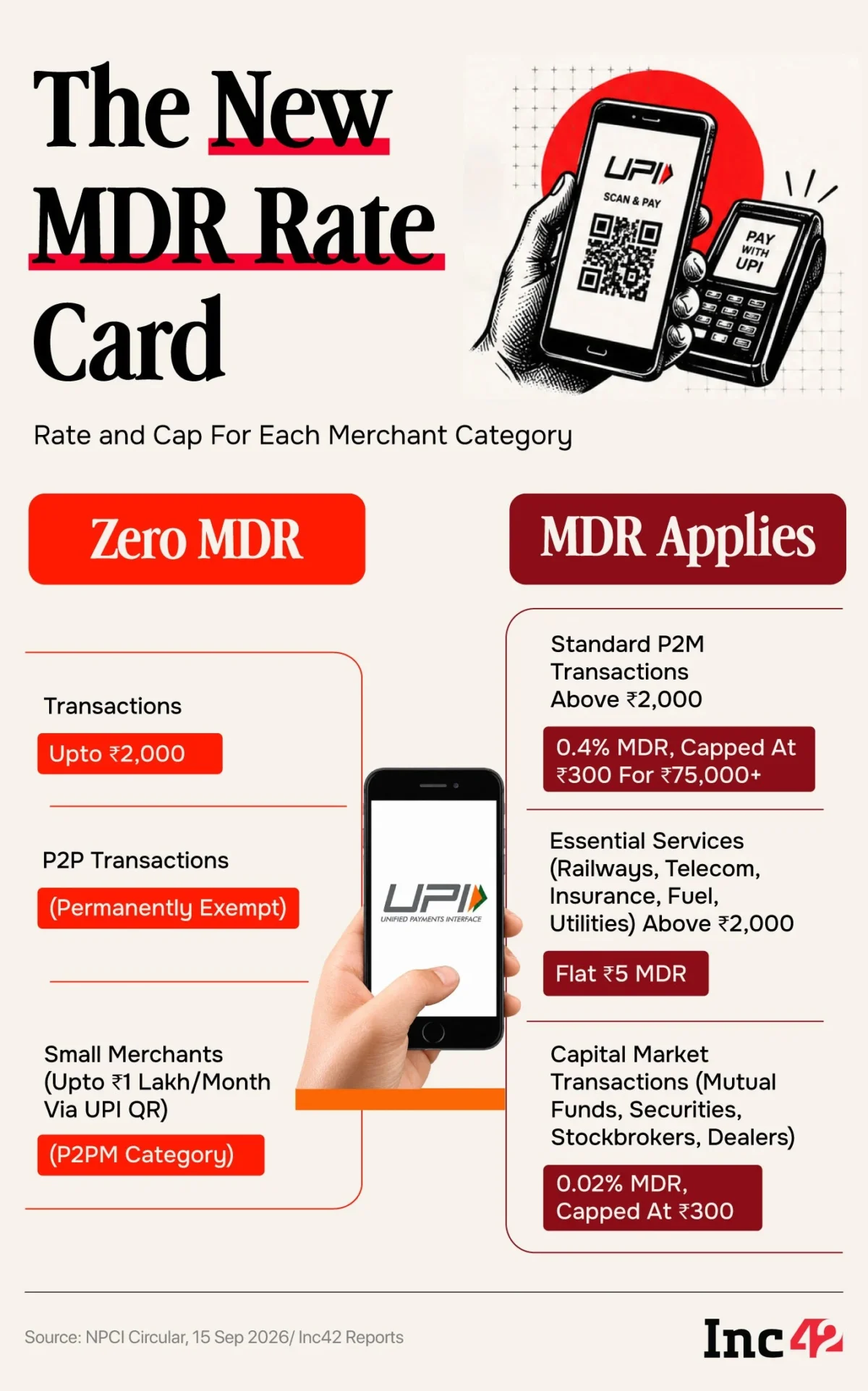
The new regulatory framework fundamentally alters the cost structure of person-to-merchant (P2M) transactions. Under the updated guidelines, banks and payment service providers will levy an MDR of 0.4% on all UPI P2M transactions exceeding ₹2,000. To prevent excessive costs on high-value retail, the fee is capped at ₹300 for transactions of ₹75,000 and above.
Crucially, the policy includes a "safe-harbor" threshold designed to protect micro-enterprises. Merchants whose monthly UPI QR code receipts remain below ₹1 Lakh are exempt from these charges. However, the threshold is strictly enforced: should a merchant’s receipts exceed this ₹1 Lakh limit for three consecutive months, they are automatically migrated into the standard P2M category, becoming liable for the MDR on subsequent transactions.
The Revenue Distribution Breakdown
The new regime isn’t just a cost to the merchant; it is a mechanism for revenue distribution across the banking and fintech stack. The 0.4% fee is partitioned as follows:
- Acquiring Bank: Retains 0.12% of the transaction value.
- Issuing Bank: Receives 0.28% of the transaction value.
- TPAP and PSPs: Within the issuing bank’s share, 0.08% is allocated to the Third-Party Application Provider (TPAP)—such as Google Pay, PhonePe, or Paytm—while 0.04% is directed to the Payment Service Provider (PSP) bank associated with the TPAP.
For a ₹2,500 transaction, this results in a ₹10 fee, with ₹7 flowing to the issuing bank and ₹3 remaining with the acquiring bank. This structured flow ensures that all stakeholders in the UPI ecosystem—from the banks providing the infrastructure to the apps providing the interface—receive a cut of the transaction revenue.
A Chronology of the UPI Evolution
- 2016: UPI is launched by the NPCI, initially characterized by zero transaction fees to encourage rapid adoption.
- 2019-2023: As volumes skyrocket, the government subsidizes the zero-MDR model, effectively paying the cost of processing to ensure digital inclusion.
- Mid-2026: Industry stakeholders and regulatory bodies finalize discussions regarding the unsustainability of a zero-cost model for high-volume, high-value payments.
- October 15, 2026: The new MDR framework goes live, establishing a permanent revenue stream for the UPI ecosystem.
Financial Projections: The Scale of the "Revenue Pool"
The transition is not merely administrative; it is a massive financial recalibration. Estimates from Bernstein suggest that applying a 40-basis-point MDR to approximately half of all eligible UPI transaction value could generate an annual revenue pool of roughly ₹22,000 Crore by Fiscal Year 2028.

This projected revenue is expected to be distributed significantly across the financial sector. Banks are positioned to capture the lion’s share—estimated at ₹14,000 Crore—while TPAPs are projected to earn approximately ₹7,000 Crore. For fintech giants that have spent years burning capital to acquire users and build infrastructure, this represents a shift from "growth-at-all-costs" to "unit-economic-sustainability."
Official and Industry Responses: A "Robin Hood" Move?
The reaction from the industry has been bifurcated. Fintech leaders, who have long advocated for a monetizable UPI, view this as a maturation of the market.
MobiKwik CEO Bipin Preet Singh has been vocal about the reality of the previous model, stating, "UPI has never been free; it has been running on an ecosystem of banks, fintechs, and the NPCI, with the government’s incentive scheme funded directly by taxpayers." From this perspective, the new framework removes the tax burden from the public and shifts the cost to the large-scale businesses that benefit most from the frictionless nature of UPI.
Paytm’s leadership has echoed this sentiment, framing the move as a "Robin Hood" strategy. By targeting higher-value transactions and exempting smaller vendors, the government aims to keep the burden away from the informal sector while ensuring the long-term viability of the payment rail.
However, the Retailers Association of India (RAI) offers a more cautious outlook. CEO Kumar Rajagopalan has warned that the timing, coinciding with the peak festive season, could dampen digital adoption among smaller merchants. "Small merchants will now think twice about whether to accept cash or UPI," Rajagopalan noted. He argues that the government, which benefits from the transparency and GST compliance provided by digital payments, should continue to bear the cost rather than passing it on to retailers.
Operational and Strategic Implications for Businesses
The impact of the new MDR is not uniform; it varies wildly depending on a business’s Average Order Value (AOV) and industry sector.

The Operational Burden
For many, the biggest hurdle is not the cost itself, but the operational complexity. Sunbeam Ventures, for instance, found that while their actual MDR expense is minimal (roughly 0.06% of total collections), the cost of reconciliation is high. They must now segregate transactions above and below the ₹2,000 threshold and update internal accounting systems that have historically treated UPI as a "zero-cost" utility.
The Margin Squeeze
For businesses with thin margins, such as those in the D2C (Direct-to-Consumer) or retail space, the 0.4% fee is significant. An athleisure brand owner in Surat noted that for a business doing ₹1 Crore in monthly UPI sales, the annual cost could reach ₹5 Lakh. While this might seem manageable at scale, in highly competitive markets, this cost cannot simply be absorbed.
The Pricing Dilemma: Will Consumers Pay?
The most critical question remains: will this cost reach the consumer? While the policy does not allow for an explicit "UPI surcharge" at the point of sale, merchants are likely to fold the cost into their overall unit economics.
"Businesses may not add a surcharge, but they will fold the cost into a general price increase," says Rajesh Londhe, CEO of PhiCommerce. In a competitive landscape, if multiple players in a sector all face the same MDR, the industry-wide trend will likely be a modest increase in product pricing to offset the payment processing expense.
Conclusion: The Long-Term Sustainability of UPI
The introduction of the new MDR framework is a litmus test for the Indian digital economy. It signals a departure from the "startup era" of subsidized payments to a "mature era" of financial utility.
While the Retailers Association of India continues to lobby for a more graded structure that separates standard UPI from credit-linked payments, the government and the NPCI appear committed to the current model. The challenge for the next few years will be balancing this new cost of doing business with the need to keep digital payments more attractive than the "path of least resistance"—physical cash. As the ecosystem adjusts, one thing is certain: the era of "free" digital payments has effectively come to an end, replaced by a complex, multi-layered financial infrastructure that must now prove its worth through sustained efficiency and innovation.