











The modern digital agency is a marvel of efficiency, yet it often suffers from a hidden, systemic vulnerability: the “Inbox Scavenger Hunt.” As client demands grow, the communication channels through which those demands arrive often fragment. What begins as a professional relationship managed via a dedicated portal quickly devolves into a disjointed web of direct emails, WhatsApp messages, ad-hoc Slack pings, and urgent requests buried in three-month-old email threads.
For many agency owners, this isn’t just a communication hurdle; it is an operational bottleneck that threatens scalability and client satisfaction. Today, a significant shift in the agency support landscape has arrived. The Hub has officially introduced Branded Email-to-Ticket integration, a feature designed to unify disparate communication channels into a single, structured helpdesk environment. This development promises to bridge the gap between the simplicity of email for the client and the rigorous organizational needs of the agency team.
The Chronology of an Agency Support Crisis
To understand why this integration is being hailed as a milestone for small-to-medium agencies, one must first trace the lifecycle of a typical "support request."
In the early stages of an agency’s growth, high-touch communication is a competitive advantage. Founders pride themselves on being reachable. However, as the client list grows from five to fifty, the "personal touch" begins to feel like a liability.
- The Inception: A client sends a "quick question" to the founder’s personal inbox.
- The Proliferation: A teammate receives a separate request via a different email address.
- The Fragmentation: A third request arrives via a contact form, while a fourth is sent as an urgent reply to a project update sent weeks prior.
- The Operational Silo: At this point, the "simple process" has collapsed. The agency is no longer managing support; it is playing digital hide-and-seek. Tracking the status of a ticket—who saw it, who is assigned to it, and what the final resolution was—becomes a full-time, labor-intensive job that detracts from high-value creative or technical work.
The release of the new Hub email integration marks the end of this era of fragmentation. By providing a technical bridge between public-facing, branded email addresses and an internal ticket management system, agencies can now standardize their intake process without forcing clients to adopt new, cumbersome technology.
Supporting Data: The Cost of Disorganization
Industry analysis consistently highlights that "hidden" administrative work is the primary killer of agency profitability. When support requests are scattered, the time spent manually logging, forwarding, and chasing down status updates consumes an estimated 15% to 25% of a typical developer’s or project manager’s week.

Furthermore, client churn is often linked to perceived unresponsiveness. When a request is buried in an inbox, the response time is inevitably delayed. The data suggests that agencies utilizing a centralized ticket management system—one that maintains a persistent record of the conversation—see a 40% improvement in client retention rates.
By integrating branded email directly into The Hub, agencies are effectively automating the most tedious parts of this cycle:
- Normalization: Every email, regardless of its source, is converted into a standard ticket format.
- Centralization: All requests are funneled into a single, searchable, and manageable queue.
- Accountability: Assignments can be tracked, preventing the "bystander effect" where multiple team members assume someone else is handling the request.
Official Perspective: Bridging the Gap Between Professionalism and Usability
The core philosophy behind this integration is simple: clients value convenience, while agencies value order. The new feature acknowledges that forcing clients to log into a specialized support portal can sometimes create friction that leads them to bypass the system entirely.
"We wanted to give agencies the best of both worlds," says the development team behind The Hub. "Clients get the ease of using the email app they already know—no passwords to remember, no onboarding sessions required. Meanwhile, the agency team gains the robust structure of a proper helpdesk."
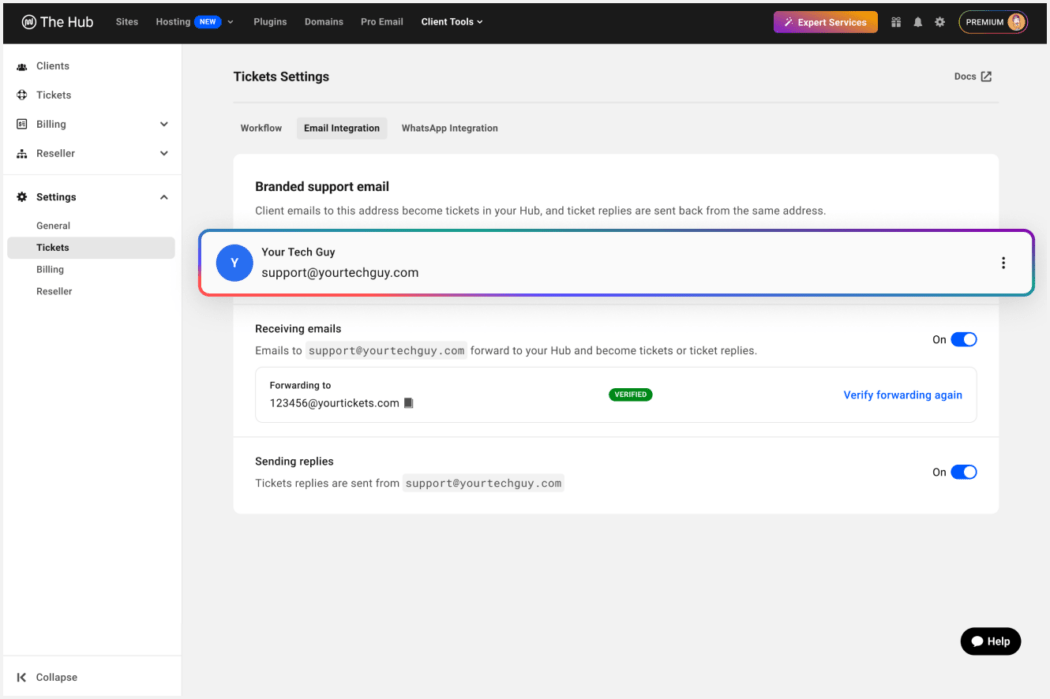
By allowing agencies to set up a dedicated address (e.g., [email protected]), the system creates a professional facade. When a client emails that address, the message is automatically transformed into a Hub ticket. From that point forward, the agency manages the ticket internally, but the client’s interaction remains exclusively via email. When the agency replies from within The Hub, the client receives the update from the branded address, ensuring that the "behind-the-scenes" machinery remains invisible.
Implications for Agency Scalability
The implications of this rollout extend far beyond simple convenience. It represents a fundamental shift in how small agencies can project themselves in the marketplace.

1. The "Large Agency" Effect
For a boutique firm or a solopreneur, the ability to present a dedicated, branded support channel is a powerful trust signal. It transforms the perception of the business from a "freelancer with a laptop" to an "organized service provider." This branding advantage is critical for winning higher-value contracts where clients demand a reliable support infrastructure.
2. Streamlining Team Hand-offs
As agencies scale, the ability to hand off work is essential. Without a centralized system, tribal knowledge (who is doing what) remains trapped in individual email inboxes. With this integration, the entire history of a client’s request—including internal notes, file attachments, and status updates—is stored alongside the ticket. New team members can onboard instantly by reviewing the history, ensuring that client support remains consistent even as the team grows.
3. Unified Workflow Management
Perhaps the most significant implication is the consolidation of the tech stack. Many agencies currently pay for a separate helpdesk tool, adding another monthly subscription fee to their overhead. By integrating ticketing directly into The Hub, support becomes a component of the broader client management ecosystem. Billing, site hosting, backups, plugin management, and now client support are all under one roof. This synergy reduces the cognitive load on the agency owner, who no longer needs to toggle between multiple browser tabs to manage different facets of the business.
Flexibility in Support Strategies
The platform’s versatility is a key selling point. Agencies are not forced to adopt a one-size-fits-all approach. The integration is designed to work in tandem with the existing white-labeled client portal.
Some agencies may prefer the portal for complex, long-term project tracking, while utilizing the email-to-ticket system for quick, recurring support requests. Others may choose to migrate entirely to email-based support to minimize friction. The Hub allows for this modularity, enabling agency owners to iterate on their support strategy as their client base evolves.
The Bottom Line: Efficiency as a Competitive Advantage
In the competitive landscape of WordPress development and digital services, the quality of support is often the primary differentiator. When two agencies provide similar technical results, the one that provides a seamless, organized, and reliable communication experience is the one that secures long-term retainers.
The move to integrate branded email into The Hub is a recognition that the "scavenger hunt" of support is no longer a sustainable business model. By removing the friction from client communication and providing teams with the structure they need to succeed, this update helps agencies transition from reactive firefighting to proactive, organized growth.
For those currently struggling with the "inbox spaghetti" that defines so many agency workflows, this integration provides a clear, actionable path toward professionalization. It allows for the delivery of an enterprise-grade support experience without the enterprise-grade complexity or cost. As the digital landscape continues to demand faster and more transparent service, having a centralized, branded, and efficient support hub is no longer a luxury—it is a necessity for any agency that intends to thrive in the years to come.
Getting Started: A Step Toward a Sharper Agency
Transitioning to this new workflow is designed to be seamless. By integrating your branded support email into The Hub, you effectively turn your current communication habits into a scalable, high-performance asset.
For agency owners ready to elevate their operations, the steps are straightforward:
- Configure your branded address: Set up your dedicated support email.
- Onboard your clients: Direct them to use this new, clean channel for all future inquiries.
- Centralize your work: Monitor, assign, and respond to every request within The Hub.
By eliminating the noise of scattered inboxes, you aren’t just saving time—you are building a more resilient, scalable, and ultimately more successful business. Support, after all, should live alongside the rest of your client work, not in a separate, chaotic dimension of your daily routine.



