







In the high-speed corridors of modern marketing, advertising, and creative strategy, a silent crisis is unfolding. As generative Artificial Intelligence (AI) tools become ubiquitous, the industry finds itself at a crossroads: are we using these technologies to augment human ingenuity, or are we trading the long-term cultivation of expertise for the hollow comfort of immediate output?
The core of professional fulfillment has historically been found in the "rigor"—the grueling, intentional thoroughness that transforms raw effort into polished craft. However, as AI begins to automate the very cognitive processes that build professional judgment, the industry risks entering an era of "hollow proficiency," where tasks are completed, but the practitioner remains stagnant.
The Cognitive Cost of Automation
The satisfaction of a job well done is not merely in the final deliverable; it is found in the methodology, the process, and the iterative quality control that precedes it. When a professional engages deeply with a problem, they aren’t just producing output—they are engaging in intellectual stimulation that fires neurons, creates new synaptic connections, and builds a repository of tacit knowledge.
This "laggy phase" of a career—those early, difficult years spent struggling through complex briefs, failing, and iterating—is the forge in which instinct and taste are tempered. By offloading these struggles to AI, professionals are bypassing the very mechanism that develops their expertise.
The Chronology of a Shifting Paradigm
To understand the current tension, one must look at the rapid evolution of the creative workspace:
- The Pre-Generative Era: Creativity was defined by the "slow burn." Insights were gleaned from long hours of behavioral observation, consumer ethnography, and the messy, non-linear process of human brainstorming.
- The Proliferation Phase (2022–2023): The arrival of accessible Large Language Models (LLMs) triggered a gold rush. Agencies and individual practitioners began integrating AI to handle "grunt work," initially with the goal of increasing productivity.
- The "Efficiency Trap" (2024–Present): The industry has hit a wall where the utility of AI is being conflated with the quality of the work. Reports are surfacing of copywriters submitting twenty headlines in thirty minutes—generated entirely by prompts—and strategists relying on AI-synthesized "insights" rather than real-world observation.
Supporting Data and the Erosion of Craft
While industry data consistently highlights the "time saved" by AI, there is a lack of equivalent data regarding the "quality of thought" being lost. Current surveys from industry bodies suggest that over 60% of creative professionals are using AI tools daily. Yet, qualitative interviews reveal a troubling trend: junior staff are becoming increasingly reliant on automated tools to bridge gaps in their own knowledge, meaning they never truly learn how to structure an argument or frame a creative concept independently.
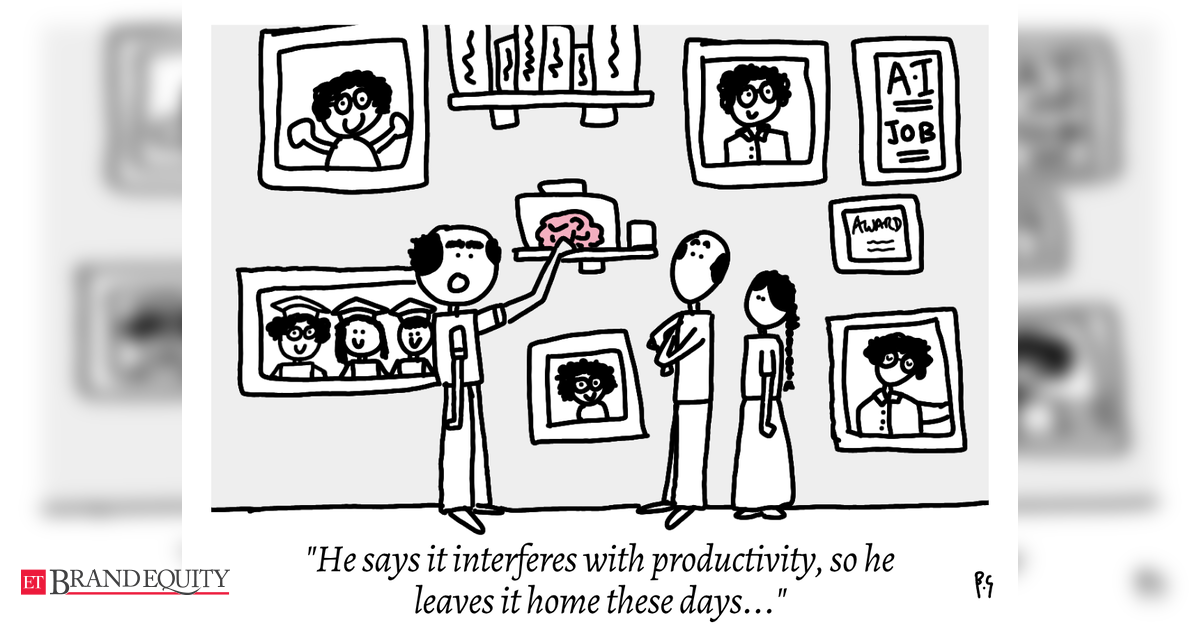
The irony is acute: in our pursuit of extreme efficiency, we are becoming proficient at avoiding the very exercises that make us masters of our craft. When a strategist "generates" an insight rather than gleaning it from the world, they lose the ability to verify the truth of that insight against reality.
The Implications: A Crisis of Instinct
The professional implications of this shift are profound and far-reaching:
1. The Death of Taste and Judgment
Taste is not an algorithm; it is a cumulative result of lived experience. If the "initial phase" of a career is entirely supported by AI scaffolding, the professional never develops the "gut instinct" required to make high-stakes creative decisions. When the machine becomes the arbiter of quality, the human practitioner ceases to be a curator and becomes a mere filter.
2. The Homogenization of Output
Because AI models are trained on the "average" of human knowledge, relying on them for core ideation leads to regression to the mean. Campaigns begin to look, feel, and sound the same. The disruptive, "out-of-the-box" thinking that defines industry legends is increasingly replaced by safe, derivative outputs that satisfy the brief but fail to capture the imagination.
3. The Commoditization of Talent
When a professional’s value is reduced to their ability to operate an AI tool, they become replaceable. If a junior copywriter can produce twenty headlines in thirty minutes using a tool, the agency’s rationale for maintaining a high-headcount staff diminishes. Ironically, by embracing AI to save time, professionals are accelerating the process of their own commoditization.
Professional Perspectives: Where is the Balance?
Industry leaders are beginning to speak out against the unchecked adoption of generative tools. While there is no official consensus, the prevailing sentiment among creative directors is one of cautious skepticism.

"Using AI to expand thinking is a superpower," notes one creative lead. "But using it to replace thinking is a surrender."
The debate centers on the distinction between augmentation and substitution. Augmentation involves using AI to research faster, check data, or brainstorm variants once a human has established the core creative thesis. Substitution, however, involves asking the machine to define the problem and provide the solution, leaving the human only to hit "send."
Toward a Sustainable Future: Recommendations
If the industry is to avoid a future of creative stagnation, it must re-evaluate how it integrates AI into professional development:
- Prioritize "Slow Thinking": Agencies should mandate "human-only" brainstorming sessions for key project phases, forcing teams to rely on observation and original synthesis before touching generative tools.
- Mentorship over Prompt-Engineering: The value of a mentor is not in how to use a specific software, but in how to interpret human behavior. Senior leaders must focus on teaching the why and how of creative judgment, rather than the what of AI output.
- Redefining "Efficiency": Efficiency should be measured by the depth of the final output, not the speed of the process. If a campaign requires extra time for reflection and observation, that time should be viewed as an investment in quality, not a lapse in productivity.
Conclusion: The Intellectual Stimulation Imperative
The brain, like any muscle, requires resistance to grow. The "rigor" mentioned at the start of this discussion is not an obstacle to be cleared—it is the workout that keeps the mind sharp. By seeking to remove the struggle from our work, we are inadvertently removing the intellectual stimulation that prevents our professional skills from atrophying.
The tasklist might be cleared faster, and the relief of meeting a deadline might be achieved with less stress, but at what cost to the craft? The industry must decide if it wants to be a factory of automated outputs or a crucible of human brilliance. To remain the latter, we must reclaim the process, embrace the struggle, and ensure that AI remains our tool, not our substitute.
As we look toward the future, the most valuable professionals will not be those who can generate the most content in the shortest time, but those who can navigate the complexities of the human experience with an instinct that no machine can replicate. The journey of professional development is meant to be difficult; therein lies its value.